



 Chat with AI
Exam 15: Chemical Kinetics

Exam 1: The Quantum World100 Questions
Exam 2: Quantum Mechanics in Action: Atoms100 Questions
Exam 3: Chemical Bonds83 Questions
Exam 4: Molecular Shape and Structure95 Questions
Exam 5: The Properties of Gases94 Questions
Exam 6: Liquids and Solids95 Questions
Exam 7: Inorganic Materials100 Questions
Exam 8: Thermodynamics: The First Law94 Questions
Exam 9: Thermodynamics: The Second and Third Laws95 Questions
Exam 10: Physical Equilibria94 Questions
Exam 11: Chemical Equilibria94 Questions
Exam 12: Acids and Bases94 Questions
Exam 13: Aqueous Equilibria94 Questions
Exam 14: Electrochemistry94 Questions
Exam 15: Chemical Kinetics93 Questions
Exam 16: The Elements: the Main Group Elements189 Questions
Exam 17: The Elements: The D Block94 Questions
Exam 18: Nuclear Chemistry95 Questions
Exam 19: Organic Chemistry I94 Questions
Exam 20: Organic Chemistry II95 Questions
Select questions type


If the average rate of formation of H2(g)is 3.90 (mol H2).L-1.s-1 for the reaction 2PH3(g) 2P(g)+ 3H2(g),the unique average reaction rate is
(Multiple Choice)
4.8/5  (62)
(62) For the reaction 2A + B products
Determine the rate law for the reaction given the following data:

(Multiple Choice)
4.7/5 (84)
(84) The concentration-time curves for two sets of reactions,A/B and C/D,are: 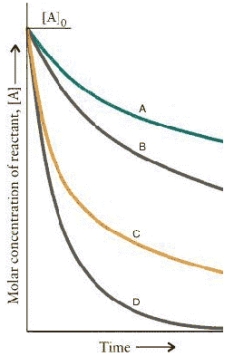 Which of the reactions are first order?
 (Multiple Choice)
4.9/5 (80)
(80) The reaction
2ClO2(g)+ F2(g) 2FClO2(g)
Is first order in both ClO2 and F2.When the initial concentrations of ClO2 and F2 are equal,the rate after 25% of the F2 has reacted is what percent of the initial rate?
(Multiple Choice)
4.8/5 (84)
(84) Given:
CH4(g)+ Cl2(g) CH3Cl(g)+ HCl(g)
The rate law for this elementary process is
(Multiple Choice)
4.9/5 (84)
(84) Given: A P rate = k[A] If 20% of A reacts in 5.12 min,calculate the time required for 90% of A to react.
(Multiple Choice)
4.9/5 (68)
(68) For the proposed mechanism A + X → B k1,k-1 (fast)
B products k2 (slow)
What is the rate law?
(Multiple Choice)
4.8/5 (66)
(66) Consider the mechanism
NO2(g)+ F2(g) NO2F(g)+ F(g)k1 (slow)
F(g)+ NO2(g) NO2F(g)k2 (fast)
Give the molecularity of the first step and any intermediates in the mechanism.
(Multiple Choice)
4.8/5 (81)
(81) Given: 2O3(g) 3O2(g)
Rate = k[O3]2[O2]-1
The overall order of the reaction and the order with respect to [O3] are
(Multiple Choice)
4.9/5 (79)
(79) The rate law for the following mechanism is NO2(g)+ F2(g) NO2F(g)+ F(g)
K1,slow
F(g)+ NO2(g) NO2F(g)
K2,fast
(Multiple Choice)
4.9/5 (60)
(60) The concentration-time dependence for a first-order reaction is: 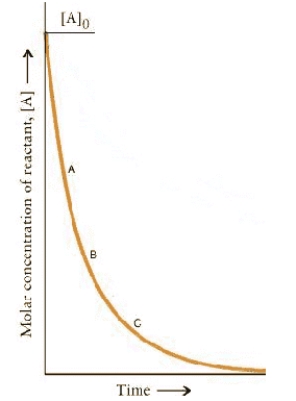 At which point on the curve is the reaction fastest?
 (Multiple Choice)
4.8/5 (84)
(84) If the rate of reaction increases by a factor of 2.3 when the concentration of reactant increases by a factor of 1.5,the order of the reaction with respect to this reactant is
(Multiple Choice)
5.0/5 (68)
(68) 
Filters
- Essay(0)
- Multiple Choice(0)
- Short Answer(0)
- True False(0)
- Matching(0)