



 Chat with AI
Exam 19: Organic Chemistry I

Exam 1: The Quantum World100 Questions
Exam 2: Quantum Mechanics in Action: Atoms100 Questions
Exam 3: Chemical Bonds83 Questions
Exam 4: Molecular Shape and Structure95 Questions
Exam 5: The Properties of Gases94 Questions
Exam 6: Liquids and Solids95 Questions
Exam 7: Inorganic Materials100 Questions
Exam 8: Thermodynamics: The First Law94 Questions
Exam 9: Thermodynamics: The Second and Third Laws95 Questions
Exam 10: Physical Equilibria94 Questions
Exam 11: Chemical Equilibria94 Questions
Exam 12: Acids and Bases94 Questions
Exam 13: Aqueous Equilibria94 Questions
Exam 14: Electrochemistry94 Questions
Exam 15: Chemical Kinetics93 Questions
Exam 16: The Elements: the Main Group Elements189 Questions
Exam 17: The Elements: The D Block94 Questions
Exam 18: Nuclear Chemistry95 Questions
Exam 19: Organic Chemistry I94 Questions
Exam 20: Organic Chemistry II95 Questions
Select questions type


What is the product of benzoic acid after it is treated with nitric acid and concentrated sulfuric acid?

Free
(Multiple Choice)
4.9/5  (69)
(69) Correct Answer: Verified
C
Name the compound (CH3CH2)2CHCH=CHCH3.
Free
(Multiple Choice)
4.8/5 (83)
(83) Correct Answer:Verified
VerifiedD
Which of the following undergo nitration more slowly than benzene? 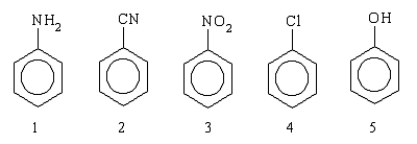
Free
(Multiple Choice)
4.9/5 (80)
(80) Correct Answer:Verified
VerifiedC
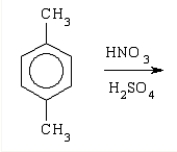
Consider a molecule of molecular formula C10H16.What total number of rings plus bonds are present in the molecule?
(Multiple Choice)
4.8/5 (87)
(87) Consider a molecule of molecular formula C10H18.What total number of rings plus bonds are present in the molecule?
(Multiple Choice)
4.7/5 (91)
(91) Alkanes react with boiling sulfuric acid because the C-C and C-H bonds are easily attacked.
(True/False)
4.8/5 (92)
(92) By what type of mechanism do alkanes undergo substitution reactions?
(Short Answer)
4.9/5 (73)
(73) How many of the structural isomers of C6H14 have tertiary hydrogens?
(Multiple Choice)
4.8/5 (73)
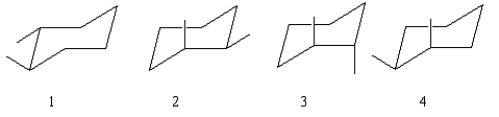
(73) 

The alkene CH3CH=CHCH2CH3 cannot exist as cis and trans isomers.
(True/False)
4.7/5 (88)
(88) When 2-methyl-1-butene reacts with HBr,the reaction occurs in two steps.What is the major product? (Hint: Intermediate carbocations are most stable when formed at tertiary carbons.)
(Short Answer)
4.7/5 (65)
(65) How many monobrominated products are predicted theoretically from the following reaction? 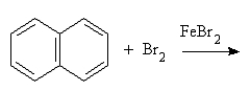
(Multiple Choice)
4.7/5 (72)
(72) 
Filters
- Essay(0)
- Multiple Choice(0)
- Short Answer(0)
- True False(0)
- Matching(0)