



 Chat with AI
Exam 20: Organic Chemistry II

Exam 1: The Quantum World100 Questions
Exam 2: Quantum Mechanics in Action: Atoms100 Questions
Exam 3: Chemical Bonds83 Questions
Exam 4: Molecular Shape and Structure95 Questions
Exam 5: The Properties of Gases94 Questions
Exam 6: Liquids and Solids95 Questions
Exam 7: Inorganic Materials100 Questions
Exam 8: Thermodynamics: The First Law94 Questions
Exam 9: Thermodynamics: The Second and Third Laws95 Questions
Exam 10: Physical Equilibria94 Questions
Exam 11: Chemical Equilibria94 Questions
Exam 12: Acids and Bases94 Questions
Exam 13: Aqueous Equilibria94 Questions
Exam 14: Electrochemistry94 Questions
Exam 15: Chemical Kinetics93 Questions
Exam 16: The Elements: the Main Group Elements189 Questions
Exam 17: The Elements: The D Block94 Questions
Exam 18: Nuclear Chemistry95 Questions
Exam 19: Organic Chemistry I94 Questions
Exam 20: Organic Chemistry II95 Questions
Select questions type


What is the product of the reaction
CH3CH(NH2)CH3 + CH3CH2C(O)OCH3

Free
(Short Answer)
4.8/5  (88)
(88) Correct Answer: Verified
CH3CH2C(O)NHCH(CH3)2
What reactants would be used to synthesize diethyl ether?
Free
(Essay)
4.9/5 (78)
(78) Correct Answer:Verified
VerifiedCH3CH2Br and CH3CH2O-Na+
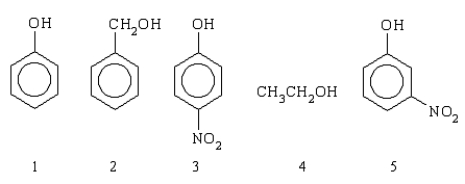
Consider the reaction
CH3(CH2)4CH2CH(Br)CH3 + NaOH CH3(CH2)4CH2CH(OH)CH3
(optically pure enantiomer)
The rate law for this reaction over a wide range of [OH-] is R = k1[RX] + k2[RX][OH-] where RX is 2-bromooctane and k2/k1 = 20.At very low hydroxide ion concentration,
(Multiple Choice)
5.0/5 (74)
(74) 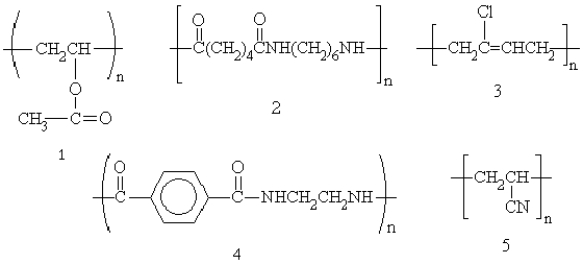
Predict the product(s)of the reaction of acetic acid with methylamine at 200oC.
(Multiple Choice)
4.7/5 (72)
(72) Which of the following reactants can be used to produce butanamide? 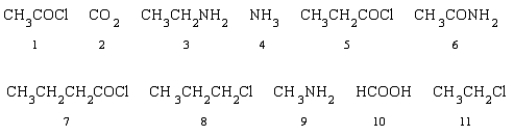
(Multiple Choice)
5.0/5 (82)
(82) In the SN1 mechanism for nucleophilic substitution,the carbocation produced is a Lewis acid and the nucleophile is a Lewis base.
(True/False)
4.7/5 (85)
(85) The structure of rubber,a polymer,is 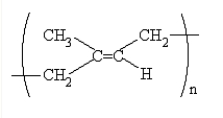 What is the formula of the monomer used to produce rubber?
 (Multiple Choice)
4.9/5 (73)
(73) Amines react with both carboxylic acids and acid chlorides to produce amides.
(True/False)
4.8/5 (68)
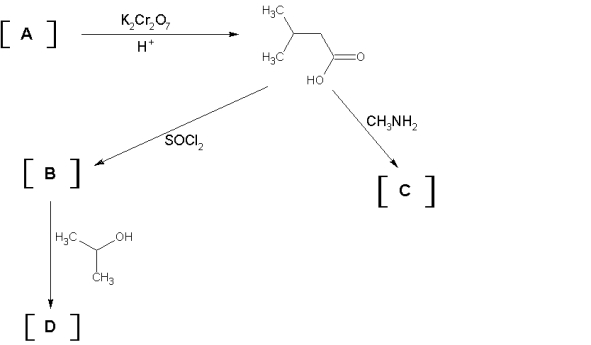
(68) 
How many secondary alcohols are there with the formula C4H9OH?
(Multiple Choice)
4.8/5 (67)
(67) When amines condense with carboxylic acids,what molecule is eliminated?
(Short Answer)
4.8/5 (80)
(80) 
Filters
- Essay(0)
- Multiple Choice(0)
- Short Answer(0)
- True False(0)
- Matching(0)