



 Chat with AI
Exam 15: Chemical Kinetics

Exam 1: The Quantum World100 Questions
Exam 2: Quantum Mechanics in Action: Atoms100 Questions
Exam 3: Chemical Bonds83 Questions
Exam 4: Molecular Shape and Structure95 Questions
Exam 5: The Properties of Gases94 Questions
Exam 6: Liquids and Solids95 Questions
Exam 7: Inorganic Materials100 Questions
Exam 8: Thermodynamics: The First Law94 Questions
Exam 9: Thermodynamics: The Second and Third Laws95 Questions
Exam 10: Physical Equilibria94 Questions
Exam 11: Chemical Equilibria94 Questions
Exam 12: Acids and Bases94 Questions
Exam 13: Aqueous Equilibria94 Questions
Exam 14: Electrochemistry94 Questions
Exam 15: Chemical Kinetics93 Questions
Exam 16: The Elements: the Main Group Elements189 Questions
Exam 17: The Elements: The D Block94 Questions
Exam 18: Nuclear Chemistry95 Questions
Exam 19: Organic Chemistry I94 Questions
Exam 20: Organic Chemistry II95 Questions
Select questions type


A certain reaction has a rate constant of 8.8 s-1 at 298 K and 140 s-1 at 323 K.What is the activation energy for this reaction?
(Multiple Choice)
4.9/5  (81)
(81) If the rate of a reaction increases by a factor of 64 when the concentration of reactant increases by a factor of 4,the order of the reaction with respect to this reactant is
(Multiple Choice)
4.9/5 (81)
(81) For the reaction A products,the following data were collected.  The half-life for this reaction is
 (Multiple Choice)
4.7/5 (75)
(75) A possible mechanism for the reaction
2NO(g)+ O2(g) 2NO2(g)is: 2NO(g) →N2O2(g)
K1,k1',fast
N2O2(g)+ O2(g) 2NO2(g)
K2,slow
Application of the steady-state approximation gives
(Multiple Choice)
4.8/5 (76)
(76) Consider the reaction 2N2O5(g) 4NO2(g)+ O2(g)
Rate = k[N2O5]
Calculate the time for the concentration of N2O5 to fall to one-fourth its initial value if the half-life is 133 s.
(Multiple Choice)
4.7/5 (84)
(84) The reaction profile for the mechanism
NO2(g)+ F2(g) NO2F(g)+ F(g)slow
F(g)+ NO2(g) NO2F(g)fast
Shows
(Multiple Choice)
4.8/5 (81)
(81) For a zero-order reaction,the rate constant has the same units as the rate of reaction.
(True/False)
4.8/5 (68)
(68) For the reaction cyclobutane(g) 2ethylene(g)at 800 K,a plot of ln[cyclobutane] vs t gives a straight line with a slope of -1.6 s-1.Calculate the time needed for the concentration of cyclobutane to fall to 1/16 of its initial value.
(Multiple Choice)
4.8/5 (73)
(73) Technetium-99m,used to image the heart and brain,has a half-life of 6.00 h.What fraction of technetium-99m remains in the body after 1 day?
(Multiple Choice)
4.7/5 (78)
(78) It is important to distinguish between the reaction rate and the rate constant.The units of reaction rate are M∙s-1.
(True/False)
4.9/5 (78)
(78) All of the following statements with respect to the effect of a catalyst on a reaction are true except:
(Multiple Choice)
4.9/5 (66)
(66) For the reaction cyclopropane(g) propene(g)at 500 C,a plot of ln[cyclopropane] vs t gives a straight line with a slope of -0.00067 s-1.What is the order of this reaction and what is the rate constant?
(Short Answer)
4.8/5 (74)
(74) What is the rate constant for a first-order reaction with a half-life of 9.0 ms?
(Multiple Choice)
4.9/5 (90)
(90) The reaction 2NO(g)+ O2(g) 2NO2(g)has Hr = -114 kJ.mol-1.A possible mechanism for this reaction is
2NO(g)b N2O2(g)
rapid equilibrium,K
N2O2(g)+ O2(g) 2NO2(g)
slow,k
Draw the reaction profile diagram (plot of energy vs reaction coordinate)for this reaction and label any intermediates and activated complexes.
(Essay)
4.8/5 (71)
(71) The HBr synthesis is thought to involve the following reactions:
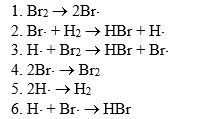 The chain propagation reactions in this mechanism are reactions
 (Multiple Choice)
4.8/5 (75)
(75) For the reaction S2O82-(aq)+ 3I-(aq) 2SO42-(aq)+ I3-(aq),rate = k[S2O82-][I-].When the reaction is followed under pseudo-first-order conditions with [S2O82-] = 200 m M and [I-] = 1.5 m M,the rate constant was 1.82 s-1.The second order rate constant,k,for the reaction is
(Multiple Choice)
4.9/5 (89)
(89) The concentration-time dependence is shown below for two first-order reactions is: 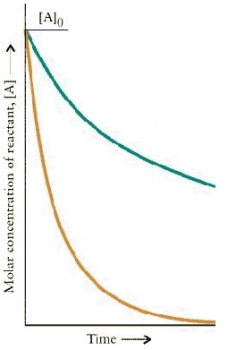 Which reaction has the larger rate constant?
 (Short Answer)
5.0/5 (82)
(82) Given: 5Br-(aq)+ BrO3-(aq)+ 6H+(aq) 3Br2(aq)+ 3H2O(l)
Rate = k[Br-][ BrO3-][H+]2
The overall order of the reaction and the order with respect to H+ are
(Multiple Choice)
4.7/5 (74)
(74) The rates of first-order and second-order reactions do not change with elapsed time.
(True/False)
4.9/5 (92)
(92) 
Filters
- Essay(0)
- Multiple Choice(0)
- Short Answer(0)
- True False(0)
- Matching(0)