



 Chat with AI
Exam 15: Chemical Kinetics

Exam 1: The Quantum World100 Questions
Exam 2: Quantum Mechanics in Action: Atoms100 Questions
Exam 3: Chemical Bonds83 Questions
Exam 4: Molecular Shape and Structure95 Questions
Exam 5: The Properties of Gases94 Questions
Exam 6: Liquids and Solids95 Questions
Exam 7: Inorganic Materials100 Questions
Exam 8: Thermodynamics: The First Law94 Questions
Exam 9: Thermodynamics: The Second and Third Laws95 Questions
Exam 10: Physical Equilibria94 Questions
Exam 11: Chemical Equilibria94 Questions
Exam 12: Acids and Bases94 Questions
Exam 13: Aqueous Equilibria94 Questions
Exam 14: Electrochemistry94 Questions
Exam 15: Chemical Kinetics93 Questions
Exam 16: The Elements: the Main Group Elements189 Questions
Exam 17: The Elements: The D Block94 Questions
Exam 18: Nuclear Chemistry95 Questions
Exam 19: Organic Chemistry I94 Questions
Exam 20: Organic Chemistry II95 Questions
Select questions type


Given: 2NO2(g)+ F2(g) 2NO2F(g)
Rate = - [F2]/ t
The rate of the reaction can also be expressed as
(Multiple Choice)
5.0/5  (92)
(92) A possible mechanism for the reaction A + B + D E + F is
A + B → C
k1,k-1,fast
C + D E + F
k2
where C is a reactive intermediate present in very low concentrations.Calculate the steady state concentration of C in terms of the rate constants for the individual steps and the concentrations of the reactants.
(Short Answer)
4.7/5 (73)
(73) Consider the reaction
2A B,Rate = k[A]2
If the rate of appearance of B is followed,derive the experimental rate constant.
(Essay)
4.9/5 (82)
(82) A reaction has k = 8.39 M-1.s-1.How long does it take for the reactant concentration to drop from 0.0840 M to 0.0220 M?
(Multiple Choice)
4.8/5 (95)
(95) Given: A + B P rate = k[A][B] Which of the following is true?
(Multiple Choice)
5.0/5 (79)
(79) The reaction profile for the reaction
[(CN)5CoOH2]2-(aq)+ SCN-(aq) [(CN)5CoSCN]3- + H2O(l)
is  Identify the structure of B.What do A and C represent?
 (Essay)
4.8/5 (95)
(95) For the reaction A products,the following data were collected.  Determine the order of the reaction and calculate the rate constant.
 (Short Answer)
4.8/5 (77)
(77) Consider the reaction 2N2O(g) 2N2(g)+ O2(g)
Rate = k[N2O]
For an initial concentration of N2O of 0.50 M,what is the concentration of N2O remaining after 2.0 min if k = 3.4 * 10-3 s-1?
(Multiple Choice)
4.7/5 (65)
(65) For the reaction cyclobutane(g) 2ethylene(g)at 800 K,the half-life is 0.43 s.Calculate the time needed for the concentration of cyclobutane to fall to 1/64 of its initial value.
(Multiple Choice)
4.7/5 (88)
(88) Consider the reaction
2A B,Rate = k[A]2
If the rate of disappearance of A is followed,derive the experimental rate constant.
(Essay)
5.0/5 (83)
(83) Consider the following mechanism for the destruction of ozone.
O3 + NO NO2 + O2
NO2 + O NO + O2
What is the catalyst in this reaction?
(Short Answer)
4.8/5 (75)
(75) For a second-order reaction,a straight line is obtained from a plot of
(Multiple Choice)
4.9/5 (72)
(72) For a given first-order reaction,after 230 s,33% of the reactants remain.Calculate the rate constant for the reaction.
(Multiple Choice)
5.0/5 (75)
(75) Consider the following mechanism for the production of phosgene.
Cl2 Cl + Cl
Cl + CO COCl
COCl + Cl COCl2
The molecularity of the first and second elementary reactions is ____ and ____.
(Short Answer)
4.9/5 (83)
(83) A first-order reaction has a rate constant of 0.00300 s-1.The time required for 60% reaction is
(Multiple Choice)
4.9/5 (74)
(74) For the reaction
HO(g)+ H2(g) H2O(g)+ H(g)
A plot of  versus 1/T gives a straight line with a slope equal to -5.1 * 103 K.What is the activation energy for the reaction?
 (Multiple Choice)
5.0/5 (79)
(79) The concentration-time dependence for two first order reactions is: 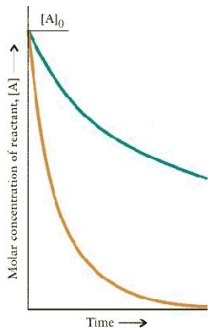 Which reaction has the greater t½?
 (Short Answer)
4.9/5 (77)
(77) Given:
2A(g)+ B(g)+ C(g) AC(g)+ BD(g)
The following data were collected for this reaction.
 What is the rate law for this reaction?
 (Multiple Choice)
4.8/5 (79)
(79) Consider the mechanism
ClO-(aq)+ H2O(l) → HOCl(aq)+ OH-(aq)K,fast
I-(aq)+ HOCl(aq) HOI(aq)+ Cl-(aq)k,slow
HOI(aq)+ OH-(aq) OI-(aq)+ H2O(l)k,fast
Draw the reaction profile for this mechanism.
(Essay)
4.8/5 (80)
(80) 
Filters
- Essay(0)
- Multiple Choice(0)
- Short Answer(0)
- True False(0)
- Matching(0)