



 Chat with AI
Exam 15: Chemical Kinetics

Exam 1: The Quantum World100 Questions
Exam 2: Quantum Mechanics in Action: Atoms100 Questions
Exam 3: Chemical Bonds83 Questions
Exam 4: Molecular Shape and Structure95 Questions
Exam 5: The Properties of Gases94 Questions
Exam 6: Liquids and Solids95 Questions
Exam 7: Inorganic Materials100 Questions
Exam 8: Thermodynamics: The First Law94 Questions
Exam 9: Thermodynamics: The Second and Third Laws95 Questions
Exam 10: Physical Equilibria94 Questions
Exam 11: Chemical Equilibria94 Questions
Exam 12: Acids and Bases94 Questions
Exam 13: Aqueous Equilibria94 Questions
Exam 14: Electrochemistry94 Questions
Exam 15: Chemical Kinetics93 Questions
Exam 16: The Elements: the Main Group Elements189 Questions
Exam 17: The Elements: The D Block94 Questions
Exam 18: Nuclear Chemistry95 Questions
Exam 19: Organic Chemistry I94 Questions
Exam 20: Organic Chemistry II95 Questions
Select questions type


The HBr synthesis is thought to involve the following reactions:
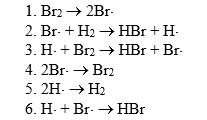 The chain termination reactions in this mechanism are reactions
 (Multiple Choice)
4.9/5  (88)
(88) For the reaction
2NO(g)+ 2H2(g) N2(g)+ 2H2O(g)
the following data were collected.
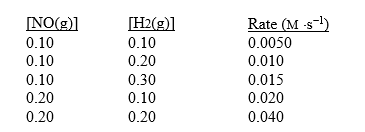 What is the rate law for this reaction?
 (Short Answer)
4.9/5 (75)
(75) If the rate of reaction increases by a factor of 9.6 when the concentration of reactant increases by a factor of 3.1,the order of the reaction with respect to this reactant is
(Multiple Choice)
4.9/5 (67)
(67) For the reaction cyclopropane propene
A plot of ln[cyclopropane] vs time in seconds gives a straight line with slope -4.1 * 10-3 s-1 at 550 C.What is the rate constant for this reaction?
(Multiple Choice)
4.9/5 (80)
(80) If the average rate of decomposition of PH3(g)is 3.2 (mol PH3).L-1.min-1 for the reaction 2PH3(g) 2P(g)+ 3H2(g),the unique average reaction rate is
(Multiple Choice)
4.9/5 (82)
(82) An elementary process has an activation energy of 92 kJ/mol.If the enthalpy change for the reaction is -62 kJ/mol,what is the activation energy for the reverse reaction?
(Multiple Choice)
4.9/5 (81)
(81) For a given first-order reaction,after 2.00 min,20% of the reactants remain.Calculate the rate constant for the reaction.
(Multiple Choice)
4.8/5 (70)
(70) The reaction 2A + B D + E has the rate law,rate = a[A]2[B]/(b + c[A])where a,b,and c are constants.The following mechanism has been proposed for this reaction.
A + B →
k1,k-1
I + A D + E
k2
I is an unstable intermediate present in minute concentrations.Show that this mechanism leads to the observed rate law and evaluate the constants a,b,and c in terms of the rate constants k1,k-1,and k2.
(Essay)
5.0/5 (78)
(78) The concentration-time curves for two sets of reactions,A/B and C/D,are: 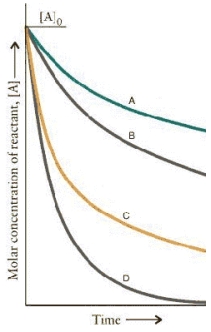 Which set of reactions has the largest rate constant?
 (Short Answer)
4.9/5 (83)
(83) Consider the dimerization reaction below:
2A A2
Rate = k[A]2
When the initial concentration of A is 2.0 M,it requires 30 min for 60% of A to react.Calculate the rate constant.
(Multiple Choice)
4.9/5 (69)
(69) A first-order reaction has a half-life of 1.10 s.If the initial concentration of reactant is 0.384 M,how long will it take for the reactant concentration to reach 0.00100 M?
(Multiple Choice)
4.9/5 (79)
(79) The rate law for the following mechanism is Cl2(g) → 2Cl(g)
K1,fast
Cl(g)+ CO(g)  COCl(g)
K2,fast
COCl(g)+ Cl2(g) COCl2(g)+ Cl(g)
K3,slow
COCl(g)
K2,fast
COCl(g)+ Cl2(g) COCl2(g)+ Cl(g)
K3,slow (Multiple Choice)
4.9/5 (85)
(85) The reaction 2NO(g)+ O2(g) 2NO2(g)has Hr = -114 kJ.mol-1.A possible mechanism for this reaction is 2NO(g) →N2O2(g)
Rapid equilibrium,K
N2O2(g)+ O2(g) 2NO2(g)
Slow,k
If the activation energy for the reverse reaction is 225 kJ.mol-1,what is the activation energy for the forward reaction?
(Multiple Choice)
4.7/5 (79)
(79) The reaction 2NO2(g) 2NO(g)+ O2(g)
Is postulated to occur via the mechanism
NO2(g)+ NO2(g) NO(g)+ NO3(g)
Slow
NO3(g) NO(g)+ O2(g)
Fast
An intermediate in this reaction is
(Multiple Choice)
4.9/5 (78)
(78) The reaction between nitrogen dioxide and carbon monoxide is thought to occur by the mechanism 2NO2(g) NO3(g)+ NO(g)
K1,slow
NO3(g)+ CO(g) NO2(g)+ CO2(g)
K2,fast
The rate law for this mechanism is
(Multiple Choice)
4.8/5 (81)
(81) The reaction [(CN)5CoOH2]2-(aq)+ SCN-(aq) [(CN)5CoSCN]3- + H2O(l)has the rate law,rate = k[(CN)5CoOH22-].Postulate a mechanism for this reaction.
(Essay)
4.9/5 (96)
(96) Consider the reaction 2N2O5(g) 4NO2(g)+ O2(g)
Rate = k[N2O5]
If the initial concentration of N2O5 is 0.80 M,the concentration after 5 half-lives is
(Multiple Choice)
4.8/5 (87)
(87) Consider the reaction
A + B C + D rate = k[A]2
The time it takes for [A] to decrease from 1.0 to 0.50 M is the same as the time it takes for [A] to decrease from0.50 to 0.25 M.
(True/False)
4.8/5 (57)
(57) 
Filters
- Essay(0)
- Multiple Choice(0)
- Short Answer(0)
- True False(0)
- Matching(0)