



 Chat with AI
Exam 14: Taxes on the Financial Statements

Exam 1: Understanding and Working With the Federal Tax Law74 Questions
Exam 2: Corporations: Introduction and Operating Rules113 Questions
Exam 3: Corporations: Special Situations111 Questions
Exam 4: Corporations: Organization and Capital Structure93 Questions
Exam 5: Corporations: Earnings Profits and Dividend Distributions89 Questions
Exam 6: Corporations: Redemptions and Liquidations112 Questions
Exam 7: Corporations: Reorganizations121 Questions
Exam 8: Consolidated Tax Returns145 Questions
Exam 9: Taxation of International Transactions159 Questions
Exam 10: Partnerships: Formation, Operation, and Basis100 Questions
Exam 11: Partnerships: Distributions, Transfer of Interests, and Terminations97 Questions
Exam 12: S: Corporations157 Questions
Exam 13: Comparative Forms of Doing Business143 Questions
Exam 14: Taxes on the Financial Statements87 Questions
Exam 15: Exempt Entities151 Questions
Exam 16: Multistate Corporate Taxation160 Questions
Exam 17: Tax Practice and Ethics153 Questions
Exam 18: The Federal Gift and Estate Taxes173 Questions
Exam 19: Family Tax Planning145 Questions
Exam 20: Income Taxation of Trusts and Estates156 Questions
Select questions type


Repatriating prior year earnings from a foreign subsidiary located in a low-tax country where ASC 740-30 (APB 23) benefits were previously adopted will cause an increase in a corporation's current year effective tax rate.
(True/False)
5.0/5  (71)
(71) Domestic and foreign entities owned more than 80% are included in a consolidated group's U.S. tax return.
(True/False)
4.8/5 (71)
(71) ASC 740 (FIN 48) replaced FAS 5, Accounting for Contingencies, with regard to accounting for uncertain tax positions.
(True/False)
4.8/5 (80)
(80) Amelia, Inc., is a domestic corporation with the following balance sheet for book and tax purposes at the end of the year. Assume a 34% corporate tax rate and no valuation allowance.
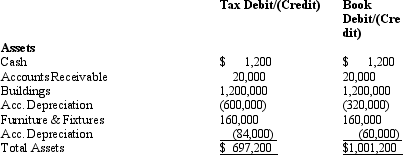
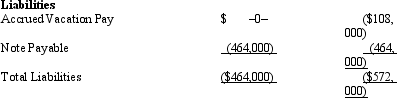
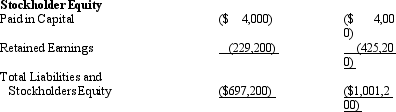
(Essay)
5.0/5 (72)
(72) Current tax expense always totals the amount a taxpayer actually paid all Federal, state, and foreign tax authorities in a particular year.
(True/False)
4.7/5 (76)
(76) Purple, Inc., a domestic corporation, owns 100% of Blue, Ltd., a foreign corporation and Yellow, Inc., a domestic corporation. Purple also owns 40% of Green, Inc., a domestic corporation. Purple receives no distributions from any of these corporations. Which of these entities' net income are included in Purple's GAAP income statement for current year financial reporting purposes?
(Multiple Choice)
4.9/5 (85)
(85) Phyllis, Inc., earns book net income before tax of $600,000. Phyllis puts into service a depreciable asset this year, and first year tax depreciation exceeds book depreciation by $120,000. Phyllis has recorded no other temporary or permanent book-tax differences. Assuming that the U.S. tax rate is 35%, what is Phyllis's total income tax expense reported on its GAAP financial statements?
(Multiple Choice)
4.8/5 (80)
(80) The current tax expense reported on the GAAP financial statement generally represents the taxes actually payable to domestic or foreign governmental authorities.
(True/False)
4.9/5 (82)
(82) Which of the following taxes are included in the total income tax expense of a corporation as reported on its financial statements?
(Multiple Choice)
4.8/5 (89)
(89) Jogg, Inc., earns book net income before tax of $600,000. Jogg puts into service a depreciable asset this year, and first year tax depreciation exceeds book depreciation by $120,000. Jogg has recorded no other temporary or permanent book-tax differences. Assuming that the U.S. tax rate is 35%, and that this is Jogg's first year of operations, what is Jogg's balance in its deferred tax asset and deferred tax liability accounts at year end?
(Multiple Choice)
4.9/5 (79)
(79) Clipp, Inc., earns book net income before tax of $600,000. Clipp puts into service a depreciable asset this year, and first year tax depreciation exceeds book depreciation by $120,000. Clipp has recorded no other temporary or permanent book-tax differences. Assuming that the U.S. tax rate is 35%, what is Clipp's deferred income tax liability reported on its GAAP financial statements?
(Multiple Choice)
4.8/5 (91)
(91) If a valuation allowance is increased in the current year, the corporation's effective tax rate is higher than if the valuation allowance had not increased.
(True/False)
4.9/5 (77)
(77) How does an auditor determine whether a valuation allowance is needed against an entity's deferred tax asset? List some of the factors than an auditor will consider in this regard.
(Essay)
4.7/5 (80)
(80) Larson, Inc., hopes to report a total book tax expense of $160,000 in the current year. This $160,000 expense consists of $240,000 in current tax expense and an $80,000 tax benefit related to the expected future use of an NOL by Larson. If the auditors determine that a valuation allowance of $30,000 must be placed against Larson's deferred tax assets, what is Larson's total book tax expense?
(Multiple Choice)
4.7/5 (70)
(70) Morrisson, Inc., earns book net income before tax of $500,000. In computing its book income, Morrisson deducts $50,000 more in warranty expense for book purposes than is allowed for tax purposes. Morrisson records no other temporary or permanent book-tax differences. Assuming that the U.S. tax rate is 35% and no valuation allowance is required, what is Morrisson's current income tax expense reported on its GAAP financial statements?
(Multiple Choice)
4.9/5 (85)
(85) Beach, Inc., a domestic corporation, owns 100% of Mountain, Ltd., a manufacturing facility in Ireland. Mountain has no operations or activities in the United States. The U.S. tax rate is 35% and the Irish tax rate is 10%. For the current year, Beach earns $500,000 in taxable income. Mountain earns $300,000 in taxable income from its operations, pays $30,000 in taxes to Ireland, and makes no distributions to Beach. What is Beach's effective tax rate for GAAP book purposes, assuming that Beach does not make the permanent reinvestment assumption of ASC 740-30 (APB 23)?
(Multiple Choice)
4.9/5 (90)
(90) A corporation's taxable income almost never is the same as its GAAP financial accounting income. Explain why this occurs. Use the terms permanent and temporary book-tax differences in your answer. Give examples of each.
Temporary differences are caused by income and expenses appearing in both the financial statement and tax return, but in different periods (i.e., a timing difference). Permanent differences are caused by items appearing in the financial statement or the tax return, but not both. Temporary differences do not affect the book total tax expense. Temporary differences merely shift tax expense (benefit) between the current and deferred accounts. Permanent differences do affect the total book tax expense and are identified in the tax footnote rate reconciliation.
(Essay)
4.8/5 (74)
(74) Amelia, Inc., is a domestic corporation with the following balance sheet for book and tax purposes at the end of the year. Assume a 34% corporate tax rate and no valuation allowance.
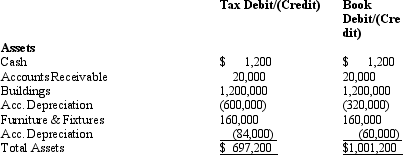
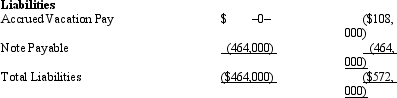
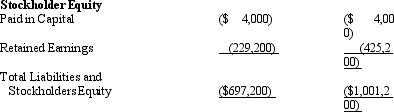
(Essay)
4.8/5 (66)
(66) PaintCo Inc., a domestic corporation, owns 100% of BrushCo Ltd., an Irish corporation. Assume that the U.S. corporate tax rate is 35% and the Irish rate is 10%. PaintCo is permanently reinvesting BrushCo's earnings outside the United States under ASC 740-30 (APB 23). The corporations' book income, permanent and temporary book-tax differences, and current tax expense are as follows. Provide the income tax footnote rate reconciliation for PaintCo using both dollar amounts and percentages.

(Essay)
5.0/5 (87)
(87) A deferred tax asset is the expected future tax benefit (savings) associated with income reported in the current year GAAP financial statements.
(True/False)
4.8/5 (85)
(85) 
Filters
- Essay(0)
- Multiple Choice(0)
- Short Answer(0)
- True False(0)
- Matching(0)