



 Chat with AI
Exam 14: Taxes on the Financial Statements

Exam 1: Understanding and Working With the Federal Tax Law74 Questions
Exam 2: Corporations: Introduction and Operating Rules113 Questions
Exam 3: Corporations: Special Situations111 Questions
Exam 4: Corporations: Organization and Capital Structure93 Questions
Exam 5: Corporations: Earnings Profits and Dividend Distributions89 Questions
Exam 6: Corporations: Redemptions and Liquidations112 Questions
Exam 7: Corporations: Reorganizations121 Questions
Exam 8: Consolidated Tax Returns145 Questions
Exam 9: Taxation of International Transactions159 Questions
Exam 10: Partnerships: Formation, Operation, and Basis100 Questions
Exam 11: Partnerships: Distributions, Transfer of Interests, and Terminations97 Questions
Exam 12: S: Corporations157 Questions
Exam 13: Comparative Forms of Doing Business143 Questions
Exam 14: Taxes on the Financial Statements87 Questions
Exam 15: Exempt Entities151 Questions
Exam 16: Multistate Corporate Taxation160 Questions
Exam 17: Tax Practice and Ethics153 Questions
Exam 18: The Federal Gift and Estate Taxes173 Questions
Exam 19: Family Tax Planning145 Questions
Exam 20: Income Taxation of Trusts and Estates156 Questions
Select questions type


Which of the following items represents a temporary book-tax difference?
(Multiple Choice)
5.0/5  (78)
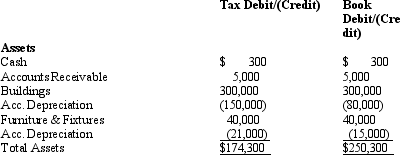
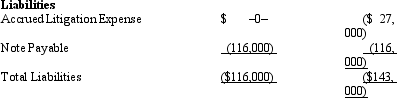
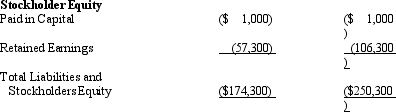
(78) Gator, Inc., is a domestic corporation with the following balance sheet for book and tax purposes at the end of the year. Assume a 34% corporate tax rate and no valuation allowance.
(Essay)
4.8/5 (73)
(73) Bunker, Inc., is a domestic corporation. It owns 100% of Texas, Inc., a domestic corporation, 100% of Paris, a foreign corporation, and 35% of Iowa, Inc., a domestic corporation.

(Essay)
4.8/5 (76)
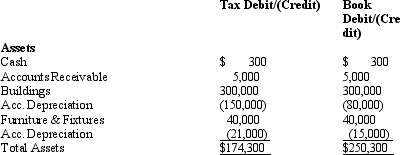
(76) Gator, Inc., is a domestic corporation with the following balance sheet for book and tax purposes at the end of the year. Assume a 34% corporate tax rate and no valuation allowance.
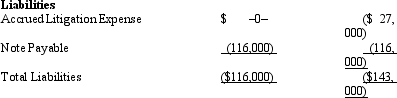
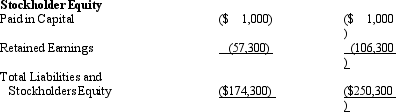
(Essay)
4.7/5 (78)
(78) You are the tax adviser to a publicly traded U.S. corporation. How might you use a "benchmarking" analysis to begin your review of the entity's tax situation and planning opportunities?
(Essay)
4.9/5 (83)
(83) Giant uses the "equity method" to account for the operations of its 40% owned subsidiary Little. A portion of Little's profits for the year are included in Giant's GAAP book income.
(True/False)
4.9/5 (80)
(80) The taxpayer should use the technique of ASC 740-30 (APB 23) income deferral only when the tax rates that apply to the subsidiary are less than those of the applicable U.S. income tax rate.
(True/False)
5.0/5 (82)
(82) ASC 740 (FIN 48) allows companies to choose their own level of certainty in reporting uncertain tax positions in their financial statements.
(True/False)
4.8/5 (84)
(84) "Temporary differences" are book-tax income differences that eventually appear in both the financial statements and the income tax return, but not in the same reporting period.
(True/False)
4.8/5 (75)
(75) Yahr, Inc., is a domestic corporation with no subsidiaries. It operates in almost every U.S. state. Yahr records no permanent or temporary book-tax differences this year. Yahr's tax expense on its GAAP financial statements and its tax liability reported on its Federal income tax return are identical.
(True/False)
4.8/5 (89)
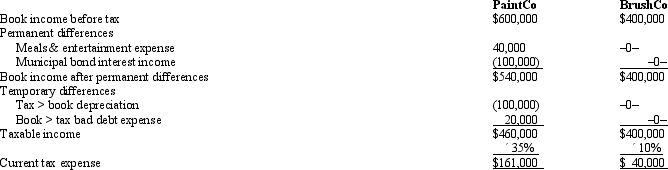
(89) PaintCo Inc., a domestic corporation, owns 100% of BrushCo Ltd., an Irish corporation. Assume that the U.S. corporate tax rate is 35% and the Irish rate is 10%. PaintCo is permanently reinvesting BrushCo's earnings outside the United States under ASC 740-30 (APB 23). The corporations' book income, permanent and temporary book-tax differences, and current tax expense are as follows. Determine PaintCo's total tax expense reported on its financial statements, its current tax expense (benefit), and its deferred tax expense (benefit).

(Essay)
4.9/5 (84)
(84) Qute, Inc., earns book net income before tax of $500,000. In computing its book income, Qute deducts $50,000 more in warranty expense for book purposes than is allowed for tax purposes. Qute records no other temporary or permanent book-tax differences. Assuming that the U.S. tax rate is 35% and no valuation allowance is required, what is Qute's total income tax expense reported on its GAAP financial statements?
(Multiple Choice)
4.8/5 (70)
(70) Beach, Inc., a domestic corporation, owns 100% of Mountain, Ltd., a manufacturing facility in Ireland. Mountain has no operations or activities in the United States. The U.S. tax rate is 35% and the Irish tax rate is 10%. For the current year, Beach earns $500,000 in taxable income. Mountain earns $300,000 in taxable income from its operations, pays $30,000 in taxes to Ireland, and makes no distributions to Beach. What is Beach's effective tax rate for GAAP book purposes, assuming that Beach makes the permanent reinvestment assumption of ASC 740-30 (APB 23)?
(Multiple Choice)
4.9/5 (82)
(82) South, Inc., earns book net income before tax of $400,000 in 2010. South acquires a depreciable asset in 2010, and first year tax depreciation exceeds book depreciation by $50,000. At the end of 2010, South's deferred tax liability account balance is $17,500. In 2011, South earns $500,000 book net income before tax, and its book depreciation exceeds tax depreciation by $20,000. South records no other temporary or permanent book-tax differences. Assuming that the U.S. tax rate is 35%, what is South's balance in its deferred tax liability account at the end of 2011?
(Multiple Choice)
4.8/5 (90)
(90) The operations of an 80% or more owned domestic subsidiaries must be included in the parent corporation's consolidated tax return.
(True/False)
4.9/5 (86)
(86) A deferred tax liability represents a potential future tax benefit associated with income reported in the current year GAAP financial statements.
(True/False)
4.9/5 (87)
(87) Collins, Inc., reports an effective tax rate in its income tax footnote of 14%. The only reconciling item with regard to the hypothetical tax at 35% is a valuation allowance reversal of negative 21%. Which of the following statements is true concerning comparing Collins, Inc.'s effective tax rate with its competitors, all of whom have an effective tax rate between 32 and 36%?
(Multiple Choice)
4.9/5 (78)
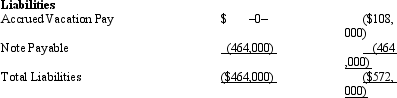
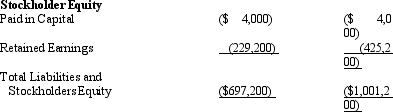
(78) Amelia, Inc., is a domestic corporation with the following balance sheet for book and tax purposes at the end of the year. Assume a 34% corporate tax rate and no valuation allowance.
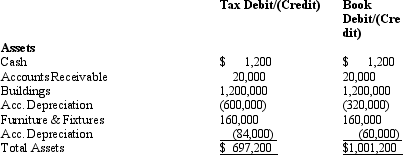
(Essay)
4.8/5 (84)
(84) The major purpose of ASC 740 (SFAS 109) is to build a cushion into currently reported income tax expense in order to insure that the financial statements are conservative.
(True/False)
4.9/5 (91)
(91) At the beginning of the year, the balance sheet of Jensen Inc., shows a $500,000 deferred tax asset relating to a net operating loss carryforward, offset by a $100,000 valuation allowance. At the end of the year, Jensen's auditors agree to release $40,000 of the allowance. Develop the journal entry to record this change in the valuation allowance.
(Essay)
4.9/5 (84)
(84) 
Filters
- Essay(0)
- Multiple Choice(0)
- Short Answer(0)
- True False(0)
- Matching(0)