



 Chat with AI
Exam 14: Taxes on the Financial Statements


Grant, a multinational corporation based in the U.S., has used ASC 740-30 (APB 23) to avoid reporting any U.S. deferred tax expense on $70 million of the earnings of its foreign subsidiaries. All of these subsidiaries operate in countries with lower tax rates than those of the U.S. When the profits eventually are repatriated, how is Grant's effective tax rate affected on its GAAP financial statements?

 (86)
 Verified
Because Grant used ASC 740-30 (APB 23) to avoid reporting any U.S. deferred tax liability for the $50 million of foreign subsidiary earnings, any repatriation of these profits back to the U.S. causes a spike (increase) in the company's book effective tax rate. The U.S. tax on these dividends (after any allowable foreign tax credit) produces a current tax expense, but the book income will not include the dividends (as the underlying profits were reported as book income in a prior year). With the numerator of the effective tax rate fraction increasing and the denominator staying the same, the effective tax rate increases.
One can describe the benefits of ASC 740-30 (APB 23) as "all or nothing." If it is elected, APB 23 applies to the earnings from all foreign subsidiaries, in the current year and thereafter.
(72) VerifiedFalse
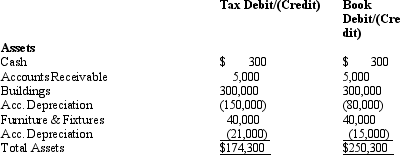
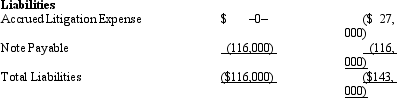
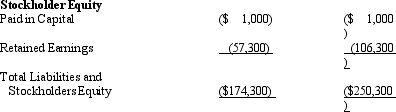
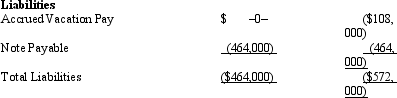
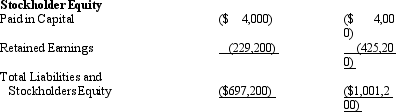
Amelia, Inc., is a domestic corporation with the following balance sheet for book and tax purposes at the end of the year. Assume a 34% corporate tax rate and no valuation allowance.
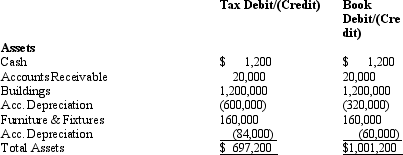
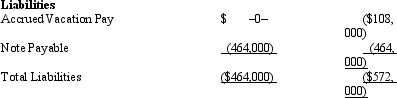
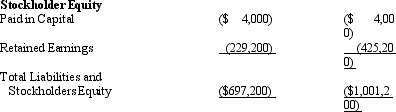
(80) VerifiedAmelia Inc.'s gross deferred tax assets and liabilities at the beginning of Amelia's year are listed below.

 Amelia Inc.'s book income before tax is $25,200. Amelia records two permanent book-tax differences. It earned $1,000 in tax exempt municipal bond interest and $1,840 in nondeductible meals and entertainment expense. Provide the journal entry to record Amelia's current tax expense.
Income Tax Expense $966
Current Income Tax Payable $966
Which of the following items are not included in the income tax note for a publicly traded company?
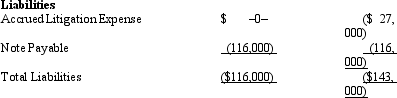
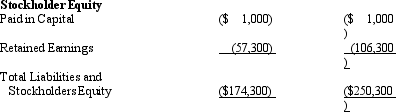
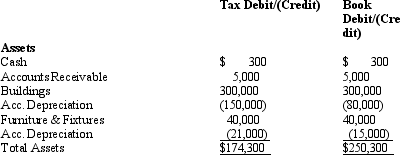
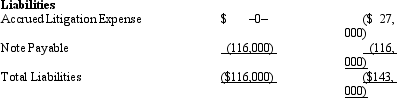
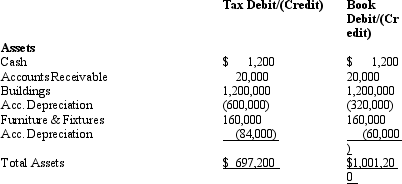
(79) Gator, Inc., is a domestic corporation with the following balance sheet for book and tax purposes at the end of the year. Assume a 34% corporate tax rate and no valuation allowance.
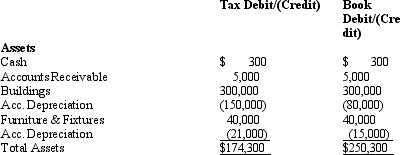
(86) South, Inc., earns book net income before tax of $400,000 in 2010. South acquires a depreciable asset in 2010, and first year tax depreciation exceeds book depreciation by $50,000. At the end of 2010, South's deferred tax liability account balance is $17,500. In 2011, South earns $500,000 book net income before tax, and its book depreciation exceeds tax depreciation by $20,000. South records no other temporary or permanent book-tax differences. Assuming that the U.S. tax rate is 35%, what is South's current income tax expense reported on its GAAP financial statements for 2011?
(79) Gator, Inc., is a domestic corporation with the following balance sheet for book and tax purposes at the end of the year. Assume a 34% corporate tax rate and no valuation allowance.
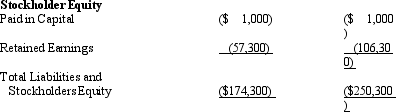
(70) South, Inc., earns book net income before tax of $400,000 in 2010. South acquires a depreciable asset in 2010, and first year tax depreciation exceeds book depreciation by $50,000. At the end of 2010, South's deferred tax liability account balance is $17,500. In 2011, South earns $500,000 book net income before tax, and its book depreciation exceeds tax depreciation by $20,000. South records no other temporary or permanent book-tax differences. Assuming that the U.S. tax rate is 35%, what is South's total income tax expense reported on its GAAP financial statements for 2011?
(77) The income tax note to the GAAP financial statements includes a reconciliation of a corporation's hypothetical tax on book income to its book tax expense as if it were taxed at the applicable U.S. income tax rates.
(74) Amelia, Inc., is a domestic corporation with the following balance sheet for book and tax purposes at the end of the year. Assume a 34% corporate tax rate and no valuation allowance.
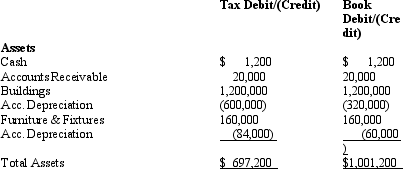
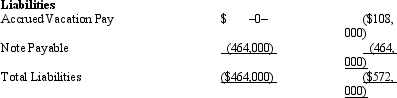
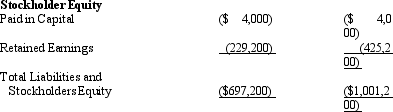
(79) Gator, Inc., is a domestic corporation with the following balance sheet for book and tax purposes at the end of the year. Assume a 34% corporate tax rate and no valuation allowance.
(67) Purple, Inc., a domestic corporation, owns 80% of Blue, Ltd., a foreign corporation and Yellow, Inc., a domestic corporation. Purple also owns 50% of Green, Inc., a domestic corporation. Purple receives no distributions from any of these corporations. Which of these entities' net income are included in Purple's Federal tax return for the current year assuming Purple elects to include all eligible entities in its consolidated Federal income tax return?
(89) Never, Inc., earns book net income before tax of $500,000. In computing its book income, Never deducts $50,000 more in warranty expense for book purposes than is allowed for tax purposes. Never records no other temporary or permanent book-tax differences. Assuming that the U.S. tax rate is 35% and no valuation allowance is required, what is Never's deferred income tax asset reported on its GAAP financial statements?
(80) Amelia, Inc., is a domestic corporation with the following balance sheet for book and tax purposes at the end of the year. Assume a 34% corporate tax rate and no valuation allowance.
(92) Which of the following statements best describes considerations regarding a company's tax expense that may be made by users of GAAP financial statements?
(72) After applying the balance sheet method to determine the GAAP income tax expense of Cutter Inc., the following account balances are found. Determine the balance sheet presentation of these amounts. Hint: Which of the accounts should you combine for the final balance sheet disclosure?

(84) If a valuation allowance is decreased (released) in the current year, the corporation's effective tax rate is higher than if the valuation allowance had not increased.
(90) A deferred tax liability represents a current tax liability associated with income or expense to be reported in future year GAAP financial statements.
(86) After applying the balance sheet method to determine the GAAP income tax expense of Poppert Inc., the following account balances are found. Determine the balance sheet presentation of these amounts. Hint: Which of the accounts should you combine for the final balance sheet disclosure?

(72) A deferred tax asset is the current tax benefit (savings) associated with income or expense to be reported in future year GAAP financial statements.
(80) 
Filters
- Essay(0)
- Multiple Choice(0)
- Short Answer(0)
- True False(0)
- Matching(0)