



 Chat with AI
Exam 4: Reactions in Aqueous Solutions

Exam 1: Chemical Tools: Experimentation and Measurement154 Questions
Exam 2: Atoms, molecules, and Ions275 Questions
Exam 3: Mass Relationships in Chemical Reactions159 Questions
Exam 4: Reactions in Aqueous Solutions211 Questions
Exam 5: Periodicity and the Electronic Structure of Atoms168 Questions
Exam 6: Ionic Compounds: Periodic Trends and Bonding138 Questions
Exam 7: Covalent Bonding and Electron-Dot Structures92 Questions
Exam 8: Covalent Compounds: Bonding Theories and Molecular Structure205 Questions
Exam 9: Thermochemistry: Chemical Energy170 Questions
Exam 10: Gases: Their Properties and Behavior188 Questions
Exam 11: Liquids, solids, and Phase Changes141 Questions
Exam 12: Solutions and Their Properties198 Questions
Exam 13: Chemical Kinetics190 Questions
Exam 14: Chemical Equilibrium171 Questions
Exam 15: Aqueous Equilibria: Acids and Bases231 Questions
Exam 16: Applications of Aqueous Equilibria201 Questions
Exam 17: Thermodynamics: Entropy, free Energy, and Equilibrium150 Questions
Exam 18: Electrochemistry212 Questions
Exam 19: Nuclear Chemistry176 Questions
Exam 20: Transition Elements and Coordination Chemistry190 Questions
Exam 21: Metals and Solid-State Materials154 Questions
Exam 22: The Main-Group Elements294 Questions
Exam 23: Connections to Organic and Biological Chemistry290 Questions
Select questions type


What reagent could be used to separate I- from CH3CO2- when added to an aqueous solution containing both?
(Multiple Choice)
4.8/5  (88)
(88) The following pictures represent aqueous solutions of three acids HA (A = X,Y,or Z),with water molecules omitted for clarity.Unshaded spheres represent hydrogen atoms or ions and gray spheres represent A atoms or ions.Which of the three is the strongest acid,and which is the weakest? 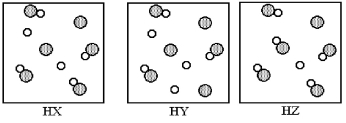
(Multiple Choice)
4.7/5 (73)
(73) Using the following sequence of reactions,determine the order of reducing agents (strongest to weakest). A + B+ → A+ + B
A + C+ → A+ + C
B + C+ → no reaction
(Multiple Choice)
4.8/5 (82)
(82) The substance is undergoing oxidation in the reaction below is ________.
2 S2O32-(aq)+ I3-(aq)→ S4O62-(aq)+ 3 I-(aq)
(Short Answer)
5.0/5 (90)
(90) What is the molarity of a solution prepared by dissolving 0.80 g of NaOH in enough water to make 250 mL of solution?
(Short Answer)
4.8/5 (69)
(69) What is the concentration of an AlCl3 solution if 150.mL of the solution contains 250.mg of Cl- ion?
(Multiple Choice)
4.9/5 (70)
(70) What is the molarity of chloride ions when 10.4 grams of MgCl2 is dissolved in 753 mL of water?
(Multiple Choice)
4.8/5 (78)
(78) When 50.0 mL of a 1.00 M solution of Fe(NO3)3 are mixed with 50.0 mL of a 1.00 M solution of NaOH,a precipitate forms.How many moles of precipitate is formed? Fe(NO3)3(aq) + 3 NaOH(aq)→ Fe(OH)3(s)+ 3 NaNO3(aq)
(Multiple Choice)
4.9/5 (92)
(92) In the following reaction,Cl2 is 2 Rb(s)+ Cl2(g)→ 2 RbCl(s)
(Multiple Choice)
4.8/5 (84)
(84) The number of milliliters of 12.0 M HCl required to prepare 250 mL of 0.500 M HCl is ________.
(Short Answer)
4.9/5 (74)
(74) What is the concentration of HNO3 in the final solution when 70.0 mL of a 6.00 M HNO3 solution is diluted with pure water to a total volume of 0.15 L?
(Multiple Choice)
4.8/5 (75)
(75) When K2SO4(aq)and Pb(NO3)2(aq)are mixed,a white colored precipitate forms which is
(Multiple Choice)
4.8/5 (73)
(73) The mixing of which pair of reactants will result in a precipitation reaction?
(Multiple Choice)
4.8/5 (79)
(79) In the reaction AgNO3(aq)+ HI(aq)→ AgI(s)+ HNO3(aq)the spectator ions are
(Multiple Choice)
4.9/5 (79)
(79) When NaOH(aq)is mixed with CuSO4(aq)a precipitate forms.Based on solubility guidelines the formula of the precipitate is ________.
(Short Answer)
4.8/5 (74)
(74) Write a net ionic equation for the neutralization reaction of HCN(aq)with NaOH(aq).
(Multiple Choice)
4.9/5 (76)
(76) The mixing of which pair of reactants will result in a precipitation reaction?
(Multiple Choice)
4.9/5 (64)
(64) 
Filters
- Essay(0)
- Multiple Choice(0)
- Short Answer(0)
- True False(0)
- Matching(0)