



 Chat with AI
Exam 4: Reactions in Aqueous Solutions

Exam 1: Chemical Tools: Experimentation and Measurement154 Questions
Exam 2: Atoms, molecules, and Ions275 Questions
Exam 3: Mass Relationships in Chemical Reactions159 Questions
Exam 4: Reactions in Aqueous Solutions211 Questions
Exam 5: Periodicity and the Electronic Structure of Atoms168 Questions
Exam 6: Ionic Compounds: Periodic Trends and Bonding138 Questions
Exam 7: Covalent Bonding and Electron-Dot Structures92 Questions
Exam 8: Covalent Compounds: Bonding Theories and Molecular Structure205 Questions
Exam 9: Thermochemistry: Chemical Energy170 Questions
Exam 10: Gases: Their Properties and Behavior188 Questions
Exam 11: Liquids, solids, and Phase Changes141 Questions
Exam 12: Solutions and Their Properties198 Questions
Exam 13: Chemical Kinetics190 Questions
Exam 14: Chemical Equilibrium171 Questions
Exam 15: Aqueous Equilibria: Acids and Bases231 Questions
Exam 16: Applications of Aqueous Equilibria201 Questions
Exam 17: Thermodynamics: Entropy, free Energy, and Equilibrium150 Questions
Exam 18: Electrochemistry212 Questions
Exam 19: Nuclear Chemistry176 Questions
Exam 20: Transition Elements and Coordination Chemistry190 Questions
Exam 21: Metals and Solid-State Materials154 Questions
Exam 22: The Main-Group Elements294 Questions
Exam 23: Connections to Organic and Biological Chemistry290 Questions
Select questions type


What is the concentration of FeBr3 in a solution prepared by dissolving 10.0 g of FeBr3 in enough water to make 275 mL of solution?
(Multiple Choice)
4.7/5  (85)
(85) 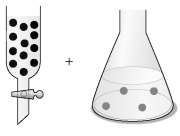 -The concentration of an aqueous solution of Fe2+ can be determined by a redox titration with aqueous bromate ion,BrO3⁻: 6 Fe2+ (aq)+ BrO3⁻ (aq)+ 6 H⁺ (aq)→ 6 Fe3+ (aq)+ Br⁻ (aq)+ 3 H2O (l)
Assume that the black spheres in the buret represent BrO3⁻ ions,the gray spheres in the flask represent Fe2+ ions,the concentration of the BrO3⁻ ions in the buret is 0.120 M,and the volumes in the buret and the flask are identical.What is the concentration of the Fe2+ in the flask,and what fraction of the BrO3⁻ solution in the buret must be added to the flask to react with all the Fe2+ ions?
-The concentration of an aqueous solution of Fe2+ can be determined by a redox titration with aqueous bromate ion,BrO3⁻: 6 Fe2+ (aq)+ BrO3⁻ (aq)+ 6 H⁺ (aq)→ 6 Fe3+ (aq)+ Br⁻ (aq)+ 3 H2O (l)
Assume that the black spheres in the buret represent BrO3⁻ ions,the gray spheres in the flask represent Fe2+ ions,the concentration of the BrO3⁻ ions in the buret is 0.120 M,and the volumes in the buret and the flask are identical.What is the concentration of the Fe2+ in the flask,and what fraction of the BrO3⁻ solution in the buret must be added to the flask to react with all the Fe2+ ions? (Multiple Choice)
4.9/5 (93)
(93) The number of grams of NaCl required to prepare 500 mL of 0.100 M NaCl is ________.
(Short Answer)
4.9/5 (79)
(79) What is the oxidation number change for the chromium atom in the following unbalanced reduction half reaction? Cr2O72-(aq)+ H+(aq)→ Cr3+(aq)+ H2O(l)
(Multiple Choice)
4.8/5 (71)
(71) Which of the following compounds is not an Arrhenius acid?
(Multiple Choice)
4.9/5 (84)
(84) What is the concentration of NO3- ions in a solution prepared by dissolving 20.0 g of Ca(NO3)2 in enough water to produce 300.mL of solution?
(Multiple Choice)
4.9/5 (62)
(62) Which pair of reactants will produce a precipitate when mixed together?
(Multiple Choice)
4.9/5 (85)
(85) Balance the chemical equation given below,and determine the number of milliliters of 0.00300 M phosphoric acid required to neutralize 25.00 mL of 0.00150 M calcium hydroxide. ________ Ca(OH)2(aq)+ ________ H3PO4(aq)→ ________ Ca3(PO4)2(aq)+ ________ H2O(l)
(Multiple Choice)
4.8/5 (80)
(80) What is the oxidation number of the sulfur atom in Li2SO4?
(Multiple Choice)
4.9/5 (77)
(77) Which of the compounds of H NO2, Ra(OH)2,FrOH,and HI,behave as acids when they are dissolved in water?
(Multiple Choice)
4.9/5 (88)
(88) Assume that an aqueous solution of a cation,represented by shaded spheres,is allowed to mix with a solution of an anion,represented by unshaded spheres.Three possible outcomes are represented by boxes (a)-(c). 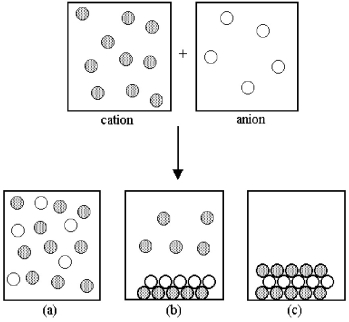 -Which outcome corresponds to the mixing of potassium and sulfide ions shown in the following equation? 2 K+(aq)+ S2-(aq)→ ?
 (Multiple Choice)
4.8/5 (80)
(80) Using the following sequence of reactions,determine the order of oxidizing agents (strongest to weakest). Q + U+ → Q+ + U
U + W+ → U+ + W
Q + W+ → Q+ + W
(Multiple Choice)
4.8/5 (78)
(78) Predict the products of a reaction between AgNO3(aq)and CsBr(aq).
(Multiple Choice)
4.9/5 (92)
(92) What reagent could be used to separate Br- from SO42- when added to an aqueous solution containing both?
(Multiple Choice)
4.9/5 (87)
(87) How many milliliters of 0.100 M FeCl3 are needed to react with an excess of Na2S to produce 2.75 g of Fe2S3 if the percent yield for the reaction is 65.0%? 3 Na2S(aq)+ 2 FeCl3(aq)→ Fe2S3(s)+ 6 NaCl(aq)
(Multiple Choice)
4.8/5 (87)
(87) How many grams of KNO3 are needed to make 250.mL of a solution that is 0.135 M?
(Multiple Choice)
4.7/5 (74)
(74) 
Filters
- Essay(0)
- Multiple Choice(0)
- Short Answer(0)
- True False(0)
- Matching(0)