



 Chat with AI
Exam 26: Lipids

Exam 1: Covalent Bonding and Shapes of Molecules115 Questions
Exam 2: Alkanes and Cycloalkanes95 Questions
Exam 3: Stereoisomerism and Chirality93 Questions
Exam 4: Acids and Bases94 Questions
Exam 5: Alkenes: Bonding, Nomenclature, and Properties86 Questions
Exam 6: Reactions of Alkenes98 Questions
Exam 7: Alkynes100 Questions
Exam 8: Haloalkanes, Halogenation, and Radical Reactions76 Questions
Exam 9: Nucleophilic Substitution and Beta-Elimination111 Questions
Exam 10: Alcohols98 Questions
Exam 11: Ethers, Epoxides, and Sulfides93 Questions
Exam 12: Infrared Spectroscopy67 Questions
Exam 13: Nuclear Magnetic Resonance Spectroscopy102 Questions
Exam 14: Mass Spectrometry65 Questions
Exam 15: An Introduction to Organometallic Compounds66 Questions
Exam 16: Aldehydes and Ketones119 Questions
Exam 17: Carboxylic Acids71 Questions
Exam 18: Functional Derivatives of Carboxylic Acids112 Questions
Exam 19: Enolate Anions and Enamines93 Questions
Exam 20: Dienes, Conjugated Systems, and Pericyclic Reactions69 Questions
Exam 21: Benzene and the Concept of Aromaticity85 Questions
Exam 22: Reactions of Benzene and Its Derivatives107 Questions
Exam 23: Amines88 Questions
Exam 24: Catalytic Carbon-Carbon Bond Formation77 Questions
Exam 25: Carbohydrates60 Questions
Exam 26: Lipids54 Questions
Exam 27: Amino Acids and Proteins70 Questions
Exam 28: Nucleic Acids52 Questions
Exam 29: Organic Polymer Chemistry60 Questions
Select questions type


What functional group of the protein opsin reacts with retinal to form rhodopsin, a light-sensitive pigment?
(Multiple Choice)
4.7/5  (89)
(89) The following tetracylic structure is common to steroids, an importnat class of biomolecules that have a number of sterocenters. Modify the structure on the right by placing the hydrogen atoms and methyl groups to accurately depict the structure on the left (including steeochemistry). 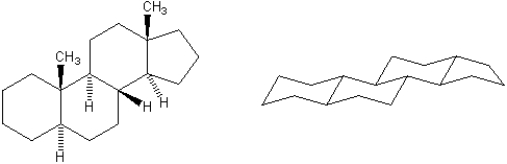
(Essay)
4.7/5 (82)
(82) Arachidonic acid is a C20 acid that is involved in the biosynthesis of prostaglandins, an important class of biomolecules. Provide the IUPAC name of arachidinic acid. 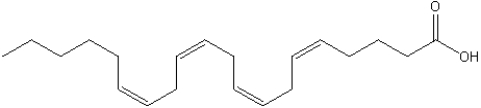
(Essay)
4.8/5 (83)
(83) How many triglycerides (including stereoisomers) are there which contain one molecule of stearic acid, one of myristic acid and one of arachidic acid?
(Multiple Choice)
4.9/5 (77)
(77) The main difference between fats and oils is that oils contain a lower percentage of unsaturated alkyl chains.
(True/False)
5.0/5 (72)
(72) Circle the hydrophilic part of sodium palmitate, a soap that is the sodium salt of a fatty acid, and put a rectangle around the hydrophobic part. 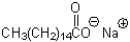
(Essay)
4.8/5 (62)
(62) Explain the formation of "soap scum", formed in areas which have "hard" water. What chemical reaction takes place, and what physical process results?
(Essay)
4.8/5 (89)
(89) 
The chiral centers in -santonin are indicated by asterisks in the following. 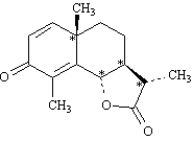
(True/False)
4.8/5 (77)
(77) Which of the following is not an intermediate in the biosynthesis of cholesterol?
(Multiple Choice)
4.8/5 (91)
(91) Which of the following processes is used to harden an oil to give a fat?
(Multiple Choice)
4.9/5 (75)
(75) Consider the following structures.  Use these to answer the following questions by placing the appropriate Roman numerical in the blank.
-Saponification followed by protonation of structure _____ produces two moles of the salt of stearic acid and one mole of the salt of oleic acid.
Use these to answer the following questions by placing the appropriate Roman numerical in the blank.
-Saponification followed by protonation of structure _____ produces two moles of the salt of stearic acid and one mole of the salt of oleic acid. (Short Answer)
4.9/5 (88)
(88) Which of the following fatty acids has the highest melting point?
(Multiple Choice)
4.8/5 (76)
(76) Describe how the structure of a phospholipid differs from that of a trigyceride fat, and what influence this difference has on the interaction of these molecules with water.
(Essay)
4.9/5 (81)
(81) Consider the following.  Structure ____ would be classified as an synthetic detergent.
 (Short Answer)
4.8/5 (85)
(85) 
Filters
- Essay(0)
- Multiple Choice(0)
- Short Answer(0)
- True False(0)
- Matching(0)