



 Chat with AI
Exam 17: Carboxylic Acids

Exam 1: Covalent Bonding and Shapes of Molecules115 Questions
Exam 2: Alkanes and Cycloalkanes95 Questions
Exam 3: Stereoisomerism and Chirality93 Questions
Exam 4: Acids and Bases94 Questions
Exam 5: Alkenes: Bonding, Nomenclature, and Properties86 Questions
Exam 6: Reactions of Alkenes98 Questions
Exam 7: Alkynes100 Questions
Exam 8: Haloalkanes, Halogenation, and Radical Reactions76 Questions
Exam 9: Nucleophilic Substitution and Beta-Elimination111 Questions
Exam 10: Alcohols98 Questions
Exam 11: Ethers, Epoxides, and Sulfides93 Questions
Exam 12: Infrared Spectroscopy67 Questions
Exam 13: Nuclear Magnetic Resonance Spectroscopy102 Questions
Exam 14: Mass Spectrometry65 Questions
Exam 15: An Introduction to Organometallic Compounds66 Questions
Exam 16: Aldehydes and Ketones119 Questions
Exam 17: Carboxylic Acids71 Questions
Exam 18: Functional Derivatives of Carboxylic Acids112 Questions
Exam 19: Enolate Anions and Enamines93 Questions
Exam 20: Dienes, Conjugated Systems, and Pericyclic Reactions69 Questions
Exam 21: Benzene and the Concept of Aromaticity85 Questions
Exam 22: Reactions of Benzene and Its Derivatives107 Questions
Exam 23: Amines88 Questions
Exam 24: Catalytic Carbon-Carbon Bond Formation77 Questions
Exam 25: Carbohydrates60 Questions
Exam 26: Lipids54 Questions
Exam 27: Amino Acids and Proteins70 Questions
Exam 28: Nucleic Acids52 Questions
Exam 29: Organic Polymer Chemistry60 Questions
Select questions type


What is the major organic product obtained from the following reaction? 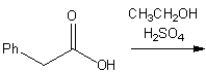
(Essay)
4.8/5  (80)
(80) Benzoic acid can be produced by the treatment of bromobenzene with 1. Mg, ether, and 2.) CO2 followed by acidification.
(True/False)
4.9/5 (93)
(93) What is the major organic product obtained from the following reaction? 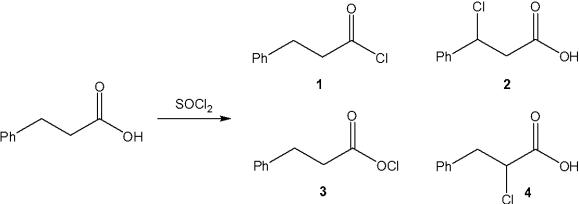
(Multiple Choice)
5.0/5 (76)
(76) Consider the data in the Table below to answer the following question:
Acidities of Substituted Benzoic and Acetic Acids
pKas at 25 C
Y-C6H4COOH
Y
Y-CH2COOH
meta
para
H
4.75
4.19
4.19
CN
2.47
3.64
3.55
OCH3
3.57
4.09
4.46
The structure of the strongest acid in the table above is NC-CH2-COOH.
(True/False)
4.9/5 (91)
(91) Which of the following statements is not true regarding benzoic acid acids?
(Multiple Choice)
5.0/5 (72)
(72)  The expected product is
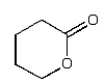
Which of the following is a reactive intermediate in the thermal decarboxylation of a 1,3-diacid?
(Multiple Choice)
4.7/5 (88)
(88) Consider the following reaction. 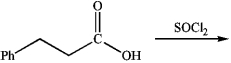 The major organic product obtained is
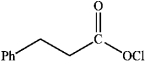
The major organic product obtained is (True/False)
4.9/5 (67)
(67) The strongest acid of the following is indicated by the Roman numeral ______. 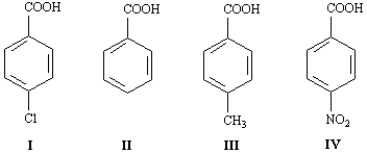
(Short Answer)
4.8/5 (78)
(78) Consider the following 1H NMR to answer the following question. 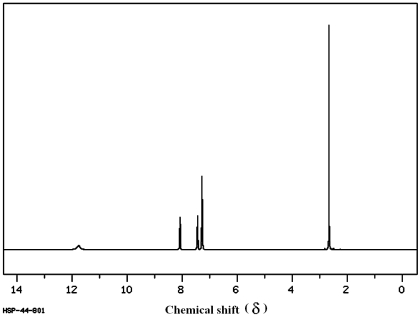 Spectrum obtained from: SDBSWeb : http://riodb01.ibase.aist.go.jp/sdbs/ (National Institute of Advanced Industrial Science and Technology, 11-07-08)
This compound is known to contain both a -C=O group and an -OH group. Based on this spectrum, this compound would be classified as aliphatic carboxylic acid.
Spectrum obtained from: SDBSWeb : http://riodb01.ibase.aist.go.jp/sdbs/ (National Institute of Advanced Industrial Science and Technology, 11-07-08)
This compound is known to contain both a -C=O group and an -OH group. Based on this spectrum, this compound would be classified as aliphatic carboxylic acid. (True/False)
4.8/5 (77)
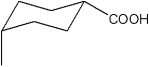
(77) 

Filters
- Essay(0)
- Multiple Choice(0)
- Short Answer(0)
- True False(0)
- Matching(0)