



 Chat with AI
Exam 6: Reactions of Alkenes

Exam 1: Covalent Bonding and Shapes of Molecules115 Questions
Exam 2: Alkanes and Cycloalkanes95 Questions
Exam 3: Stereoisomerism and Chirality93 Questions
Exam 4: Acids and Bases94 Questions
Exam 5: Alkenes: Bonding, Nomenclature, and Properties86 Questions
Exam 6: Reactions of Alkenes98 Questions
Exam 7: Alkynes100 Questions
Exam 8: Haloalkanes, Halogenation, and Radical Reactions76 Questions
Exam 9: Nucleophilic Substitution and Beta-Elimination111 Questions
Exam 10: Alcohols98 Questions
Exam 11: Ethers, Epoxides, and Sulfides93 Questions
Exam 12: Infrared Spectroscopy67 Questions
Exam 13: Nuclear Magnetic Resonance Spectroscopy102 Questions
Exam 14: Mass Spectrometry65 Questions
Exam 15: An Introduction to Organometallic Compounds66 Questions
Exam 16: Aldehydes and Ketones119 Questions
Exam 17: Carboxylic Acids71 Questions
Exam 18: Functional Derivatives of Carboxylic Acids112 Questions
Exam 19: Enolate Anions and Enamines93 Questions
Exam 20: Dienes, Conjugated Systems, and Pericyclic Reactions69 Questions
Exam 21: Benzene and the Concept of Aromaticity85 Questions
Exam 22: Reactions of Benzene and Its Derivatives107 Questions
Exam 23: Amines88 Questions
Exam 24: Catalytic Carbon-Carbon Bond Formation77 Questions
Exam 25: Carbohydrates60 Questions
Exam 26: Lipids54 Questions
Exam 27: Amino Acids and Proteins70 Questions
Exam 28: Nucleic Acids52 Questions
Exam 29: Organic Polymer Chemistry60 Questions
Select questions type


Provide a neatly drawn mechanism for the following reaction, including curved arrows to show the movement of pairs of electrons and the structure of reactive intermediates. 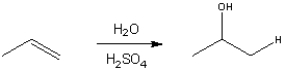
(Short Answer)
4.9/5  (90)
(90) What is the major organic product obtained from the following reaction? 
(Multiple Choice)
4.9/5 (73)
(73) Consider the following reaction sequence.  The product of this sequence is

The product of this sequence is (True/False)
4.8/5 (87)
(87) What is (are) the major organic product(s) obtained from the following reaction? 
(Multiple Choice)
4.8/5 (66)
(66) Which of the following concepts explains Markovnikov's rule as applied to the addition of HBr to propene?
(Multiple Choice)
4.8/5 (71)
(71) What type of reaction mechanism accounts for the reaction of an alkene with aqueous acid to give an alcohol?
(Multiple Choice)
4.8/5 (76)
(76) Consider the following reaction.  The mechanism for this reaction is shown below.

The mechanism for this reaction is shown below. (True/False)
4.9/5 (77)
(77) What type of orbitals overlap to provide stability to the tert-butyl carbocation by hyperconjugation?
(Multiple Choice)
4.8/5 (73)
(73) Which of the following concepts explains why tertiary carbocations are more stable than primary and secondary carbocations?
(Multiple Choice)
4.9/5 (72)
(72) The reaction of methylpropene with HBr in ether gives one of the two products below as the major product. Answer the following question(s) about this reaction.  -Product _____ would have the lowest activation energy required to form the intermediate in the mechanism.
 (Short Answer)
4.8/5 (77)
(77) Which of the following alkenes is most likely to undergo rearrangement upon acid-catalyzed hydration (treatment with aqueous H2SO4)? 
(Multiple Choice)
4.7/5 (77)
(77) What is the major organic product obtained from the following reaction? 
(Multiple Choice)
4.9/5 (78)
(78) Upon ozonolysis, _____________ will produce only acetone, (CH3)2C=O. (Enter an IUPAC name.)
(Short Answer)
4.8/5 (83)
(83) Provide a neatly drawn mechanism for the following reaction, including curved arrows to show the movement of pairs of electrons and the structure of reactive intermediates. 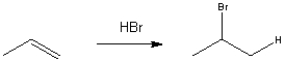
(Short Answer)
4.9/5 (77)
(77) What is the best choice of reagent(s) to perform the following transformation? 
(Multiple Choice)
4.8/5 (79)
(79) What is the major organic product obtained from the following reaction? 
(Essay)
4.9/5 (86)
(86) 
The reaction of methylpropene with HBr in ether gives one of the two products below as the major product. Answer the following question(s) about this reaction.
-Product _____would be the major product.
-Product _____would be the major product. (Short Answer)
4.9/5 (63)
(63) What is the major organic product obtained from the following reaction? 
(Multiple Choice)
4.9/5 (82)
(82) Provide the structure of the key intermediate in the following reaction? 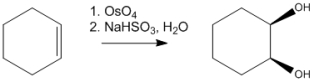
(Essay)
4.9/5 (74)
(74) 
Filters
- Essay(0)
- Multiple Choice(0)
- Short Answer(0)
- True False(0)
- Matching(0)