



 Chat with AI
Exam 1: Covalent Bonding and Shapes of Molecules

Exam 1: Covalent Bonding and Shapes of Molecules115 Questions
Exam 2: Alkanes and Cycloalkanes95 Questions
Exam 3: Stereoisomerism and Chirality93 Questions
Exam 4: Acids and Bases94 Questions
Exam 5: Alkenes: Bonding, Nomenclature, and Properties86 Questions
Exam 6: Reactions of Alkenes98 Questions
Exam 7: Alkynes100 Questions
Exam 8: Haloalkanes, Halogenation, and Radical Reactions76 Questions
Exam 9: Nucleophilic Substitution and Beta-Elimination111 Questions
Exam 10: Alcohols98 Questions
Exam 11: Ethers, Epoxides, and Sulfides93 Questions
Exam 12: Infrared Spectroscopy67 Questions
Exam 13: Nuclear Magnetic Resonance Spectroscopy102 Questions
Exam 14: Mass Spectrometry65 Questions
Exam 15: An Introduction to Organometallic Compounds66 Questions
Exam 16: Aldehydes and Ketones119 Questions
Exam 17: Carboxylic Acids71 Questions
Exam 18: Functional Derivatives of Carboxylic Acids112 Questions
Exam 19: Enolate Anions and Enamines93 Questions
Exam 20: Dienes, Conjugated Systems, and Pericyclic Reactions69 Questions
Exam 21: Benzene and the Concept of Aromaticity85 Questions
Exam 22: Reactions of Benzene and Its Derivatives107 Questions
Exam 23: Amines88 Questions
Exam 24: Catalytic Carbon-Carbon Bond Formation77 Questions
Exam 25: Carbohydrates60 Questions
Exam 26: Lipids54 Questions
Exam 27: Amino Acids and Proteins70 Questions
Exam 28: Nucleic Acids52 Questions
Exam 29: Organic Polymer Chemistry60 Questions
Select questions type




Which atomic orbitals overlap to form the carbon-hydrogen bonding molecular orbitals of ethane, CH3CH3?
(Multiple Choice)
4.9/5  (84)
(84) Which atomic orbitals overlap to form the carbon-hydrogen bonding molecular orbitals of ethyne, HC CH?
(Multiple Choice)
4.8/5 (80)
(80) Draw bond-line structures of all of the alcohols that have the formula C4H10O.
(Essay)
4.8/5 (73)
(73) Which of the following statements is not true about the acetate anion, CH3CO2-?
(Multiple Choice)
4.8/5 (85)
(85) The most electronegative elements in the periodic table are generally found toward the right in a horizontal row and toward the top in a column.
(True/False)
4.8/5 (89)
(89) Which of the following molecules has a molecular dipole moment? 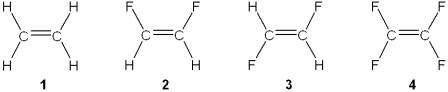
(Multiple Choice)
4.8/5 (81)
(81) The following molecules all contain the same functional group except 2.
CH3OH
CH3OCH3
CH3CH2OH
CH3CH(OH)CH3
1
2
3
4
(True/False)
4.8/5 (71)
(71) What is the ground-state electronic configuration of a fluorine atom (fluorine: atomic number 9)?
(Multiple Choice)
5.0/5 (70)
(70) What is the approximate strength of the C-C bond of ethane?
(Multiple Choice)
4.7/5 (70)
(70) Rank the following in order of decreasing importance as a contributing resonance structure to the molecular structure of acetone, CH3COCH3 (more important > less important) 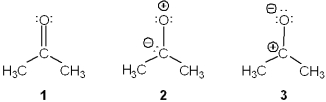
(Multiple Choice)
4.9/5 (80)
(80) Provide a neatly drawn figure to show the atomic orbitals that overlap to form each of the bonds in water (H2O) and which contain the lone pair of electrons. Label each orbital with its hybridization.
(Essay)
4.8/5 (86)
(86) The maximum number of electrons that a molecular orbital can contain is four.
(True/False)
4.9/5 (82)
(82) What is the ground-state electronic configuration of a sodium cation (sodium: atomic number 11)?
(Multiple Choice)
4.8/5 (78)
(78) Which of the following best represents the shape of a 2p atomic orbital of carbon? 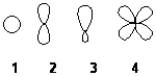
(Multiple Choice)
4.8/5 (78)
(78) Circle all of the sp hybridized atoms in the following molecular structure. 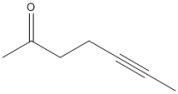
(Essay)
4.7/5 (73)
(73) Which of the following elements has the highest electronegativity?
(Multiple Choice)
4.8/5 (79)
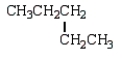
(79) 
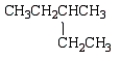
Draw bond-line structures of all of the primary (1 ) alcohols that have the formula C5H12O.
(Essay)
4.9/5 (85)
(85) 
Filters
- Essay(0)
- Multiple Choice(0)
- Short Answer(0)
- True False(0)
- Matching(0)