



 Chat with AI
Exam 23: Nuclear Chemistry

Exam 1: Chemistry: The Study of Change153 Questions
Exam 2: Atoms, Molecules, and Ions141 Questions
Exam 3: Mass Relationships in Chemical Reactions168 Questions
Exam 4: Reactions in Aqueous Solution161 Questions
Exam 5: Gases109 Questions
Exam 6: Thermo-Chemistry111 Questions
Exam 7: Quantum Theory and the Electronic Structure of Atoms115 Questions
Exam 8: Periodic Relationships Among the Elements119 Questions
Exam 9: Chemical Bonding I: Basic Concepts118 Questions
Exam 10: Chemical Bonding Ii: Molecular Geometry and Hybridization of Atomic Orbitals122 Questions
Exam 11: Intermolecular Forces and Liquids and Solids140 Questions
Exam 12: Physical Properties of Solutions109 Questions
Exam 13: Chemical Kinetics114 Questions
Exam 14: Chemical Equilibrium100 Questions
Exam 15: Acids and Bases163 Questions
Exam 16: Acid-Base Equilibria and Solubility Equilibria110 Questions
Exam 17: Chemistry in the Atmosphere41 Questions
Exam 18: Entropy, Free Energy, and Equilibrium112 Questions
Exam 19: Electrochemistry138 Questions
Exam 20: Metallurgy and the Chemistry of Metals58 Questions
Exam 21: Nonmetallic Elements and Their Compounds41 Questions
Exam 22: Transition Metal Chemistry and Coordination Compounds80 Questions
Exam 23: Nuclear Chemistry112 Questions
Exam 24: Organic Chemistry57 Questions
Exam 25: Synthetic and Natural Organic Polymers42 Questions
Select questions type


When a 87Br nucleus emits a beta particle, the nuclear species that results is ___________.
(Short Answer)
4.8/5  (72)
(72) The only stable isotope of iodine is iodine-127. Predict the mode of decay of  I.
I. (Multiple Choice)
4.9/5 (74)
(74) Polonium-208 is an alpha emitter with a half-life of 2.90 years. How many milligrams of polonium from an original sample of 2.00 mg will remain after 8.00 years?
(Multiple Choice)
4.9/5 (78)
(78)  or
 .
The 14C activity of some ancient Peruvian corn was found to be 10 disintegrations per minute per gram of carbon. If present-day plant life shows 15 dpm/g, how old is the Peruvian corn? The half-life of 14C is 5730 yr.
(Multiple Choice)
4.9/5 (92)
(92)  Rn

 He + ? .
The dose unit of ionizing radiation is called the rad. The rad is defined in terms of
(Multiple Choice)
4.9/5 (70)
(70) Protactinium-234 has a half-life of 1 minute.How much of a 400.g sample protactinium would remain after 1 minute?
(Short Answer)
4.9/5 (83)
(83) The carbon-14 activity of some ancient Indian corn was found to be 7.0 disintegrations per minute (dpm)per gram of carbon. If present-day plant life has 16 dpm per gram of carbon, how old is the Indian corn? (t1/2 = 5,730 yr)
(Multiple Choice)
4.8/5 (84)
(84) Protactinium-234 has a half-life of 1 minute.How much of a 400.g sample protactinium would remain after 4 minutes?
(Short Answer)
4.9/5 (73)
(73) How many neutrons and protons (nucleons)does an atom with the symbol  have?
have? (Multiple Choice)
4.8/5 (70)
(70) Protactinium-234 has a half-life of 1 minute.How much of a 400.g sample protactinium would remain after 2 minutes?
(Short Answer)
4.9/5 (82)
(82) Calculate the binding energy per nucleon of an Al-27 nucleus given the following masses:  Al: 26.981541 amu;
 H: 1.007838 amu;
 n: 1.008665 amu.
Al: 26.981541 amu; H: 1.007838 amu; n: 1.008665 amu. (Short Answer)
4.9/5 (86)
(86) A rock contains 0.37 mg of Pb-206 and 0.95 mg of U-238. Approximately how many U-238 atoms were in the rock when it was formed billions of years ago? (The half life for 238U 206Pb is 4.5 109 yr.)
(Multiple Choice)
4.8/5 (85)
(85) 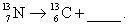
Which one of the following statements about fission and fusion is false?
(Multiple Choice)
5.0/5 (89)
(89) Radioactive nitrogen-13 has a half-life of 10 minutes.After 40 minutes, how much of this isotope would remain in a sample that originally contained 96 mg?
(Short Answer)
5.0/5 (74)
(74) 
Filters
- Essay(0)
- Multiple Choice(0)
- Short Answer(0)
- True False(0)
- Matching(0)