



 Chat with AI
Exam 17: Electrochemistry

Exam 1: Chemistry: Matter and Measurement219 Questions
Exam 2: Atoms, molecules, and Ions257 Questions
Exam 3: Formulas, equations, and Moles208 Questions
Exam 4: Reactions in Aqueous Solutions174 Questions
Exam 5: Periodicity and the Atomic Structure of Atoms158 Questions
Exam 6: Ionic Bonds and Some Main-Group Chemistry173 Questions
Exam 7: Covalent Bonds and Molecular Structure232 Questions
Exam 8: Thermochemistry: Chemical Energy163 Questions
Exam 9: Gases: Their Properties and Behavior182 Questions
Exam 10: Liquids,solids,and Phase Changes186 Questions
Exam 11: Solutions and Their Properties192 Questions
Exam 12: Chemical Kinetics206 Questions
Exam 13: Chemical Equilibrium166 Questions
Exam 14: Aqueous Equilibria: Acids and Bases224 Questions
Exam 15: Applications of Aqueous Equilibria190 Questions
Exam 16: Thermodynamics: Entropy, free Energy, and Equilibrium144 Questions
Exam 17: Electrochemistry176 Questions
Exam 18: Hydrogen, oxygen, and Water175 Questions
Exam 19: The Main-Group Elements202 Questions
Exam 20: Transition Elements and Coordination Chemistry185 Questions
Exam 21: Metals and Solid-State Materials149 Questions
Exam 22: Nuclear Chemistry85 Questions
Exam 23: Organic and Biological Chemistry285 Questions
Select questions type


Shown below is an electrochemical cell with anode a and cathode c.Both the anode and the cathode are inert electrodes.The liquid shown in compartment b of the cell is molten potassium chloride,KCl(l). 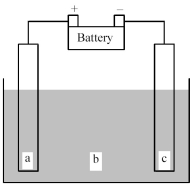 -Determine the direction of electron flow and the direction of ion flow.
 (Multiple Choice)
4.8/5  (91)
(91) Shown below is a galvanic cell with anode compartment b containing anode a and cathode compartment d containing cathode c.Electrons flow through wire f,ions flow through salt bridge e,and the cell potential is read using voltmeter g.
This galvanic cell uses the reaction: Cu(s)+ 2 Ag+(aq) 2 Ag(s)+ Cu2+(aq).  -Identify the anode and cathode half-reactions and categorize each as either oxidation or reduction.
 (Multiple Choice)
4.8/5 (96)
(96) Chromium can be electroplated from an aqueous solution containing sulfuric acid and chromic acid,H2CrO4.What current is required to deposit chromium at a rate of 1.25 g/min?
(Multiple Choice)
4.9/5 (62)
(62) Doubling all the coefficients in the equation for the cell reaction
(Multiple Choice)
4.8/5 (74)
(74) The cell reaction for a dry cell battery is
Zn(s)+ 2 MnO2(s)+ 2 NH4+(aq)→ 2 NH3(aq)+ Mn2O3(s)+ Zn2+(aq)+ H2O(l).
The standard cell potential for this cell is 1.56 V.What is the standard free energy change for this cell?
(Multiple Choice)
4.9/5 (73)
(73) Based on the half-reactions and their respective standard reduction potentials below,the strongest reducing agent is ________,and the strongest oxidizing agent is ________.
Ag+(aq)+ e- → Ag(s)0.80 V
2 H+(aq)+ 2 e- → H2(g)0.00 V
Cd2+(aq)+ 2 e- → Cd(s)-0.40 V
(Multiple Choice)
4.8/5 (87)
(87) A particular 12V battery is based on a reaction having a standard cell potential,E° = +1.92 V.What happens when the battery "dies"?
(Multiple Choice)
4.8/5 (74)
(74) Shown below is a galvanic cell with anode compartment b containing anode a and cathode compartment d containing cathode c.Electrons flow through wire f,ions flow through salt bridge e,and the cell potential is read using voltmeter g.
This galvanic cell uses the reaction: Cu(s)+ 2 Ag+(aq) 2 Ag(s)+ Cu2+(aq).
-NaNO3(aq)is employed in the salt bridge.Give the direction of electron flow and the direction of ion flow from the salt bridge.
-NaNO3(aq)is employed in the salt bridge.Give the direction of electron flow and the direction of ion flow from the salt bridge. (Multiple Choice)
4.8/5 (79)
(79) The two half-reactions that are used in the direct methanol fuel cell are shown below.
I.2 CH3OH(aq)+ 2 H2O(l)→ 2 CO2(g)+ 12 H+(aq)+ 12 e-
II.3 O2(g)+ 12 H+(aq)+ 12 e- → 6 H2O(l)
The electrode at which half-reaction I occurs is the ________ at which ________ is oxidized,and half-reaction II occurs at the ________ at which ________ is reduced.
(Short Answer)
4.8/5 (88)
(88) For a galvanic cell,the cathode has a ________ sign and is the site of ________.
(Multiple Choice)
4.8/5 (74)
(74) The chlor-alkali industry is based on the electrolysis of aqueous NaCl.What are the products of this electrolysis?
(Multiple Choice)
4.9/5 (79)
(79) The following cell has a potential of 0.45 V at 25°C.
Pt(s)∣ H2(1 atm)|H+(? M)∣∣ Cl-(1 M)∣ Hg2Cl2(s)|Hg(l)
The standard half-cell potential for the half-reaction Hg2Cl2(s)+ 2 e- → 2 Hg(l)+ 2 Cl-(aq)is 0.28 V.What is the pH in the anode compartment?
(Multiple Choice)
4.8/5 (79)
(79) 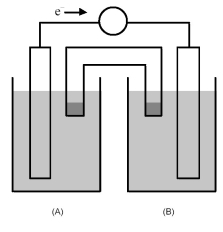 -The cell reaction 2 Fe3+(aq)+ Zn(s)→ Zn2+(aq)+ 2 Fe2+(aq)occurs in the galvanic cell shown above.Which would be the most appropriate choices for the solid electrode in half-cell (A)and in half-cell (B)?
 (Multiple Choice)
4.7/5 (92)
(92) O2(g)+ 4 H+(aq)+ 4 e- → 2 H2O(l)E° = +1.23 V
Pb2+(aq)+ 2 e- → Pb(s)E° = -0.13 V
2 H2O(l)+ 2 e- → H2(g)+ 2 OH-(aq)E° = -0.83 V
Based on the half-reactions above,electrolysis of an aqueous solution of Pb(NO3)2 is expected to produce.
(Multiple Choice)
4.8/5 (83)
(83) Consider the galvanic cell shown below.  -What is the balanced equation for the cell reaction?
 (Multiple Choice)
4.8/5 (83)
(83) Consider the following galvanic cell. 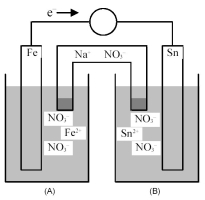 -Identify the anode and cathode,and indicate the direction of Na+ ion and NO3- ion flow from the salt bridge.
 (Multiple Choice)
4.8/5 (80)
(80) A galvanic cell consists of one half-cell that contains Ag(s)and Ag+(aq),and one half-cell that contains Cu(s)and Cu2+(aq).What species are produced at the electrodes under standard conditions?
Ag+(aq)+ e- → Ag(s)E° = +0.80 V
Cu2+(aq)+ 2 e- → Cu(s)E° = +0.34 V
(Multiple Choice)
4.9/5 (81)
(81) 
Filters
- Essay(0)
- Multiple Choice(0)
- Short Answer(0)
- True False(0)
- Matching(0)