



 Chat with AI
Exam 17: Electrochemistry

Exam 1: Chemistry: Matter and Measurement219 Questions
Exam 2: Atoms, molecules, and Ions257 Questions
Exam 3: Formulas, equations, and Moles208 Questions
Exam 4: Reactions in Aqueous Solutions174 Questions
Exam 5: Periodicity and the Atomic Structure of Atoms158 Questions
Exam 6: Ionic Bonds and Some Main-Group Chemistry173 Questions
Exam 7: Covalent Bonds and Molecular Structure232 Questions
Exam 8: Thermochemistry: Chemical Energy163 Questions
Exam 9: Gases: Their Properties and Behavior182 Questions
Exam 10: Liquids,solids,and Phase Changes186 Questions
Exam 11: Solutions and Their Properties192 Questions
Exam 12: Chemical Kinetics206 Questions
Exam 13: Chemical Equilibrium166 Questions
Exam 14: Aqueous Equilibria: Acids and Bases224 Questions
Exam 15: Applications of Aqueous Equilibria190 Questions
Exam 16: Thermodynamics: Entropy, free Energy, and Equilibrium144 Questions
Exam 17: Electrochemistry176 Questions
Exam 18: Hydrogen, oxygen, and Water175 Questions
Exam 19: The Main-Group Elements202 Questions
Exam 20: Transition Elements and Coordination Chemistry185 Questions
Exam 21: Metals and Solid-State Materials149 Questions
Exam 22: Nuclear Chemistry85 Questions
Exam 23: Organic and Biological Chemistry285 Questions
Select questions type


Shown below is a galvanic cell with anode compartment b containing anode a and cathode compartment d containing cathode c.Electrons flow through wire f,ions flow through salt bridge e,and the cell potential is read using voltmeter g.
This galvanic cell uses the reaction: Cu(s)+ 2 Ag+(aq) 2 Ag(s)+ Cu2+(aq).  -If the concentrations of Ag+(aq)and Cu2+(aq)are varied in this galvanic cell,which of the following four cells has the largest cell potential?
 (Multiple Choice)
4.8/5  (82)
(82) What is the relationship between the standard cell potentials,E°,for the following two galvanic cell reactions?
I.3 Cu2+(aq)+ 2 Al(s)→ 3 Cu(s)+ 2 Al3+(aq)
II.6 Cu2+(aq)+ 4 Al(s)→ 6 Cu(s)+ 4 Al3+(aq)
(Multiple Choice)
4.9/5 (79)
(79) Consider the following galvanic cell. 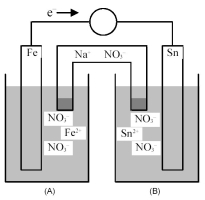 -Identify the anode and cathode,and indicate the direction of ion flow to and from each electrode.
 (Multiple Choice)
4.9/5 (92)
(92) Consider the galvanic cell shown below.  -What is the shorthand notation for the cell?
 (Multiple Choice)
4.8/5 (64)
(64) Which of the following statements concerning the rusting of iron is false?
(Multiple Choice)
4.9/5 (76)
(76) Reduction half-reactions with corresponding standard half-cell potentials are shown below.
Ag+(aq)+ 1 e- → Ag(s)E° = +0.80 V
Zn2+(aq)+ 2 e- → Zn(s)E° = -0.76 V
Al3+(aq)+ 3 e- → Al(s)E° = -1.66 V
Of the species above,the strongest oxidizing agent is ________,and the strongest reducing agent is ________.
(Short Answer)
4.9/5 (63)
(63) 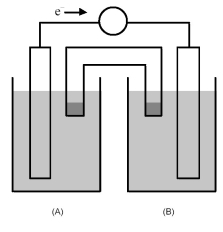 -The cell reaction 2 Fe3+(aq)+ Zn(s)→ Zn2+(aq)+ 2 Fe2+(aq)occurs in the galvanic cell shown above.Where should the Fe3+(aq)and Fe2+(aq)be found?
 (Multiple Choice)
4.8/5 (71)
(71) What is the relation between joules (J),volts (V),and coulombs (C)?
(Multiple Choice)
4.8/5 (73)
(73) What is the shorthand notation that represents the following galvanic cell reaction?
2 Fe2+(aq)+ Cl2(g)→ 2 Fe3+(aq)+ 2 Cl-(aq)
(Multiple Choice)
4.8/5 (72)
(72) Consider the galvanic cell shown below.
-Identify the anode and cathode,and indicate the direction of Na+ ion and NO3- ion flow from the salt bridge.
-Identify the anode and cathode,and indicate the direction of Na+ ion and NO3- ion flow from the salt bridge. (Multiple Choice)
5.0/5 (76)
(76) Using the following standard reduction potentials
Fe3+(aq)+ e- → Fe2+(aq)E° = +0.77 V
Pb2+(aq)+ 2 e- → Pb(s)E° = -0.13 V
Calculate the standard cell potential for the galvanic cell reaction given below,and determine whether or not this reaction is spontaneous under standard conditions.
Pb2+(aq)+ 2 Fe2+(aq)→ 2 Fe3+(aq)+ Pb(s)
(Multiple Choice)
4.7/5 (84)
(84) For the hypothetical reaction 3 A + 2 Bx → 3 Ay + 2 B,E° = 0.85 V and G° = -495 kJ.For this reaction the values of x and y are ________ and ________.
(Short Answer)
4.9/5 (85)
(85) The gas OF2 can be produced from the electrolysis of an aqueous solution of KF,as shown in the equation below.
OF2(g)+ 2 H+(aq)+ 4 e- → H2O(l)+ 2 F-(aq)E° = +2.15 V
Using the given standard reduction potential,calculate the amount of OF2 that is produced,and the electrode at which the OF2 is produced,upon the passage of 0.240 faradays through an aqueous KF solution.
(Multiple Choice)
4.9/5 (78)
(78) Based on the following information,
Cl2(g)+ 2 e- → 2 Cl-(aq)E° = + 1.36 V
Mg2+(aq)+ 2 e- → 2 Mg(s)E° = -2.37 V
Which of the following chemical species is the strongest reducing agent?
(Multiple Choice)
4.8/5 (85)
(85) In the relationship ΔG = -nFE°,what is the value of n for the reaction shown below?
3 Cu2+(aq)+ 2 Al(s)→ 3 Cu(s)+ 2 Al3+(aq)
(Multiple Choice)
4.9/5 (66)
(66) How many grams of chromium metal are plated out when a constant current of 8.00 A is passed through an aqueous solution containing Cr3+ ions for 320.minutes?
(Multiple Choice)
5.0/5 (75)
(75) At 25°C,E° = +1.88 V for a cell based on the reaction
3 AgCl(s)+ Al(s)→ 3 Ag(s)+ Al3+(aq)+ 3 Cl-(aq).
Find the cell potential E if [Al3+] = 0.20 M and [Cl-] = 0.010 M.
(Multiple Choice)
4.9/5 (77)
(77) What is the reduction half-reaction for the following overall cell reaction?
Ni2+(aq)+ 2 Ag(s)→ Ni(s)+ 2 Ag+(aq)
(Multiple Choice)
4.9/5 (67)
(67) 
Filters
- Essay(0)
- Multiple Choice(0)
- Short Answer(0)
- True False(0)
- Matching(0)