



 Chat with AI
Exam 17: Electrochemistry

Exam 1: Chemistry: Matter and Measurement219 Questions
Exam 2: Atoms, molecules, and Ions257 Questions
Exam 3: Formulas, equations, and Moles208 Questions
Exam 4: Reactions in Aqueous Solutions174 Questions
Exam 5: Periodicity and the Atomic Structure of Atoms158 Questions
Exam 6: Ionic Bonds and Some Main-Group Chemistry173 Questions
Exam 7: Covalent Bonds and Molecular Structure232 Questions
Exam 8: Thermochemistry: Chemical Energy163 Questions
Exam 9: Gases: Their Properties and Behavior182 Questions
Exam 10: Liquids,solids,and Phase Changes186 Questions
Exam 11: Solutions and Their Properties192 Questions
Exam 12: Chemical Kinetics206 Questions
Exam 13: Chemical Equilibrium166 Questions
Exam 14: Aqueous Equilibria: Acids and Bases224 Questions
Exam 15: Applications of Aqueous Equilibria190 Questions
Exam 16: Thermodynamics: Entropy, free Energy, and Equilibrium144 Questions
Exam 17: Electrochemistry176 Questions
Exam 18: Hydrogen, oxygen, and Water175 Questions
Exam 19: The Main-Group Elements202 Questions
Exam 20: Transition Elements and Coordination Chemistry185 Questions
Exam 21: Metals and Solid-State Materials149 Questions
Exam 22: Nuclear Chemistry85 Questions
Exam 23: Organic and Biological Chemistry285 Questions
Select questions type


What is the relationship between the standard cell potentials,E°,for the following two galvanic cell reactions?
I.2 Ag+(aq)+ Sn2+(aq)→ Sn4+(aq)+ 2 Ag(s)
II.Ag(s)+ 1/2 Sn4+(aq)→ 1/2 Sn2+(aq)+ Ag+(aq)
(Multiple Choice)
4.7/5  (83)
(83) What is the relation between ΔG° and E° for the cell reaction below?
Ni2+(aq)+ Cd(s)→ Cd2+(aq)+ Ni(s)
(Multiple Choice)
5.0/5 (75)
(75) Shown below is an electrochemical cell with anode a and cathode c.Both the anode and the cathode are inert electrodes.The liquid shown in compartment b of the cell is molten potassium chloride,KCl(l). 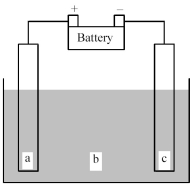 -Determine whether this is a galvanic or an electrolytic cell and give the reaction occurring at the anode and the reaction occurring at the cathode.
 (Multiple Choice)
4.8/5 (90)
(90) A galvanic cell uses the reaction
Mg(s)+ Pb2+(aq)→ Mg2+(aq)+ Pb(s).
Mg(s)→ Mg2+(aq)+ 2 e- is the ________ half-reaction,which occurs at the ________.
(Short Answer)
4.8/5 (71)
(71) Consider the galvanic cell,Pt(s)| H2(1 atm)| H+(1 M)|| Cl-(1 M)| Hg2Cl2(s)| Hg(l).Which one of the following changes to the cell would cause the cell potential to increase (i.e. ,become more positive)?
(Multiple Choice)
4.7/5 (72)
(72) Given that E°red = -0.26 V for Ni2+/Ni at 25°C,find E° and E for the concentration cell expressed using shorthand notation below.
Ni(s)∣ Ni2+(aq,1.0 × 10-5 M)∣∣ Ni2+(aq,0.100 M)∣ Ni(s)
(Multiple Choice)
4.9/5 (86)
(86)  -Using Table 17.1,find E° for 2 H2O(l)→ 2 H2(g)+ O2(g).
For the hypothetical reaction A + Bx → Ax + B,E° = 1.19 V = and ΔG° = -115 kJ.For this reaction the value of x = .
(Multiple Choice)
5.0/5 (81)
(81) Reduction half-reactions with corresponding standard half-cell potentials are shown below.
Zn2+(aq)+ 2 e- → Zn(s)E° = - 0.76 V
Al3+(aq)+ 3 e- → Al(s)E° = - 1.66 V
The standard potential for the galvanic cell that uses these two half-reactions is ________ V.
(Short Answer)
4.9/5 (81)
(81) Consider the galvanic cell shown below. 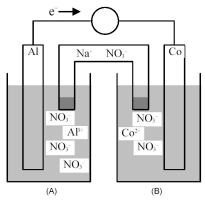 -What is the quantitative change in the cell voltage on increasing the ion concentration in the cathode compartment by a factor of 10?
 (Multiple Choice)
4.9/5 (79)
(79) The standard reduction potential E° = -0.45 V for the half-reaction Fe2+ + 2 e- → Fe.If the measured cell potential at 25°C is 0.35 V,the pH in the anode compartment of the following cell is ________.
Pt(s)|H2(1 atm)|H+(? M)||Fe2+(1 M)|Fe(s)
(Short Answer)
4.9/5 (87)
(87) Consider the following galvanic cell. 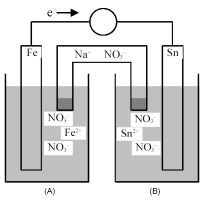 -What is the quantitative change in the cell voltage on increasing the ion concentration in the anode compartment by a factor of 10?
 (Multiple Choice)
4.8/5 (81)
(81) Consider the half-reaction: MnO4- (aq)+ 8 H+ (aq)+ 5 e- → Mn2+ (aq)+ 4 H2O(l).The formation of MnO4- from Mn2+ occurs most readily when the solution is
(Multiple Choice)
4.8/5 (77)
(77) How long must a constant current of 50.0 A be passed through an electrolytic cell containing aqueous Cu2+ ions to produce 3.00 moles of copper metal?
(Multiple Choice)
4.7/5 (79)
(79) The iron content of foods can be determined by dissolving them in acid (forming Fe3+),reducing the iron(III)to iron(II),and titrating with cerium(IV):
Fe2+(aq)+ Ce4+(aq)→ Fe3+(aq)+ Ce3+(aq).
Identify the two half-reactions in the above reaction.
(Multiple Choice)
4.9/5 (60)
(60) Which of the following reactions is most suitable for a fuel cell?
(Multiple Choice)
4.8/5 (79)
(79) The Hall-Heroult process for the production of aluminum involves the electrolysis of
(Multiple Choice)
5.0/5 (90)
(90) 
Filters
- Essay(0)
- Multiple Choice(0)
- Short Answer(0)
- True False(0)
- Matching(0)