



 Chat with AI
Exam 11: Solutions and Their Properties

Exam 1: Chemistry: Matter and Measurement219 Questions
Exam 2: Atoms, molecules, and Ions257 Questions
Exam 3: Formulas, equations, and Moles208 Questions
Exam 4: Reactions in Aqueous Solutions174 Questions
Exam 5: Periodicity and the Atomic Structure of Atoms158 Questions
Exam 6: Ionic Bonds and Some Main-Group Chemistry173 Questions
Exam 7: Covalent Bonds and Molecular Structure232 Questions
Exam 8: Thermochemistry: Chemical Energy163 Questions
Exam 9: Gases: Their Properties and Behavior182 Questions
Exam 10: Liquids,solids,and Phase Changes186 Questions
Exam 11: Solutions and Their Properties192 Questions
Exam 12: Chemical Kinetics206 Questions
Exam 13: Chemical Equilibrium166 Questions
Exam 14: Aqueous Equilibria: Acids and Bases224 Questions
Exam 15: Applications of Aqueous Equilibria190 Questions
Exam 16: Thermodynamics: Entropy, free Energy, and Equilibrium144 Questions
Exam 17: Electrochemistry176 Questions
Exam 18: Hydrogen, oxygen, and Water175 Questions
Exam 19: The Main-Group Elements202 Questions
Exam 20: Transition Elements and Coordination Chemistry185 Questions
Exam 21: Metals and Solid-State Materials149 Questions
Exam 22: Nuclear Chemistry85 Questions
Exam 23: Organic and Biological Chemistry285 Questions
Select questions type


How many grams of KBr are required to make 650.mL of a 0.115 M KBr solution?
(Multiple Choice)
4.7/5  (82)
(82) In general,as the temperature increases,the solubility of gases in water ________ and the solubility of most solids in water ________.
(Multiple Choice)
4.8/5 (90)
(90) If one mole of each is dissolved in 1.00 L of water,which will lower the vapor pressure the most?
(Multiple Choice)
4.9/5 (72)
(72) The boiling point of a solution containing a nonvolatile solute will be ________ than the boiling point of the pure solvent,whereas the boiling point of a solution of two volatile liquids will be ________ than the boiling point of the more volatile liquid and ________ than the boiling point of the less volatile liquid.
(Short Answer)
4.9/5 (78)
(78) A KCl solution is prepared by dissolving 40.0 g KCl in 250.0 g of water at 25°C.What is the vapor pressure of the solution if the vapor pressure of water at 25°C is 23.76 mm Hg?
(Multiple Choice)
4.7/5 (81)
(81) An aqueous solution has a normal boiling point of 10 3.0°C.What is the freezing point of this solution? For water Kb = 0.51°C /m and Kf = 1.86°C /m.
(Multiple Choice)
4.9/5 (77)
(77) Arrows in the energy diagram below represent enthalpy changes occurring in the exothermic formation of a solution:
ΔHsoln = enthalpy of solution
ΔHsolute-solute = enthalpy change involving solute-solute interactions
ΔHsolute-solvent = enthalpy change involving solute-solvent interactions
ΔHsolvent-solvent = enthalpy change involving solvent-solvent interactions 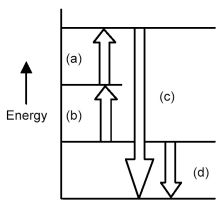 -Which arrow represents ΔHsoln?
 (Multiple Choice)
5.0/5 (79)
(79) Most gases become less soluble in water as the temperature increases.What can be concluded about the signs of ΔHsoln and ΔSsoln in this case?
(Multiple Choice)
4.9/5 (79)
(79) When a particular solid begins to dissolve in water,the temperature rises dramatically.For the dissolving of this solid in pure water
(Multiple Choice)
4.8/5 (86)
(86)  -Which drawing above represents the system with the second highest entropy?
 (Multiple Choice)
4.7/5 (78)
(78) The change in the Gibbs free energy for dissolving more solute in a supersaturated solution is
(Multiple Choice)
4.8/5 (77)
(77) Arrows in the energy diagram below represent enthalpy changes occurring in the exothermic formation of a solution:
ΔHsoln = enthalpy of solution
ΔHsolute-solute = enthalpy change involving solute-solute interactions
ΔHsolute-solvent = enthalpy change involving solute-solvent interactions
ΔHsolvent-solvent = enthalpy change involving solvent-solvent interactions
-Which arrow represents ΔHsolute-solvent?
-Which arrow represents ΔHsolute-solvent? (Multiple Choice)
4.9/5 (91)
(91) In the process of dissolving ionic compounds,the cations and anions are separated from the crystal lattice and surrounded by an ordered shell of solvent molecules.If the solvent is water,the dissolved ions are said to be
(Multiple Choice)
4.8/5 (73)
(73) A solution of LiCl in water is 18.0 wt% LiCl.What is the mole fraction of LiCl?
(Multiple Choice)
4.9/5 (86)
(86) Which concentration becomes smaller as the temperature is increased from 20°C to 80°C?
(Multiple Choice)
4.9/5 (70)
(70) What is the molality of a glucose solution prepared by dissolving 18.0 g of glucose,C6H12O6,in 125.9 g of water?
(Multiple Choice)
4.8/5 (82)
(82) What are the major solute-solvent interactions created when HOCH2CH2OH dissolves in water?
(Multiple Choice)
4.7/5 (85)
(85) The normal boiling point of pure benzene is found to be 80.10°C.What is the approximate molecular weight of a nonionizing substance if a solution of 3.55 g of the substance dissolved in 100.g of benzene has a normal boiling point of 80.19°C? Kb = 5.12°C/m for benzene,C6H6.
(Multiple Choice)
4.9/5 (78)
(78) To make a 2.0 M solution,one could take 2.00 moles of solute and add
(Multiple Choice)
4.8/5 (78)
(78) The osmotic pressure of a 100-mL solution containing 1.0 g of sucrose,C12H22O11 will be ________ (equal to,greater than,less than)the osmotic pressure of a 100-mL solution containing 1.0 g of fructose,C6H12O6.
(Short Answer)
4.8/5 (94)
(94) 
Filters
- Essay(0)
- Multiple Choice(0)
- Short Answer(0)
- True False(0)
- Matching(0)