



 Chat with AI
Exam 3: Stoichiometry

Exam 1: Introduction153 Questions
Exam 2: Atoms, Molecules, and Ions141 Questions
Exam 3: Stoichiometry168 Questions
Exam 4: Reactions in Aqueous Solution156 Questions
Exam 5: Gases109 Questions
Exam 6: Energy Relationships in Chemical Reactions105 Questions
Exam 7: The Electronic Structure of Atoms115 Questions
Exam 8: The Periodic Table119 Questions
Exam 9: Chemical Bonding I: the Covalent Bond118 Questions
Exam 10: Chemical Bonding Ii: Molecular Geometry and Hybridization of Atomic Orbitals120 Questions
Exam 11: Introduction to Organic Chemistry57 Questions
Exam 12: Intermolecular Forces and Liquids and Solids138 Questions
Exam 13: Physical Properties of Solutions109 Questions
Exam 14: Chemical Kinetics114 Questions
Exam 15: Chemical Equilibrium99 Questions
Exam 16: Acids and Bases163 Questions
Exam 17: Acid-Base Equilibria and Solubility Equilibria92 Questions
Exam 18: Thermodynamics112 Questions
Exam 19: Redox Reactions and Electrochemistry138 Questions
Exam 20: The Chemistry of Coordination Compounds76 Questions
Exam 21: Nuclear Chemistry112 Questions
Exam 22: Organic Polymerssynthetic and Natural42 Questions
Select questions type


Ammonium nitrate decomposes to give dinitrogen monoxide and water as shown in the following reaction:
NH4NO3 N2O + 2H2O
If a 108 g sample of NH4NO3 decomposes to give 23 g of N2O(g), what percent of the original sample remains?
(Short Answer)
4.7/5  (86)
(86) Liquid heptane, C7H16, burns in oxygen gas to yield carbon dioxide and water. What is the minimum mass of oxygen required for the complete reaction of 25.5 mL of heptane? (density of heptane = 0.6838 g/mL)
(Multiple Choice)
4.9/5 (87)
(87) A compound with a percent composition by mass of 87.5% N and 12.5% H was recently discovered. What is the empirical formula for this compound?
(Short Answer)
5.0/5 (63)
(63) An average atom of uranium (U)is approximately how many times heavier than an atom of potassium?
(Multiple Choice)
4.9/5 (74)
(74) Liquid heptane, C7H16, burns in oxygen gas to yield carbon dioxide and water. What mass of water is produced when 15.0 mL of heptane burns completely? (density of heptane = 0.6838 g/mL)
(Multiple Choice)
4.7/5 (78)
(78) A 0.8715 g sample of sorbic acid, a compound first obtained from the berries of a certain ash tree, is burned completely in oxygen to give 2.053 g of carbon dioxide and 0.5601 g of water. The empirical formula of sorbic acid is
(Multiple Choice)
4.7/5 (76)
(76) Oxidation of a hydrocarbon gave a product composed of carbon, hydrogen, and oxygen. The product that was purified and sent off for elemental analysis giving the following mass percents: 68.85% C and 4.95% H. Determine the empirical formula of this compound.
(Short Answer)
4.9/5 (77)
(77) Calculate the percent composition by mass of oxygen in Na2CO3.
(Short Answer)
5.0/5 (81)
(81) Ammonia reacts with diatomic oxygen to form nitric oxide and water vapor: 4NH3 + 5O2 4NO + 6H2O
What is the theoretical yield of water, in moles, when 40.0 g NH3 and 50.0 g O2 are mixed and allowed to react?
(Multiple Choice)
5.0/5 (89)
(89) What is the coefficient of H2SO4 when the following equation is properly balanced with the smallest set of whole numbers?
___ Ca3(PO4)2 + ___ H2SO4 ___ CaSO4 + ___ H3PO4
(Multiple Choice)
5.0/5 (83)
(83) Nickel has a lower atomic mass than cobalt, even though it has a higher atomic number. One possible explanation is that one of the average atomic masses was miscalculated. In the case of cobalt, there is only one isotope: 100% 59Co at a mass of 58.9332 amu. For nickel, however, there are five isotopes as given in the table. 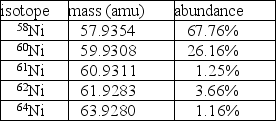 A. Using the data in the table, calculate the average atomic mass for nickel.
B. Is the atomic mass for nickel in your periodic table correct?
C. Regardless of your answer to part B, how else could you explain the observation that the atomic mass of nickel is less than the mass of cobalt, even though it has the higher atomic number?
A. Using the data in the table, calculate the average atomic mass for nickel.
B. Is the atomic mass for nickel in your periodic table correct?
C. Regardless of your answer to part B, how else could you explain the observation that the atomic mass of nickel is less than the mass of cobalt, even though it has the higher atomic number? (Essay)
4.9/5 (90)
(90) How many grams of Cr can be produced by the reaction of 44.1 g of Cr2O3 with 35.0 g of Al according to the following chemical reaction?
2Al + Cr2O3 Al2O3 + 2Cr
(Multiple Choice)
4.8/5 (82)
(82) Ammonia reacts with diatomic oxygen to form nitric oxide and water vapor: 4NH3 + 5O2 4NO + 6H2O
When 40.0 g NH3 and 50.0 g O2 are allowed to react, which is the limiting reagent?
(Multiple Choice)
4.9/5 (83)
(83) Calculate the number of moles of cesium in 50.0 g of cesium.
(Multiple Choice)
4.8/5 (90)
(90) 
Filters
- Essay(0)
- Multiple Choice(0)
- Short Answer(0)
- True False(0)
- Matching(0)