



 Chat with AI
Exam 2: Atoms Molecules and Ions

Exam 1: Chemistry: The Study of Change175 Questions
Exam 2: Atoms Molecules and Ions156 Questions
Exam 3: Mass Relationships in Chemical Reactions194 Questions
Exam 4: Reactions in Aqueous Solutions192 Questions
Exam 5: Gases130 Questions
Exam 6: Thermochemistry119 Questions
Exam 7: Quantum Theory and the Electronic Structure of Atoms135 Questions
Exam 8: Periodic Relationships Among the Elements144 Questions
Exam 9: Chemical Bonding I: Basic Concepts136 Questions
Exam 10: Chemical Bonding II: Molecular Geometry and Hybridization of Atomic146 Questions
Exam 11: Intermolecular Forces and Liquids and Solids149 Questions
Exam 12: Physical Properties of Solutions122 Questions
Exam 13: Chemical Kinetics131 Questions
Exam 14: Chemical Equilibrium119 Questions
Exam 15: Acids and Bases178 Questions
Exam 16: Acid-Base Equilibria and Solubility Equilibria145 Questions
Exam 17: Entropy Free Energy and Equilibrium128 Questions
Exam 18: Electrochemistry154 Questions
Exam 19: Nuclear Chemistry128 Questions
Exam 20: Chemistry in the Atmosphere50 Questions
Exam 21: Metallurgy and the Chemistry of Metals63 Questions
Exam 22: Nonmetallic Elements and Their Compounds52 Questions
Exam 23: Transition Metals Chemistry and Coordination Compounds92 Questions
Exam 24: Organic Chemistry66 Questions
Exam 25: Synthetic and Natural Organic Polymers46 Questions
Select questions type


An allotrope is one of the two or more distinct forms of an element.
(True/False)
4.7/5  (70)
(70) The following compound, CuCO3, can be named copper (II) carbonate. What is another acceptable name for the compound
(Multiple Choice)
4.8/5 (71)
(71) When a beam of alpha particles passes between two electrically charged plates, the beam is deflected toward the positive plate.
(True/False)
4.9/5 (78)
(78) The following binary compound, Fe2O3, can be named Iron (III) oxide. What is another acceptable name for the compound
(Multiple Choice)
4.9/5 (80)
(80) Which one of the following elements is most likely to form a 2+ ion
(Multiple Choice)
4.8/5 (88)
(88) Use the following to answer questions
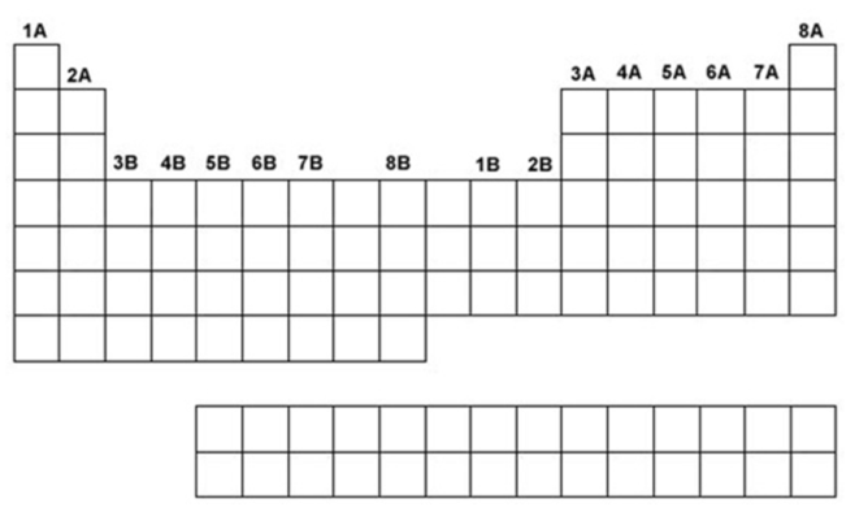 -Use the periodic table above to locate where the noble gases are located.
 (Multiple Choice)
4.9/5 (74)
(74) Use the following to answer questions
-Use the periodic table above to locate where the halogen elements are located.
-Use the periodic table above to locate where the halogen elements are located. (Multiple Choice)
4.7/5 (74)
(74) 
Filters
- Essay(0)
- Multiple Choice(0)
- Short Answer(0)
- True False(0)
- Matching(0)