



 Chat with AI
Exam 7: Utility Maximization

Exam 1: Limits, Alternatives, and Choices398 Questions
Exam 2: The Market System and the Circular Flow252 Questions
Exam 3: Demand, Supply, and Market Equilibrium339 Questions
Exam 4: Market Failures: Public Goods and Externalities235 Questions
Exam 5: Governments Role and Government Failure275 Questions
Exam 6: Elasticity255 Questions
Exam 7: Utility Maximization256 Questions
Exam 8: Behavioral Economics274 Questions
Exam 9: Businesses and the Costs of Production307 Questions
Exam 10: Pure Competition in the Short Run167 Questions
Exam 11: Pure Competition in the Long Run182 Questions
Exam 12: Pure Monopoly224 Questions
Exam 13: Monopolistic Competition194 Questions
Exam 14: Oligopoly and Strategic Behavior265 Questions
Exam 15: Technology, Rd, and Efficiency231 Questions
Exam 16: The Demand for Resources244 Questions
Exam 17: Wage Determination308 Questions
Exam 18: Rent, Interest, and Profit210 Questions
Exam 19: Natural Resource and Energy Economics290 Questions
Exam 20: Public Finance: Expenditures and Taxes232 Questions
Exam 21: Antitrust Policy and Regulation237 Questions
Exam 22: Agriculture: Economics and Policy217 Questions
Exam 23: Income Inequality, Poverty, and Discrimination272 Questions
Exam 24: Health Care240 Questions
Exam 25: Immigration197 Questions
Exam 26: International Trade241 Questions
Exam 27: The Balance of Payments, Exchange Rates, and Trade Deficits252 Questions
Exam 28: The Economics of Developing Countries249 Questions
Select questions type


If the total utility from consuming the fifth unit of a product is 6 and the total utility from all five units is 162, then the total utility from consuming four units must be
(Multiple Choice)
4.9/5  (80)
(80) Many people do not steal or commit fraud because to them, the resulting feelings of guilt and uneasiness make the
(Multiple Choice)
4.9/5 (87)
(87) Answer the question on the basis of the following marginal utility data for products X and Y. Assume that the prices of X and Y are $4 and $2, respectively, and that the consumer's income is $18.  What level of total utility will the utility-maximizing consumer realize?
 (Multiple Choice)
4.8/5 (68)
(68) Refer to the diagram. The marginal utility of the third unit of X is 
(Multiple Choice)
4.9/5 (70)
(70) Which of the following has been a significant factor in the ability of iPads to compete effectively against laptop and desktop computers?
(Multiple Choice)
4.9/5 (85)
(85) A consumer's demand curve for a product is downsloping because
(Multiple Choice)
4.8/5 (78)
(78) A child is given $4 of pocket money to be spent on either hard candies or chocolates. Chocolates cost 40 cents and hard candies 80 cents each. The marginal utilities derived from each product are as shown in the following table. 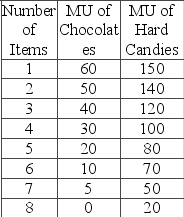 If the child buys either chocolates or hard candies one piece at a time, what will be his first two purchases?
 (Multiple Choice)
4.8/5 (73)
(73) With diminishing marginal utility, if a consumer reduces her consumption of a good, then her marginal utility from that good would increase.
(True/False)
4.8/5 (79)
(79) Assume that a consumer purchases a combination of products Y and Z and that the MUy/Py = 30/2 and MUz/Pz = 45/3. To maximize utility, without spending more money, the consumer should
(Multiple Choice)
4.8/5 (83)
(83) A consumer is making purchases of products Alpha and Beta such that the marginal utility of product Alpha is 30 and the marginal utility of product Beta is 40. The price of product Alpha is $5, and the price of product Beta is $10. The utility-maximizing rule suggests that, to stay within a given budget constraint, this consumer should
(Multiple Choice)
4.9/5 (82)
(82) Indifference curves are convex to the origin due to diminishing marginal rates of substitution.
(True/False)
5.0/5 (76)
(76) With a fixed money income, an increase in the price of one good and a decrease in the price of the other will cause the new budget line to intersect the original budget line.
(True/False)
4.9/5 (81)
(81) Answer the question based on the table below showing the marginal utility schedules for product X and product Y for a hypothetical consumer. The price of product X is $4, and the price of product Y is $2. The income of the consumer is $30.
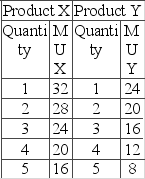 What would be the utility-maximizing combination of products X and Y that could be purchased with $30?
 (Multiple Choice)
4.9/5 (75)
(75) Prashanth decides to buy a $75 ticket to a particular New York professional hockey game rather than a $50 ticket for a particular Broadway play. We can conclude that Prashanth
(Multiple Choice)
4.9/5 (80)
(80) 
Filters
- Essay(0)
- Multiple Choice(0)
- Short Answer(0)
- True False(0)
- Matching(0)