



 Chat with AI
Exam 7: Utility Maximization

Exam 1: Limits, Alternatives, and Choices398 Questions
Exam 2: The Market System and the Circular Flow252 Questions
Exam 3: Demand, Supply, and Market Equilibrium339 Questions
Exam 4: Market Failures: Public Goods and Externalities235 Questions
Exam 5: Governments Role and Government Failure275 Questions
Exam 6: Elasticity255 Questions
Exam 7: Utility Maximization256 Questions
Exam 8: Behavioral Economics274 Questions
Exam 9: Businesses and the Costs of Production307 Questions
Exam 10: Pure Competition in the Short Run167 Questions
Exam 11: Pure Competition in the Long Run182 Questions
Exam 12: Pure Monopoly224 Questions
Exam 13: Monopolistic Competition194 Questions
Exam 14: Oligopoly and Strategic Behavior265 Questions
Exam 15: Technology, Rd, and Efficiency231 Questions
Exam 16: The Demand for Resources244 Questions
Exam 17: Wage Determination308 Questions
Exam 18: Rent, Interest, and Profit210 Questions
Exam 19: Natural Resource and Energy Economics290 Questions
Exam 20: Public Finance: Expenditures and Taxes232 Questions
Exam 21: Antitrust Policy and Regulation237 Questions
Exam 22: Agriculture: Economics and Policy217 Questions
Exam 23: Income Inequality, Poverty, and Discrimination272 Questions
Exam 24: Health Care240 Questions
Exam 25: Immigration197 Questions
Exam 26: International Trade241 Questions
Exam 27: The Balance of Payments, Exchange Rates, and Trade Deficits252 Questions
Exam 28: The Economics of Developing Countries249 Questions
Select questions type


If the quantity of X is measured on the horizontal axis and the quantity of Y on the vertical, then the slope of the budget line is equal to the price of X divided by the price of Y.
(True/False)
4.8/5  (78)
(78) The first Pepsi yields Craig 18 units of utility and the second yields him an additional 12 units of utility. His total utility from three Pepsis is 38 units of utility. The marginal utility of the third Pepsi is
(Multiple Choice)
4.9/5 (80)
(80) Suppose that football tickets at your university are given away for free and that there are still empty seats for all games. Ignoring all other costs of going to the games, you should continue attending until your
(Multiple Choice)
4.8/5 (69)
(69) Betty is maximizing her satisfaction from spending her budget on two items, movie rentals and music downloads. If her marginal utility from the last movie rental is twice that from the last music download, what is the price of a movie rental if the price of a music download is $0.80?
(Multiple Choice)
4.7/5 (85)
(85) If a consumer has an income of $200, the price of X is $5, and the price of Y is $10, what is the maximum quantity of X the consumer is able to purchase?
(Multiple Choice)
4.9/5 (78)
(78) Which of the following best expresses the law of diminishing marginal utility?
(Multiple Choice)
5.0/5 (80)
(80) Sharon purchases two products with a given fixed budget, orange juice and soda. Her marginal utility from orange juice is 60, and her marginal utility from soda is 30. The price of a bottle of orange juice is $2.00, and the price of soda is $1.00. These data suggest that
(Multiple Choice)
4.8/5 (83)
(83) When the price of a product falls, the income effect induces the consumer to purchase more of it, while the substitution effect prompts her to buy less.
(True/False)
4.7/5 (78)
(78) Refer to the diagram, in which the downsloping lines are budget lines and I1, I2, and I3 comprise an indifference map. The combinations of products M and N indicated by points 1, 2, and 5 are such that 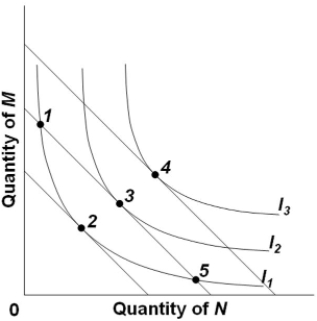
(Multiple Choice)
5.0/5 (75)
(75) A consumer has two basic choices in making a trip: rent a car for $30.00 a day and spend two days of travel to the destination, or spend $400 for an airplane ticket and fly to the destination in two hours. The marginal utilities of the car rental and the airline ticket are the same. The consumer values time at $5 an hour. The rational consumer will most likely
(Multiple Choice)
4.9/5 (74)
(74) Indifference curves and budget lines can be used to derive an individual's demand curve for a product.
(True/False)
5.0/5 (75)
(75) Suppose you have money income of $10, all of which you spend on Coke and popcorn. In the diagram, the prices of Coke and popcorn, respectively, are 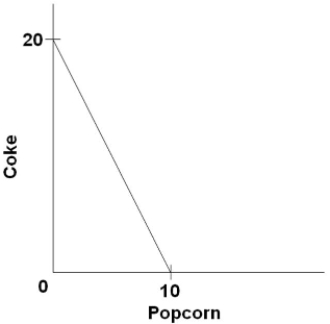
(Multiple Choice)
4.8/5 (87)
(87) After eating four slices of pizza, you are offered a fifth slice for free. You turn down the fifth slice. Your refusal indicates that the
(Multiple Choice)
4.9/5 (73)
(73) The table shows the marginal-utility schedules for goods A and B for a hypothetical consumer. The price of good A is $1, and the price of good B is $2. The income of the consumer is $8. 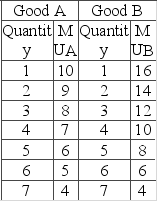 If the consumer spends the given budget and gets maximum utility out of it, then she is receiving how much satisfaction from each dollar spent on the final unit of good A consumed?
 (Multiple Choice)
4.7/5 (84)
(84) Noncash gift-giving involves value loss when the marginal utility of the gift to the receiver is less than the product price.
(True/False)
4.8/5 (93)
(93) A consumer allocates all income between two products, A and B. If, on an indifference map, the equilibrium position shifts onto a higher indifference curve, then
(Multiple Choice)
4.8/5 (83)
(83) 
Filters
- Essay(0)
- Multiple Choice(0)
- Short Answer(0)
- True False(0)
- Matching(0)