



 Chat with AI
Exam 7: Utility Maximization

Exam 1: Limits, Alternatives, and Choices398 Questions
Exam 2: The Market System and the Circular Flow252 Questions
Exam 3: Demand, Supply, and Market Equilibrium339 Questions
Exam 4: Market Failures: Public Goods and Externalities235 Questions
Exam 5: Governments Role and Government Failure275 Questions
Exam 6: Elasticity255 Questions
Exam 7: Utility Maximization256 Questions
Exam 8: Behavioral Economics274 Questions
Exam 9: Businesses and the Costs of Production307 Questions
Exam 10: Pure Competition in the Short Run167 Questions
Exam 11: Pure Competition in the Long Run182 Questions
Exam 12: Pure Monopoly224 Questions
Exam 13: Monopolistic Competition194 Questions
Exam 14: Oligopoly and Strategic Behavior265 Questions
Exam 15: Technology, Rd, and Efficiency231 Questions
Exam 16: The Demand for Resources244 Questions
Exam 17: Wage Determination308 Questions
Exam 18: Rent, Interest, and Profit210 Questions
Exam 19: Natural Resource and Energy Economics290 Questions
Exam 20: Public Finance: Expenditures and Taxes232 Questions
Exam 21: Antitrust Policy and Regulation237 Questions
Exam 22: Agriculture: Economics and Policy217 Questions
Exam 23: Income Inequality, Poverty, and Discrimination272 Questions
Exam 24: Health Care240 Questions
Exam 25: Immigration197 Questions
Exam 26: International Trade241 Questions
Exam 27: The Balance of Payments, Exchange Rates, and Trade Deficits252 Questions
Exam 28: The Economics of Developing Countries249 Questions
Select questions type


Suppose you have a limited money income and you are purchasing products A and B, whose prices happen to be the same. To maximize your utility, you should purchase A and B in such amounts that
(Multiple Choice)
4.9/5  (90)
(90) You can drive from Kansas City to St. Louis in five hours. You can fly between the cities in two hours. The price of an airline ticket is $150. The cost of driving between the cities is $50. About what hourly wage would make the "full" cost of driving equal the "full" cost of flying, where "full" cost includes the value of time?
(Multiple Choice)
4.8/5 (78)
(78) Marginal utility is total utility divided by the number of units consumed.
(True/False)
4.9/5 (77)
(77) Answer the question on the basis of the following marginal utility data for products X and Y. Assume that the prices of X and Y are $4 and $2, respectively, and that the consumer's income is $18.  If the price of X decreases to $2, then the utility-maximizing combination of the two products is
 (Multiple Choice)
4.8/5 (84)
(84) 
A leftward shift of a consumer's budget line to a position parallel with the original one could indicate that the
(Multiple Choice)
4.8/5 (70)
(70) The table below shows the utility schedule for a consumer of candy bars. 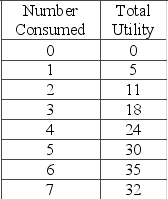 This consumer begins to experience diminishing marginal utility when consuming the
 (Multiple Choice)
4.9/5 (79)
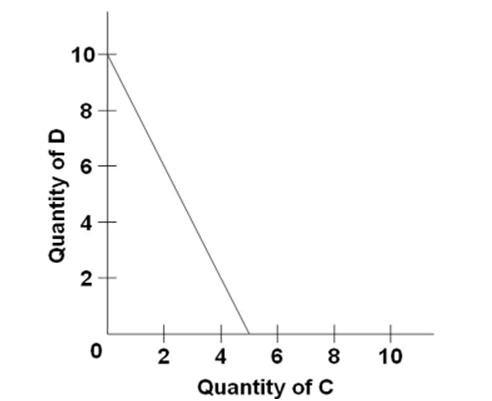
(79) Refer to the budget line shown in the diagram. The absolute value of the slope of the budget line is
(Multiple Choice)
4.8/5 (67)
(67) If consumption of a good is subsidized by the government, then the MU/P of that good among consumers will
(Multiple Choice)
4.9/5 (77)
(77) When a consumer has maximized total utility, he or she cannot increase total utility by reallocating expenditures among different products.
(True/False)
4.7/5 (88)
(88) Each point on a single indifference curve reflects the same level of total utility for a consumer.
(True/False)
4.9/5 (76)
(76) Refer to the budget line shown in the diagram. Given the same money income, reductions in the prices of both products C and D will 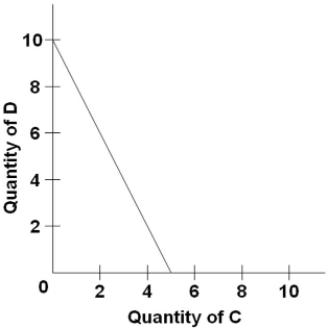
(Multiple Choice)
4.9/5 (87)
(87) (Consider This) When the federal government started requiring restaurants to print calorie counts next to menu items, some people increased their consumption of higher-calorie items. Whichof the following best explains this phenomenon?
(Multiple Choice)
4.7/5 (87)
(87) The table shows the utility schedule for a consumer of candy bars. 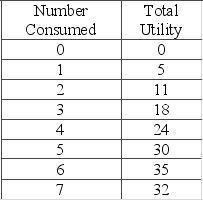 Based on the data in the table, you can conclude that the
 (Multiple Choice)
5.0/5 (90)
(90) When a consumer shifts purchases from X to Y, the marginal utility of X falls and the marginal utility of Y rises.
(True/False)
4.8/5 (87)
(87) Mrs. Arnold is spending all her money income by buying bottles of soda and bags of pretzels in such amounts that the marginal utility of the last bottle is 60 utils and the marginal utility of the last bag is 30 utils. The prices of soda and pretzels are $0.60 per bottle and $0.40 per bag, respectively. It can be concluded that
(Multiple Choice)
4.9/5 (90)
(90) 
Filters
- Essay(0)
- Multiple Choice(0)
- Short Answer(0)
- True False(0)
- Matching(0)