



 Chat with AI
Exam 14: Oligopoly and Strategic Behavior

Exam 1: Limits, Alternatives, and Choices398 Questions
Exam 2: The Market System and the Circular Flow252 Questions
Exam 3: Demand, Supply, and Market Equilibrium339 Questions
Exam 4: Market Failures: Public Goods and Externalities235 Questions
Exam 5: Governments Role and Government Failure275 Questions
Exam 6: Elasticity255 Questions
Exam 7: Utility Maximization256 Questions
Exam 8: Behavioral Economics274 Questions
Exam 9: Businesses and the Costs of Production307 Questions
Exam 10: Pure Competition in the Short Run167 Questions
Exam 11: Pure Competition in the Long Run182 Questions
Exam 12: Pure Monopoly224 Questions
Exam 13: Monopolistic Competition194 Questions
Exam 14: Oligopoly and Strategic Behavior265 Questions
Exam 15: Technology, Rd, and Efficiency231 Questions
Exam 16: The Demand for Resources244 Questions
Exam 17: Wage Determination308 Questions
Exam 18: Rent, Interest, and Profit210 Questions
Exam 19: Natural Resource and Energy Economics290 Questions
Exam 20: Public Finance: Expenditures and Taxes232 Questions
Exam 21: Antitrust Policy and Regulation237 Questions
Exam 22: Agriculture: Economics and Policy217 Questions
Exam 23: Income Inequality, Poverty, and Discrimination272 Questions
Exam 24: Health Care240 Questions
Exam 25: Immigration197 Questions
Exam 26: International Trade241 Questions
Exam 27: The Balance of Payments, Exchange Rates, and Trade Deficits252 Questions
Exam 28: The Economics of Developing Countries249 Questions
Select questions type


Which one of the following is not illustrated by the so-called Prisoner's Dilemma?

Free
(Multiple Choice)
4.9/5  (83)
(83) Correct Answer: Verified
B
A strategy that is better than any alternative strategy-regardless of what the other firm does-is called a
Free
(Multiple Choice)
4.9/5 (84)
(84) Correct Answer:Verified
VerifiedA
If oligopolistic firms facing similar cost and demand conditions successfully collude, price and output results in this industry will be most accurately predicted by which of the following models?
Free
(Multiple Choice)
4.7/5 (74)
(74) Correct Answer:Verified
VerifiedC
Unlike a monopoly, an oligopoly tends to achieve allocative efficiency due to the rivalry among several firms.
(True/False)
4.8/5 (61)
(61) An industry having a four-firm concentration ratio of 85 percent
(Multiple Choice)
5.0/5 (70)
(70) One major problem with four-firm concentration ratios is that they fail to take into account
(Multiple Choice)
4.7/5 (71)
(71) As a general rule, oligopoly exists when the four-firm concentration ratio
(Multiple Choice)
4.9/5 (80)
(80) In game theory, a credible threat of coercion by a dominant firm tends to
(Multiple Choice)
4.8/5 (87)
(87) The likelihood of a cartel being successful is greater when
(Multiple Choice)
4.8/5 (70)
(70) Aluminum competes with copper in the market for power transmission lines. This illustrates
(Multiple Choice)
4.9/5 (80)
(80) (Consider This) The story about three sellers of Native American arts and crafts best illustrates the idea of
(Multiple Choice)
4.8/5 (78)
(78) When oligopolists collude, they collectively tend to achieve similar results as a monopolist.
(True/False)
4.7/5 (85)
(85) A sequential game can be modeled in two forms: payoff-matrix form and game-tree form.
(True/False)
4.9/5 (90)
(90) In game theory, credible threats can be used to maintain collusive agreements between firms.
(True/False)
4.9/5 (75)
(75) A natural monopoly's preemption of entry by other firms by exploiting its economies of scale is an example of
(Multiple Choice)
4.8/5 (90)
(90) Suppose that currently there are no airlines serving the city of South Podunk. Both Accommodating Airlines and Friendly Flyers are looking to enter that market. (They are the only two.) The figure shows in extensive form the possible outcomes of the two firms' decisions. The payoffs represent, in thousands per month, the profit (or loss) the firm will realize from its decision. Assuming the two firms have perfect information about this game, what can we conclude about the existence of a Nash equilibrium? 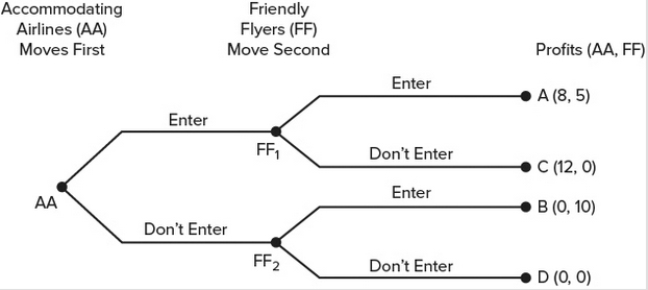
(Multiple Choice)
4.9/5 (67)
(67) A player is said to have a dominant strategy when one of the options available is superior, regardless of what strategy the other player chooses.
(True/False)
4.9/5 (60)
(60) Negative-sum games do not exist, because neither player has an incentive to play the game.
(True/False)
4.8/5 (82)
(82) 
Filters
- Essay(0)
- Multiple Choice(0)
- Short Answer(0)
- True False(0)
- Matching(0)