



 Chat with AI
Exam 14: Oligopoly and Strategic Behavior

Exam 1: Limits, Alternatives, and Choices398 Questions
Exam 2: The Market System and the Circular Flow252 Questions
Exam 3: Demand, Supply, and Market Equilibrium339 Questions
Exam 4: Market Failures: Public Goods and Externalities235 Questions
Exam 5: Governments Role and Government Failure275 Questions
Exam 6: Elasticity255 Questions
Exam 7: Utility Maximization256 Questions
Exam 8: Behavioral Economics274 Questions
Exam 9: Businesses and the Costs of Production307 Questions
Exam 10: Pure Competition in the Short Run167 Questions
Exam 11: Pure Competition in the Long Run182 Questions
Exam 12: Pure Monopoly224 Questions
Exam 13: Monopolistic Competition194 Questions
Exam 14: Oligopoly and Strategic Behavior265 Questions
Exam 15: Technology, Rd, and Efficiency231 Questions
Exam 16: The Demand for Resources244 Questions
Exam 17: Wage Determination308 Questions
Exam 18: Rent, Interest, and Profit210 Questions
Exam 19: Natural Resource and Energy Economics290 Questions
Exam 20: Public Finance: Expenditures and Taxes232 Questions
Exam 21: Antitrust Policy and Regulation237 Questions
Exam 22: Agriculture: Economics and Policy217 Questions
Exam 23: Income Inequality, Poverty, and Discrimination272 Questions
Exam 24: Health Care240 Questions
Exam 25: Immigration197 Questions
Exam 26: International Trade241 Questions
Exam 27: The Balance of Payments, Exchange Rates, and Trade Deficits252 Questions
Exam 28: The Economics of Developing Countries249 Questions
Select questions type


Suppose an oligopolistic producer assumes its rivals will ignore a price increase but match a price cut. In this case the firm perceives its
(Multiple Choice)
4.9/5  (78)
(78) Suppose that currently there are no airlines serving the city of South Podunk. Both Accommodating Airlines and Friendly Flyers are looking to enter that market. (They are the only two.) The figure shows in extensive form the possible outcomes of the two firms' decisions. The payoffs represent, in thousands per month, the profit (or loss) the firm will realize from its decision. What is the solution to this extensive form game? 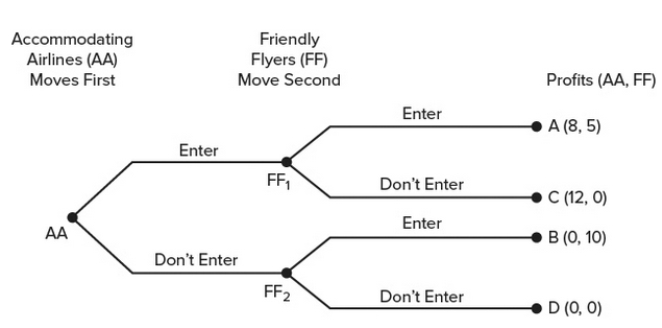
(Multiple Choice)
4.9/5 (82)
(82) Some observers assert that oligopolies are less socially desirable than pure monopolies because
(Multiple Choice)
4.9/5 (86)
(86) Larry's Lizards and Ronaldo's Reptiles are competing pet store franchises. Both are considering opening a store in the small town of Turtleville. If Ronaldo's opens a profitable store in Turtleville and Larry's management determines that it is not profitable to also open a store, then
(Multiple Choice)
4.9/5 (98)
(98) If there are significant economies of scale in an industry, then
(Multiple Choice)
4.9/5 (94)
(94) In which of these continuums of degrees of competition (lowest to highest) is oligopoly properly placed?
(Multiple Choice)
4.7/5 (90)
(90) Suppose that a particular industry has a four-firm concentration ratio of 85 and a Herfindahl index of 3,000. Most likely, this industry would achieve
(Multiple Choice)
4.9/5 (71)
(71) Suppose that currently there are no airlines serving the city of South Podunk. Both Accommodating Airlines and Friendly Flyers are looking to enter that market. (They are the only two.) The figure shows in extensive form the possible outcomes of the two firms' decisions. The payoffs represent, in thousands per month, the profit (or loss) the firm will realize from its decision. What does this extensive form game indicate about the decision to enter the South Podunk market? 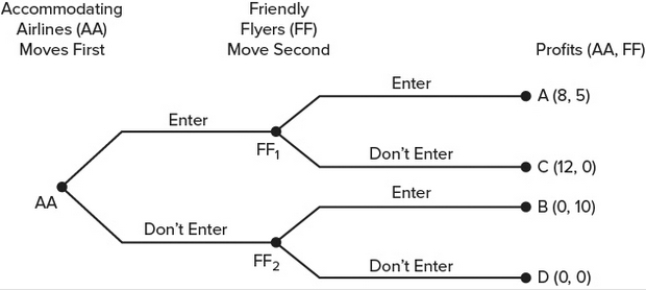
(Multiple Choice)
4.8/5 (79)
(79) (Last Word) Major Internet-related firms such as Google, Apple, Amazon, Microsoft, and Facebook each have an area of the market that they dominate. Which of the following is true about their interaction in the market?
(Multiple Choice)
4.9/5 (79)
(79) The kinked-demand curve of an oligopolist is based on the assumption that
(Multiple Choice)
4.7/5 (71)
(71) Patents and copyrights were established by the government to reduce oligopoly and monopoly power.
(True/False)
4.8/5 (83)
(83) The mutual interdependence that characterizes oligopoly arises because
(Multiple Choice)
4.8/5 (89)
(89) Price leadership in an oligopoly entails an implicit or tacit form of collusion.
(True/False)
4.9/5 (79)
(79) Mutual interdependence means that oligopolistic producers rely primarily on price competition in determining their shares of the total market for their product.
(True/False)
4.9/5 (72)
(72) You are told that the four-firm concentration ratio in an industry is 20. Based on this information you can conclude that
(Multiple Choice)
4.9/5 (85)
(85) 
Filters
- Essay(0)
- Multiple Choice(0)
- Short Answer(0)
- True False(0)
- Matching(0)