



 Chat with AI
Exam 4: Market Failures: Public Goods and Externalities

Exam 1: Limits, Alternatives, and Choices398 Questions
Exam 2: The Market System and the Circular Flow252 Questions
Exam 3: Demand, Supply, and Market Equilibrium339 Questions
Exam 4: Market Failures: Public Goods and Externalities235 Questions
Exam 5: Governments Role and Government Failure275 Questions
Exam 6: Elasticity255 Questions
Exam 7: Utility Maximization256 Questions
Exam 8: Behavioral Economics274 Questions
Exam 9: Businesses and the Costs of Production307 Questions
Exam 10: Pure Competition in the Short Run167 Questions
Exam 11: Pure Competition in the Long Run182 Questions
Exam 12: Pure Monopoly224 Questions
Exam 13: Monopolistic Competition194 Questions
Exam 14: Oligopoly and Strategic Behavior265 Questions
Exam 15: Technology, Rd, and Efficiency231 Questions
Exam 16: The Demand for Resources244 Questions
Exam 17: Wage Determination308 Questions
Exam 18: Rent, Interest, and Profit210 Questions
Exam 19: Natural Resource and Energy Economics290 Questions
Exam 20: Public Finance: Expenditures and Taxes232 Questions
Exam 21: Antitrust Policy and Regulation237 Questions
Exam 22: Agriculture: Economics and Policy217 Questions
Exam 23: Income Inequality, Poverty, and Discrimination272 Questions
Exam 24: Health Care240 Questions
Exam 25: Immigration197 Questions
Exam 26: International Trade241 Questions
Exam 27: The Balance of Payments, Exchange Rates, and Trade Deficits252 Questions
Exam 28: The Economics of Developing Countries249 Questions
Select questions type


Where there are spillover (or external) benefits from having a particular product in a society, the government can make the quantity of the product approach the socially optimal level by doing the following, except

Free
(Multiple Choice)
5.0/5  (87)
(87) Correct Answer: Verified
B
Cost-benefit analysis attempts to
Free
(Multiple Choice)
4.8/5 (82)
(82) Correct Answer:Verified
VerifiedD
Assume that a government is considering a new social program and may choose to include in this program one of four progressively larger projects. The marginal cost and the marginal benefits of each of the four projects are given in the table below.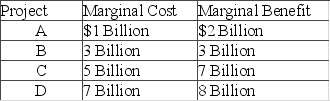 Refer to the provided table and information. What is the net benefit of project D?
Free
(Multiple Choice)
4.9/5 (72)
(72) Correct Answer:Verified
VerifiedC
Graphically, if the supply and demand curves are linear, consumer surplus is measured as the triangle
(Multiple Choice)
4.9/5 (73)
(73) Amanda buys a ruby for $330 for which she was willing to pay $340. The minimum acceptable price to the seller, Tony, was $140. Amanda experiences
(Multiple Choice)
4.8/5 (76)
(76) Answer the question on the basis of the following information for a public good. Pa and Pb are the prices that individuals A and B are willing to pay for the last unit of a public good, rather than do without it. These people are the only two members of society.  If the marginal cost of producing this good at the optimal quantity is $4, the optimal quantity must be
 (Multiple Choice)
4.8/5 (77)
(77) An effective antipollution policy from the economic perspective requires that all pollution be eliminated and banned.
(True/False)
4.8/5 (97)
(97) Credit bureaus provide credit histories to banks and insurance companies, in order to help deal with the problem of
(Multiple Choice)
4.9/5 (73)
(73) It is the custom for paper mills located alongside the Layzee River to discharge waste products into the river. As a result, operators of hydroelectric power-generating plants downstream along the river find that they must clean up the river's water before it flows through their equipment. In the situation described above, we would expect an
(Multiple Choice)
4.9/5 (71)
(71) When producers do not produce the efficient amount of a product because they are unable to charge consumers what they need to get in order to produce the efficient amount, then we have a
(Multiple Choice)
4.9/5 (81)
(81) Asymmetric information in a market transaction occurs when there is unequal knowledge possessed by the
(Multiple Choice)
4.8/5 (78)
(78) What are the two characteristics that differentiate private goods from public goods?
(Multiple Choice)
4.9/5 (82)
(82) If pollution coming from factories is bad, then why would the socially optimal level of pollution not be zero?
(Multiple Choice)
4.8/5 (79)
(79) Jennifer buys a piece of costume jewelry for $33, for which she was willing to pay $42. The minimum acceptable price to the seller, Nathan, was $30. Jennifer experiences
(Multiple Choice)
4.7/5 (97)
(97) Charlie is willing to pay $10 for a T-shirt that is priced at $9. If Charlie buys the T-shirt, then his consumer surplus is
(Multiple Choice)
4.9/5 (79)
(79) Allocative efficiency occurs where (for the last unit) maximum willingness to pay exceeds minimum acceptable price by the greatest amount.
(True/False)
4.7/5 (81)
(81) If some activity creates external benefits as well as private benefits, then economic theory suggests that the activity ought to be
(Multiple Choice)
4.9/5 (82)
(82) The trains of the Transcontinental Railway Company, when shipping goods, sometimes emit sparks that start fires along the tracks and damage the property of others. If Transcontinental does not pay for the damage it causes, what has occurred?
(Multiple Choice)
4.8/5 (66)
(66) 
Filters
- Essay(0)
- Multiple Choice(0)
- Short Answer(0)
- True False(0)
- Matching(0)