



 Chat with AI
Exam 4: Market Failures: Public Goods and Externalities

Exam 1: Limits, Alternatives, and Choices398 Questions
Exam 2: The Market System and the Circular Flow252 Questions
Exam 3: Demand, Supply, and Market Equilibrium339 Questions
Exam 4: Market Failures: Public Goods and Externalities235 Questions
Exam 5: Governments Role and Government Failure275 Questions
Exam 6: Elasticity255 Questions
Exam 7: Utility Maximization256 Questions
Exam 8: Behavioral Economics274 Questions
Exam 9: Businesses and the Costs of Production307 Questions
Exam 10: Pure Competition in the Short Run167 Questions
Exam 11: Pure Competition in the Long Run182 Questions
Exam 12: Pure Monopoly224 Questions
Exam 13: Monopolistic Competition194 Questions
Exam 14: Oligopoly and Strategic Behavior265 Questions
Exam 15: Technology, Rd, and Efficiency231 Questions
Exam 16: The Demand for Resources244 Questions
Exam 17: Wage Determination308 Questions
Exam 18: Rent, Interest, and Profit210 Questions
Exam 19: Natural Resource and Energy Economics290 Questions
Exam 20: Public Finance: Expenditures and Taxes232 Questions
Exam 21: Antitrust Policy and Regulation237 Questions
Exam 22: Agriculture: Economics and Policy217 Questions
Exam 23: Income Inequality, Poverty, and Discrimination272 Questions
Exam 24: Health Care240 Questions
Exam 25: Immigration197 Questions
Exam 26: International Trade241 Questions
Exam 27: The Balance of Payments, Exchange Rates, and Trade Deficits252 Questions
Exam 28: The Economics of Developing Countries249 Questions
Select questions type


In a well-functioning cap-and-trade system for pollution rights, society benefits because pollution will be brought down to insignificant levels.
(True/False)
4.8/5  (80)
(80) Assume there is no way to prevent someone from using an interstate highway, regardless of whether or not he or she helps pay for it. This characteristic is called
(Multiple Choice)
4.7/5 (77)
(77) If the market price of a product increases, then the total
(Multiple Choice)
4.8/5 (62)
(62) It is the custom for paper mills located alongside the Layzee River to discharge waste products into the river. As a result, operators of hydroelectric power-generating plants downstream along the river find that they must clean up the river's water before it flows through their equipment. If the government intervenes and corrects the externality in the situation described, we would expect
(Multiple Choice)
4.8/5 (81)
(81) When the marginal benefit of an output exceeds the marginal cost,
(Multiple Choice)
4.9/5 (93)
(93) The adverse selection problem is the tendency for insured drivers to drive recklessly.
(True/False)
4.9/5 (65)
(65) Insurance co-pays and deductibles are methods used by insurance companies to reduce moral hazard.
(True/False)
4.9/5 (92)
(92) When the marginal benefits exceed the marginal costs of producing a product, then allocative efficiency is not achieved in the market.
(True/False)
4.8/5 (79)
(79) Which of the following would be considered an example of adverse selection?
(Multiple Choice)
4.9/5 (98)
(98) If the unit price of a product is P and buyers buy a given quantity Q, then sellers would collect total revenues equal to
(Multiple Choice)
4.8/5 (80)
(80) The Coase Theorem suggests that the government does not have to be involved at all in resolving a market failure due to externalities.
(True/False)
4.9/5 (84)
(84) New Normal University has found it necessary to institute a crime-control program on its campus to deal with the high costs of theft and vandalism. The university is now considering several alternative levels of crime control. This table shows the expected total annual costs and benefits of these alternatives. 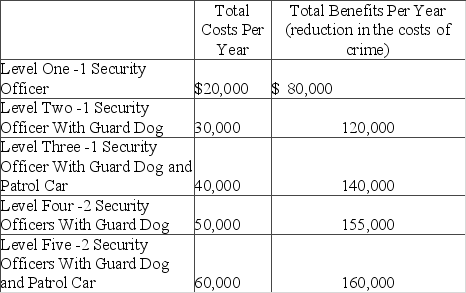 If New Normal University undertakes program Level Three,
 (Multiple Choice)
4.8/5 (76)
(76) A government is considering undertaking a construction project of an increasing scale (ranging from 1, 2, 3, to 4). The estimated marginal costs and marginal benefits of each successive scale of the project are given in the table below. 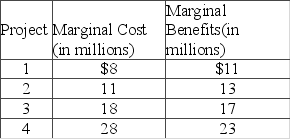 What is the total cost and total benefit of the scale-3 project?
 (Multiple Choice)
5.0/5 (90)
(90) If the consumer is willing to pay a price higher than the actual price of a product, then the consumer will not buy the product because the consumer surplus will be negative.
(True/False)
4.8/5 (100)
(100) Demand-side market failures refer to those situations when there is a shortage in the market because buyers want to buy more than what is available in the market.
(True/False)
4.9/5 (83)
(83) 
Filters
- Essay(0)
- Multiple Choice(0)
- Short Answer(0)
- True False(0)
- Matching(0)