



 Chat with AI
Exam 4: Market Failures: Public Goods and Externalities

Exam 1: Limits, Alternatives, and Choices398 Questions
Exam 2: The Market System and the Circular Flow252 Questions
Exam 3: Demand, Supply, and Market Equilibrium339 Questions
Exam 4: Market Failures: Public Goods and Externalities235 Questions
Exam 5: Governments Role and Government Failure275 Questions
Exam 6: Elasticity255 Questions
Exam 7: Utility Maximization256 Questions
Exam 8: Behavioral Economics274 Questions
Exam 9: Businesses and the Costs of Production307 Questions
Exam 10: Pure Competition in the Short Run167 Questions
Exam 11: Pure Competition in the Long Run182 Questions
Exam 12: Pure Monopoly224 Questions
Exam 13: Monopolistic Competition194 Questions
Exam 14: Oligopoly and Strategic Behavior265 Questions
Exam 15: Technology, Rd, and Efficiency231 Questions
Exam 16: The Demand for Resources244 Questions
Exam 17: Wage Determination308 Questions
Exam 18: Rent, Interest, and Profit210 Questions
Exam 19: Natural Resource and Energy Economics290 Questions
Exam 20: Public Finance: Expenditures and Taxes232 Questions
Exam 21: Antitrust Policy and Regulation237 Questions
Exam 22: Agriculture: Economics and Policy217 Questions
Exam 23: Income Inequality, Poverty, and Discrimination272 Questions
Exam 24: Health Care240 Questions
Exam 25: Immigration197 Questions
Exam 26: International Trade241 Questions
Exam 27: The Balance of Payments, Exchange Rates, and Trade Deficits252 Questions
Exam 28: The Economics of Developing Countries249 Questions
Select questions type


In the market for a particular pair of shoes, Jena is willing to pay $75 for a pair, while Jane is willing to pay $85 for a pair. The actual price that each has to pay for a pair of these shoes is $65. What is the total amount of the two girls' combined consumer surplus?
(Multiple Choice)
4.9/5  (80)
(80) In a well-functioning cap-and-trade system for pollution rights, the right to pollute will go to those who are able to acquire the largest net benefit from using the scarce resource "clean air."
(True/False)
5.0/5 (68)
(68) Answer this question on the basis of the following information for a public good. Pa and Pb represent the prices that citizens (a) and (b), the only two people in this nation, are willing to pay for additional units of a quantity (Qc) of the public good. Qs represents the quantity of the public good supplied by government at each of the collective prices. 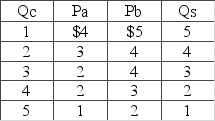 The collective willingness of this nation to pay for the fourth unit of the public good is
 (Multiple Choice)
4.9/5 (77)
(77) Answer this question on the basis of the following information for a public good. Pa and Pb represent the prices that citizens (a) and (b), the only two people in this nation, are willing to pay for additional units of a quantity (Qc) of the public good. Qs represents the quantity of the public good supplied by government at each of the collective prices.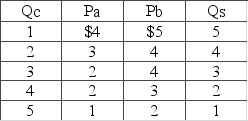 In equilibrium, the marginal benefit and cost of the public good will be
 (Multiple Choice)
4.9/5 (76)
(76) Answer the question on the basis of the following information for a public good. Pa and Pb are the prices that individuals A and B are willing to pay for the last unit of a public good, rather than do without it. These people are the only two members of society.  The collective willingness of this society to pay for the second unit of this public good is
 (Multiple Choice)
4.9/5 (77)
(77) At equilibrium in a market for a product, the total revenues received by sellers equal the
(Multiple Choice)
4.8/5 (78)
(78) Rivalry means that when one person buys and consumes a product, it is not available for purchase and consumption by another person.
(True/False)
4.9/5 (80)
(80) When the government bails out large banks when the banks become unstable, it could lead to a moral hazard problem in banking.
(True/False)
5.0/5 (88)
(88) The value that consumers get (from consuming a product) over and above what they actually paid for the product is called
(Multiple Choice)
4.9/5 (78)
(78) Nonrivalry in the use or consumption of a good means that only one person is consuming the good without any rivals.
(True/False)
4.9/5 (81)
(81) When the government bails out failing banks, it creates a moral hazard problem; but when the government bails out homeowners who are defaulting on their mortgages, there is no moral hazard problem.
(True/False)
4.9/5 (90)
(90) The government receives all of the benefits associated with the production of a public good.
(True/False)
4.9/5 (62)
(62) It is the custom for paper mills located alongside the Layzee River to discharge waste products into the river. As a result, operators of hydroelectric power-generating plants downstream along the river find that they must clean up the river's water before it flows through their equipment. If the government intervenes and corrects the externality in the situation described above, we would expect
(Multiple Choice)
4.8/5 (69)
(69) In a television advertisement for AFLAC supplemental health insurance, an ice skater says to his skating partner, "Do you want to try a triple jump?" She responds, "Why not, I have AFLAC." This response illustrates the
(Multiple Choice)
4.7/5 (70)
(70) An efficiency loss (or deadweight loss) declines in size when a unit of output is produced for which
(Multiple Choice)
4.9/5 (80)
(80) (Consider This) Darcy and Rachel live down the hall from each other in the same dorm. Darcy likes to play her music loudly down the hall, and Rachel finds the music annoying. A Coase theorem solution for this problem would be for
(Multiple Choice)
4.9/5 (87)
(87) TripAdvisor provides online reviews of hotels, restaurants, and attractions at tourist destinations around the world. When a traveler is planning a vacation, TripAdvisor helps the traveler avoid
(Multiple Choice)
5.0/5 (79)
(79) 
Filters
- Essay(0)
- Multiple Choice(0)
- Short Answer(0)
- True False(0)
- Matching(0)