



 Chat with AI
Exam 4: Market Failures: Public Goods and Externalities

Exam 1: Limits, Alternatives, and Choices398 Questions
Exam 2: The Market System and the Circular Flow252 Questions
Exam 3: Demand, Supply, and Market Equilibrium339 Questions
Exam 4: Market Failures: Public Goods and Externalities235 Questions
Exam 5: Governments Role and Government Failure275 Questions
Exam 6: Elasticity255 Questions
Exam 7: Utility Maximization256 Questions
Exam 8: Behavioral Economics274 Questions
Exam 9: Businesses and the Costs of Production307 Questions
Exam 10: Pure Competition in the Short Run167 Questions
Exam 11: Pure Competition in the Long Run182 Questions
Exam 12: Pure Monopoly224 Questions
Exam 13: Monopolistic Competition194 Questions
Exam 14: Oligopoly and Strategic Behavior265 Questions
Exam 15: Technology, Rd, and Efficiency231 Questions
Exam 16: The Demand for Resources244 Questions
Exam 17: Wage Determination308 Questions
Exam 18: Rent, Interest, and Profit210 Questions
Exam 19: Natural Resource and Energy Economics290 Questions
Exam 20: Public Finance: Expenditures and Taxes232 Questions
Exam 21: Antitrust Policy and Regulation237 Questions
Exam 22: Agriculture: Economics and Policy217 Questions
Exam 23: Income Inequality, Poverty, and Discrimination272 Questions
Exam 24: Health Care240 Questions
Exam 25: Immigration197 Questions
Exam 26: International Trade241 Questions
Exam 27: The Balance of Payments, Exchange Rates, and Trade Deficits252 Questions
Exam 28: The Economics of Developing Countries249 Questions
Select questions type


Which of the following statements about market failure is not true?
(Multiple Choice)
4.8/5  (72)
(72) A demand curve for a public good is determined by summing horizontally the individual demand curves for the public good.
(True/False)
5.0/5 (84)
(84) (Last Word) Because there are so many sources of carbon dioxide, making monitoring difficult and costly, many economists
(Multiple Choice)
4.9/5 (69)
(69) The socially optimal amount of pollution abatement occurs where society's marginal
(Multiple Choice)
4.9/5 (76)
(76) A government is considering undertaking a construction project of an increasing scale (ranging from 1, 2, 3, to 4). The estimated marginal costs and marginal benefits of each successive scale of the project are given in the table below.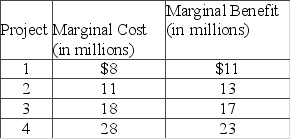 What is the total amount that the government should spend on the construction project to attain maximum net benefits for the society?
 (Multiple Choice)
4.9/5 (90)
(90) Answer the question on the basis of the following information for four highway programs of increasing scope. All figures are in millions of dollars.  The data indicate that
 (Multiple Choice)
4.9/5 (82)
(82) Near an ocean beach, a high-rise building is being constructed that will block the scenic view of the ocean for the residents of a low-rise building. The Coase theorem suggests that this type of dispute between the owners of high-rise and low-rise buildings
(Multiple Choice)
4.9/5 (88)
(88) It has been proposed that a government agency be charged with the task of determining the amount of pollution that the atmosphere (or a body of water) can safely absorb, establish "rights" to this limited amount of pollution, and sell those limited amount of rights to firms. The firms can then buy and sell these rights among themselves later. This approach is known as the
(Multiple Choice)
4.8/5 (90)
(90) Production subsidies are a way of internalizing external costs among polluting firms.
(True/False)
4.7/5 (86)
(86) If one person's consumption of a good does not preclude another's consumption, the good is said to be
(Multiple Choice)
4.9/5 (65)
(65) Suppose that Mick and Cher are the only two members of society and are willing to pay $10 and $8, respectively, for the third unit of a public good. Also, assume that the marginal cost of the third unit is $17. We can conclude that
(Multiple Choice)
4.9/5 (73)
(73) Alex, Kara, and Susie are the only three people in a community. Alex is willing to pay $40 for the third unit of a public good; Kara is willing to pay $25. If the marginal cost of producing the third unit is $100, what is the minimum amount that Susie must be willing to pay for it to be efficient for government to produce the third unit?pay for it to be efficient for government to produce the third unit?
(Multiple Choice)
4.9/5 (83)
(83) From society's perspective, in the presence of a supply-side market failure, the last unit of a good produced typically
(Multiple Choice)
4.7/5 (83)
(83) The minimum acceptable price for a product that producer Sam is willing to receive is $15. The price he could get for the product in the market is $18. How much is Sam's producer surplus?
(Multiple Choice)
4.8/5 (75)
(75) The 2010 Health Care Reform Law, also known as "Obamacare," includes a part known as universal coverage which requires everyone to have health insurance. One reason for this is to address the problem of
(Multiple Choice)
4.8/5 (81)
(81) 
Filters
- Essay(0)
- Multiple Choice(0)
- Short Answer(0)
- True False(0)
- Matching(0)