



 Chat with AI
Exam 4: Market Failures: Public Goods and Externalities

Exam 1: Limits, Alternatives, and Choices398 Questions
Exam 2: The Market System and the Circular Flow252 Questions
Exam 3: Demand, Supply, and Market Equilibrium339 Questions
Exam 4: Market Failures: Public Goods and Externalities235 Questions
Exam 5: Governments Role and Government Failure275 Questions
Exam 6: Elasticity255 Questions
Exam 7: Utility Maximization256 Questions
Exam 8: Behavioral Economics274 Questions
Exam 9: Businesses and the Costs of Production307 Questions
Exam 10: Pure Competition in the Short Run167 Questions
Exam 11: Pure Competition in the Long Run182 Questions
Exam 12: Pure Monopoly224 Questions
Exam 13: Monopolistic Competition194 Questions
Exam 14: Oligopoly and Strategic Behavior265 Questions
Exam 15: Technology, Rd, and Efficiency231 Questions
Exam 16: The Demand for Resources244 Questions
Exam 17: Wage Determination308 Questions
Exam 18: Rent, Interest, and Profit210 Questions
Exam 19: Natural Resource and Energy Economics290 Questions
Exam 20: Public Finance: Expenditures and Taxes232 Questions
Exam 21: Antitrust Policy and Regulation237 Questions
Exam 22: Agriculture: Economics and Policy217 Questions
Exam 23: Income Inequality, Poverty, and Discrimination272 Questions
Exam 24: Health Care240 Questions
Exam 25: Immigration197 Questions
Exam 26: International Trade241 Questions
Exam 27: The Balance of Payments, Exchange Rates, and Trade Deficits252 Questions
Exam 28: The Economics of Developing Countries249 Questions
Select questions type


Which of the following would be an example of a moral hazard problem?
(Multiple Choice)
4.9/5  (75)
(75) New Normal University has found it necessary to institute a crime-control program on its campus to deal with the high costs of theft and vandalism. The university is now considering several alternative levels of crime control. This table shows the expected total annual costs and benefits of these alternatives. 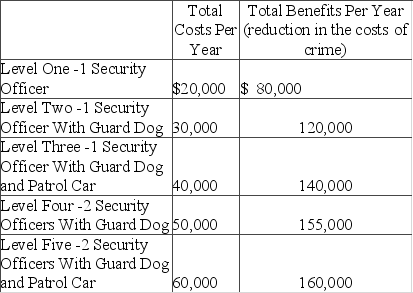 The marginal benefits of crime control for Level Two are
 (Multiple Choice)
4.9/5 (84)
(84) A government is considering undertaking a construction project of an increasing scale (ranging from 1, 2, 3, to 4). The estimated marginal costs and marginal benefits of each successive scale of the project are given in the table below. 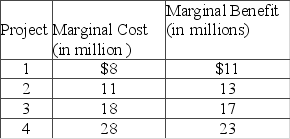 What is the net benefit of project scale 2?
 (Multiple Choice)
4.9/5 (80)
(80) A producer's minimum acceptable price for a particular unit of a good
(Multiple Choice)
4.9/5 (93)
(93) Answer the question on the basis of the following information for a public good. Pa and Pb are the prices that individuals A and B are willing to pay for the last unit of a public good, rather than do without it. These people are the only two members of society. If this good were a private good instead of a public one, the total quantity demanded at a $3 market price would be
 (Multiple Choice)
4.8/5 (69)
(69) Because in any period of time and in any region the quantity of pollutants that can be absorbed by nature is fixed, the supply of "pollution rights" in a cap-and-trade system will be perfectly elastic (horizontal).
(True/False)
4.9/5 (88)
(88) As it applies to insurance, the moral hazard problem is the tendency for
(Multiple Choice)
4.8/5 (77)
(77) An improvement in the technology of pollution control is likely to increase society's optimal amount of pollution abatement.
(True/False)
4.7/5 (76)
(76) Suppose a firm offers its workers a cafeteria plan in which it allows workers to allocate a set amount of fringe benefit money toward specific insurance. Mary, who has five kids needing braces, selects the family dental coverage. This is an example of the
(Multiple Choice)
4.8/5 (79)
(79) If many people in a community get flu shots, the whole community benefits, including those that did not get flu shots. Therefore, not enough people may decide to get the shots. This is one illustration of
(Multiple Choice)
4.8/5 (79)
(79) Society's marginal cost of pollution abatement curve slopes upward because of the law of diminishing marginal utility.
(True/False)
4.9/5 (80)
(80) In a free-market economy, a product which entails a positive externality will be
(Multiple Choice)
4.8/5 (82)
(82) Assume that there are four consumers A, B, C, and D, and the prices that each of them is willing to pay for a glass of lemonade is, respectively, $1.50, $1.20, $1.00, and $0.90. If the actual price of lemonade is $1.00 per glass, then consumer surplus in this market will be $0.70.
(True/False)
4.8/5 (83)
(83) eBay, Amazon, and other Internet shopping sites provide "seller ratings" done by previous buyers, in order to help deal with the problem of
(Multiple Choice)
4.8/5 (77)
(77) Which of the following would be an example of government intervention to correct a market failure caused by buyers having inadequate information about sellers?
(Multiple Choice)
4.8/5 (86)
(86) By requiring car producers to install emission control devices on cars, the government forces these producers to internalize some of the external costs of auto pollution. This will lead to the equilibrium price of cars
(Multiple Choice)
4.8/5 (76)
(76) eBay and Amazon provide "sellers' ratings" information based on the experiences of past buyers. This is to help resolve the adverse selection problem faced by potential buyers.
(True/False)
4.9/5 (73)
(73) 
Filters
- Essay(0)
- Multiple Choice(0)
- Short Answer(0)
- True False(0)
- Matching(0)