



 Chat with AI
Exam 4: Market Failures: Public Goods and Externalities

Exam 1: Limits, Alternatives, and Choices398 Questions
Exam 2: The Market System and the Circular Flow252 Questions
Exam 3: Demand, Supply, and Market Equilibrium339 Questions
Exam 4: Market Failures: Public Goods and Externalities235 Questions
Exam 5: Governments Role and Government Failure275 Questions
Exam 6: Elasticity255 Questions
Exam 7: Utility Maximization256 Questions
Exam 8: Behavioral Economics274 Questions
Exam 9: Businesses and the Costs of Production307 Questions
Exam 10: Pure Competition in the Short Run167 Questions
Exam 11: Pure Competition in the Long Run182 Questions
Exam 12: Pure Monopoly224 Questions
Exam 13: Monopolistic Competition194 Questions
Exam 14: Oligopoly and Strategic Behavior265 Questions
Exam 15: Technology, Rd, and Efficiency231 Questions
Exam 16: The Demand for Resources244 Questions
Exam 17: Wage Determination308 Questions
Exam 18: Rent, Interest, and Profit210 Questions
Exam 19: Natural Resource and Energy Economics290 Questions
Exam 20: Public Finance: Expenditures and Taxes232 Questions
Exam 21: Antitrust Policy and Regulation237 Questions
Exam 22: Agriculture: Economics and Policy217 Questions
Exam 23: Income Inequality, Poverty, and Discrimination272 Questions
Exam 24: Health Care240 Questions
Exam 25: Immigration197 Questions
Exam 26: International Trade241 Questions
Exam 27: The Balance of Payments, Exchange Rates, and Trade Deficits252 Questions
Exam 28: The Economics of Developing Countries249 Questions
Select questions type


Upon buying a car with airbags, Indy begins to drive recklessly. This is an example of the
(Multiple Choice)
4.8/5  (81)
(81) Toll-free roads sometimes get congested, such as during rush-hour traffic. During those times, we would say that these roads are
(Multiple Choice)
4.8/5 (76)
(76) When economic efficiency is attained, it implies all of the following, except
(Multiple Choice)
4.9/5 (77)
(77) Asymmetric information occurs when the two parties in a market transaction do not have the same amount of information regarding the product or process involved in the transaction.
(True/False)
4.9/5 (73)
(73) The optimal quantity of a public good is where the total benefits from it are equal to the total costs of producing it.
(True/False)
4.9/5 (77)
(77) When producers do not have to pay the full cost of producing a product, they tend to
(Multiple Choice)
4.9/5 (71)
(71) The free-rider problem makes a good highly profitable for a private firm to provide.
(True/False)
4.7/5 (76)
(76) The difference between the actual price that a producer receives and the minimum acceptable price the producer is willing to take is called the producer
(Multiple Choice)
4.7/5 (90)
(90) Answer the question on the basis of the following information for a public good. Pa and Pb are the prices that individuals A and B are willing to pay for the last unit of a public good, rather than do without it. These people are the only two members of society. Suppose government has already produced 4 units of this public good. The amount individual B is willing voluntarily to pay for the fourth unit is
 (Multiple Choice)
4.9/5 (75)
(75) Government can reallocate resources away from private goods toward public goods, usually through
(Multiple Choice)
4.8/5 (72)
(72) Market failures refer to those situations where the sellers are not producing as much as the buyers are wanting to buy.
(True/False)
4.9/5 (74)
(74) An emission fee levied against polluting firms will tend to shift the
(Multiple Choice)
4.8/5 (72)
(72) Which of the following conditions does not need to occur for a market to achieve allocative efficiency?
(Multiple Choice)
4.8/5 (76)
(76) Answer this question on the basis of the following information for a public good. Pa and Pb represent the prices that citizens (a) and (b), the only two people in this nation, are willing to pay for additional units of a quantity (Qc) of the public good. Qs represents the quantity of the public good supplied by government at each of the collective prices. 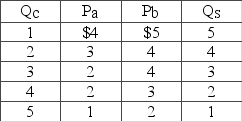 If only 1 unit of this public good is produced, then the marginal benefit is
 (Multiple Choice)
4.8/5 (75)
(75) When producers (say, of roads) are not able to make all consumers pay for enjoying their product (i.e., the roads), they tend to see a
(Multiple Choice)
4.9/5 (64)
(64) If a good that generates negative externalities were priced to take these negative externalities into account, then its
(Multiple Choice)
4.8/5 (77)
(77) 
Filters
- Essay(0)
- Multiple Choice(0)
- Short Answer(0)
- True False(0)
- Matching(0)