



 Chat with AI
Exam 14: Oligopoly and Strategic Behavior

Exam 1: Limits, Alternatives, and Choices398 Questions
Exam 2: The Market System and the Circular Flow252 Questions
Exam 3: Demand, Supply, and Market Equilibrium339 Questions
Exam 4: Market Failures: Public Goods and Externalities235 Questions
Exam 5: Governments Role and Government Failure275 Questions
Exam 6: Elasticity255 Questions
Exam 7: Utility Maximization256 Questions
Exam 8: Behavioral Economics274 Questions
Exam 9: Businesses and the Costs of Production307 Questions
Exam 10: Pure Competition in the Short Run167 Questions
Exam 11: Pure Competition in the Long Run182 Questions
Exam 12: Pure Monopoly224 Questions
Exam 13: Monopolistic Competition194 Questions
Exam 14: Oligopoly and Strategic Behavior265 Questions
Exam 15: Technology, Rd, and Efficiency231 Questions
Exam 16: The Demand for Resources244 Questions
Exam 17: Wage Determination308 Questions
Exam 18: Rent, Interest, and Profit210 Questions
Exam 19: Natural Resource and Energy Economics290 Questions
Exam 20: Public Finance: Expenditures and Taxes232 Questions
Exam 21: Antitrust Policy and Regulation237 Questions
Exam 22: Agriculture: Economics and Policy217 Questions
Exam 23: Income Inequality, Poverty, and Discrimination272 Questions
Exam 24: Health Care240 Questions
Exam 25: Immigration197 Questions
Exam 26: International Trade241 Questions
Exam 27: The Balance of Payments, Exchange Rates, and Trade Deficits252 Questions
Exam 28: The Economics of Developing Countries249 Questions
Select questions type


The economic inefficiency in an oligopoly may be reduced by the following, except
(Multiple Choice)
5.0/5  (79)
(79) The increased use of plastic bags instead of paper bags in grocery stores and retail shops is an example of
(Multiple Choice)
4.8/5 (92)
(92) A homogeneous oligopoly means that the few firms in the industry have identical cost and demand curves.
(True/False)
4.8/5 (86)
(86) When firms in an industry reach an agreement to fix prices, divide up market share, or otherwise restrict competition, they are practicing the strategy of
(Multiple Choice)
4.8/5 (76)
(76) Which of the following industries is an illustration of homogeneous oligopoly?
(Multiple Choice)
4.8/5 (85)
(85) Answer the question based on the payoff matrices for a repeated game involving two firms that are considering introducing new products to the market. The numbers indicate the profit from following either a strategy to introduce a new product or a strategy to not introduce a new product. First game. 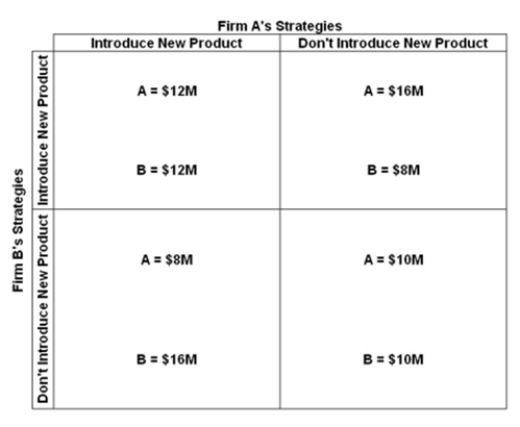 Second game.
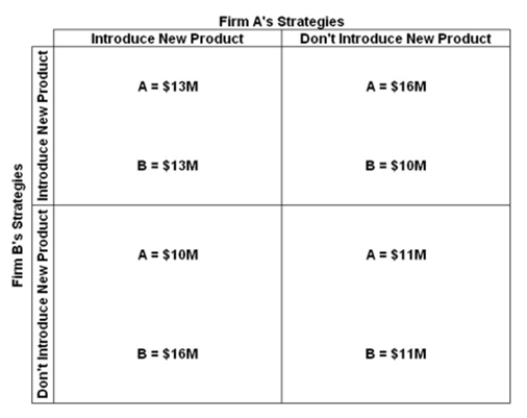 In the first game, if firm B doesn't introduce a new product and firm A does, then firm A would be better off if
Second game. In the first game, if firm B doesn't introduce a new product and firm A does, then firm A would be better off if (Multiple Choice)
4.9/5 (94)
(94) In the US market, people often refer to the "Big Three" in autos and the "Big Four" in accounting.These terms suggest that these two industries are
(Multiple Choice)
4.9/5 (79)
(79) Other things being equal, a firm in a cartel will most likely cheat on a price-fixing agreement by
(Multiple Choice)
4.8/5 (69)
(69) In a zero-sum game, the gains by one player will be exactly offset by the losses of the other.
(True/False)
4.8/5 (67)
(67) A two-player game in which one player's gain is not completely offset by the other player's loss is called a
(Multiple Choice)
4.8/5 (89)
(89) One would expect that collusion among oligopolistic producers would be easiest to achieve in which of the following cases?
(Multiple Choice)
4.8/5 (79)
(79) Use your basic knowledge and your understanding of market structures to answer this question. Which of the following companies most closely approximates a homogeneous oligopolist in a highly concentrated industry?
(Multiple Choice)
4.8/5 (84)
(84) A potential negative effect of advertising for society is that it can
(Multiple Choice)
4.7/5 (61)
(61) Which of the following is not a reason for there being no single standard model of oligopoly?
(Multiple Choice)
4.8/5 (81)
(81) 
Filters
- Essay(0)
- Multiple Choice(0)
- Short Answer(0)
- True False(0)
- Matching(0)