



 Chat with AI
Exam 7: Utility Maximization

Exam 1: Limits, Alternatives, and Choices398 Questions
Exam 2: The Market System and the Circular Flow252 Questions
Exam 3: Demand, Supply, and Market Equilibrium339 Questions
Exam 4: Market Failures: Public Goods and Externalities235 Questions
Exam 5: Governments Role and Government Failure275 Questions
Exam 6: Elasticity255 Questions
Exam 7: Utility Maximization256 Questions
Exam 8: Behavioral Economics274 Questions
Exam 9: Businesses and the Costs of Production307 Questions
Exam 10: Pure Competition in the Short Run167 Questions
Exam 11: Pure Competition in the Long Run182 Questions
Exam 12: Pure Monopoly224 Questions
Exam 13: Monopolistic Competition194 Questions
Exam 14: Oligopoly and Strategic Behavior265 Questions
Exam 15: Technology, Rd, and Efficiency231 Questions
Exam 16: The Demand for Resources244 Questions
Exam 17: Wage Determination308 Questions
Exam 18: Rent, Interest, and Profit210 Questions
Exam 19: Natural Resource and Energy Economics290 Questions
Exam 20: Public Finance: Expenditures and Taxes232 Questions
Exam 21: Antitrust Policy and Regulation237 Questions
Exam 22: Agriculture: Economics and Policy217 Questions
Exam 23: Income Inequality, Poverty, and Discrimination272 Questions
Exam 24: Health Care240 Questions
Exam 25: Immigration197 Questions
Exam 26: International Trade241 Questions
Exam 27: The Balance of Payments, Exchange Rates, and Trade Deficits252 Questions
Exam 28: The Economics of Developing Countries249 Questions
Select questions type


The table shows the marginal-utility schedules for goods A and B for a hypothetical consumer. The price of good A is $1, and the price of good B is $2. The income of the consumer is $8. 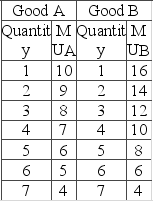 If the price of B falls to $1, while the price of A and the consumer's income stay the same, what would be the utility-maximizing combination of goods A and B?
 (Multiple Choice)
4.8/5  (72)
(72) Which situation is consistent with the law of diminishing marginal utility?
(Multiple Choice)
4.8/5 (88)
(88) Mr. Samuelson's current rates of purchase are such that the marginal utility of slacks is 18 and the marginal utility of ties for him is 5. If slacks and ties are priced at $12 and $2, respectively, it can be concluded that Mr. Samuelson
(Multiple Choice)
4.8/5 (66)
(66) Assume MUc and MUd represent the marginal utility that a consumer gets from products C and D, the respective prices of which are Pc and Pd. The consumer will increase his total utility from a specific money outlay by spending more on C and less on D if initially
(Multiple Choice)
4.9/5 (76)
(76) It is possible that as a result of the budget line shifting outward, the consumer will buy less of a product.
(True/False)
4.8/5 (71)
(71) Refer to the diagram, where xy is the relevant budget line and I1, I2, and I3 are indifference curves. If the consumer is initially at point L, he or she should 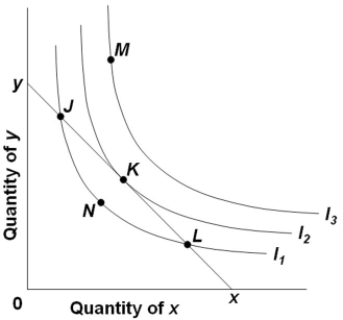
(Multiple Choice)
4.8/5 (79)
(79) The table shows a consumer's utility schedule. 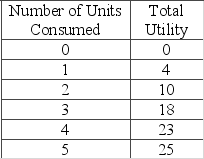 Marginal utility begins to diminish with the consumption of the
 (Multiple Choice)
5.0/5 (77)
(77) The table shows the total utility data for products X and Y. Assume that the prices of X and Y are $3 and $4, respectively, and that consumer income is $18. 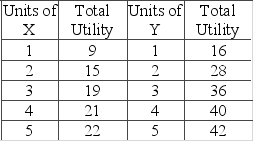 If the price of X decreases from $3 to $2, while the price of Y and the consumer's income stay the same, then the utility-maximizing combination is such that the quantity of X
 (Multiple Choice)
4.8/5 (88)
(88) An increase in the real income of a consumer is one result from an increase in the price of a product that the consumer is buying.
(True/False)
4.8/5 (85)
(85) If two combinations of goods X and Y give a consumer equal satisfaction, then these two combinations must both be on the same
(Multiple Choice)
4.8/5 (74)
(74) How did Apple overcome consumers' diminishing marginal utility for iPads?
(Multiple Choice)
4.7/5 (83)
(83) To the average consumer, the marginal utility of a second copy of today's newspaper is
(Multiple Choice)
5.0/5 (93)
(93) (Consider This) A topographical map shows successively higher equal-elevation lines, whereas an indifference map shows successively higher levels of total
(Multiple Choice)
4.8/5 (82)
(82) Answer the question on the basis of the following two schedules, which show the amounts of additional satisfaction (marginal utility) that a consumer would get from successive quantities of products J and K.  If the consumer has money income of $52 and the prices of J and K are $8 and $4 respectively, the consumer will maximize her utility by purchasing
 (Multiple Choice)
4.9/5 (85)
(85) Indifference analysis assumes that utility is numerically measurable.
(True/False)
4.8/5 (81)
(81) 
Filters
- Essay(0)
- Multiple Choice(0)
- Short Answer(0)
- True False(0)
- Matching(0)