



 Chat with AI
Exam 7: Utility Maximization

Exam 1: Limits, Alternatives, and Choices398 Questions
Exam 2: The Market System and the Circular Flow252 Questions
Exam 3: Demand, Supply, and Market Equilibrium339 Questions
Exam 4: Market Failures: Public Goods and Externalities235 Questions
Exam 5: Governments Role and Government Failure275 Questions
Exam 6: Elasticity255 Questions
Exam 7: Utility Maximization256 Questions
Exam 8: Behavioral Economics274 Questions
Exam 9: Businesses and the Costs of Production307 Questions
Exam 10: Pure Competition in the Short Run167 Questions
Exam 11: Pure Competition in the Long Run182 Questions
Exam 12: Pure Monopoly224 Questions
Exam 13: Monopolistic Competition194 Questions
Exam 14: Oligopoly and Strategic Behavior265 Questions
Exam 15: Technology, Rd, and Efficiency231 Questions
Exam 16: The Demand for Resources244 Questions
Exam 17: Wage Determination308 Questions
Exam 18: Rent, Interest, and Profit210 Questions
Exam 19: Natural Resource and Energy Economics290 Questions
Exam 20: Public Finance: Expenditures and Taxes232 Questions
Exam 21: Antitrust Policy and Regulation237 Questions
Exam 22: Agriculture: Economics and Policy217 Questions
Exam 23: Income Inequality, Poverty, and Discrimination272 Questions
Exam 24: Health Care240 Questions
Exam 25: Immigration197 Questions
Exam 26: International Trade241 Questions
Exam 27: The Balance of Payments, Exchange Rates, and Trade Deficits252 Questions
Exam 28: The Economics of Developing Countries249 Questions
Select questions type


Answer the question on the basis of the following total utility data for products L and M. Assume that the prices of L and M are $3 and $4, respectively, and that the consumer's income is $18.  What level of total utility does the rational consumer realize in equilibrium?
 (Multiple Choice)
5.0/5  (72)
(72) A consumer who has a limited budget will maximize utility or satisfaction when the
(Multiple Choice)
4.8/5 (92)
(92) In introducing the opportunity cost of time into the theory of consumer behavior, we find that, all else equal,
(Multiple Choice)
4.7/5 (84)
(84) While eating at Alex's "Pizza by the Slice" restaurant, Kara experiences diminishing marginal utility. She gained 10 units of satisfaction from her first slice of pizza consumed and would only receive 5 units of satisfaction from consuming a second slice, at the same price. Based on this information, we can conclude that
(Multiple Choice)
4.8/5 (75)
(75) When a consumer shifts purchases from product X to product Y, the marginal utility of
(Multiple Choice)
4.9/5 (79)
(79) Assume you are spending your full budget and purchasing such amounts of X and Y that the marginal utility from the last units consumed is 40 and 20 utils, respectively. Assume (a) the prices of X and Y are $8 and $4 respectively; (b) it takes 3 hours to consume a unit of X and 1 hour to consume a unit of Y; and (c) your time is worth $2 per hour. You
(Multiple Choice)
4.9/5 (68)
(68) The ability of a good or service to satisfy wants is called
(Multiple Choice)
4.8/5 (90)
(90) Someone who pays $800 to fly from one city to another instead of paying only $100 for a bus trip between the two cities is making an irrational choice and is thus not maximizing his utility.
(True/False)
4.7/5 (99)
(99) If the budget line shifts from BB to bb in the diagram, we can infer that the 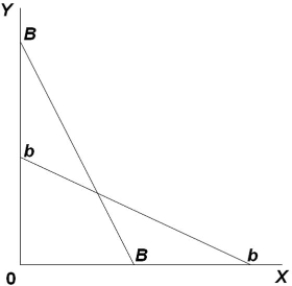
(Multiple Choice)
5.0/5 (100)
(100) The price of diamonds is substantially greater than the price of water because
(Multiple Choice)
4.9/5 (88)
(88) In 2015 the federal government started requiring restaurants to print calorie counts next to menu items. The intent was to persuade consumers to
(Multiple Choice)
4.8/5 (88)
(88) The marginal utility of the last unit of apples consumed is 12, and the marginal utility of the last unit of bananas consumed is 8. What set of prices for apples and bananas, respectively, would be consistent with consumer equilibrium?
(Multiple Choice)
4.8/5 (82)
(82) The consumer will select that point on the budget line which puts him or her on the highest attainable indifference curve.
(True/False)
4.9/5 (85)
(85) To maximize utility, a consumer should allocate money income so that the
(Multiple Choice)
4.8/5 (77)
(77) An increase in the price of a product normally enables a consumer to reach a higher indifference curve.
(True/False)
4.9/5 (81)
(81) Assume a round of golf requires four hours of leisure time, and attending a concert requires two hours. If the price of a round of golf is $40 and the price of a concert is $80, ceteris paribus, Joe will play
(Multiple Choice)
4.9/5 (78)
(78) Refer to the budget line shown in the diagram. If the consumer's money income is $20, the 
(Multiple Choice)
4.9/5 (75)
(75) (Consider This) The lines on a topographical map are analogous to a(n)
(Multiple Choice)
4.8/5 (80)
(80) From the viewpoint of potential criminals, the probability of being fined or imprisoned
(Multiple Choice)
5.0/5 (78)
(78) 
Filters
- Essay(0)
- Multiple Choice(0)
- Short Answer(0)
- True False(0)
- Matching(0)