



 Chat with AI
Exam 7: Utility Maximization

Exam 1: Limits, Alternatives, and Choices398 Questions
Exam 2: The Market System and the Circular Flow252 Questions
Exam 3: Demand, Supply, and Market Equilibrium339 Questions
Exam 4: Market Failures: Public Goods and Externalities235 Questions
Exam 5: Governments Role and Government Failure275 Questions
Exam 6: Elasticity255 Questions
Exam 7: Utility Maximization256 Questions
Exam 8: Behavioral Economics274 Questions
Exam 9: Businesses and the Costs of Production307 Questions
Exam 10: Pure Competition in the Short Run167 Questions
Exam 11: Pure Competition in the Long Run182 Questions
Exam 12: Pure Monopoly224 Questions
Exam 13: Monopolistic Competition194 Questions
Exam 14: Oligopoly and Strategic Behavior265 Questions
Exam 15: Technology, Rd, and Efficiency231 Questions
Exam 16: The Demand for Resources244 Questions
Exam 17: Wage Determination308 Questions
Exam 18: Rent, Interest, and Profit210 Questions
Exam 19: Natural Resource and Energy Economics290 Questions
Exam 20: Public Finance: Expenditures and Taxes232 Questions
Exam 21: Antitrust Policy and Regulation237 Questions
Exam 22: Agriculture: Economics and Policy217 Questions
Exam 23: Income Inequality, Poverty, and Discrimination272 Questions
Exam 24: Health Care240 Questions
Exam 25: Immigration197 Questions
Exam 26: International Trade241 Questions
Exam 27: The Balance of Payments, Exchange Rates, and Trade Deficits252 Questions
Exam 28: The Economics of Developing Countries249 Questions
Select questions type


A change in the relative prices for two goods can be shown as a parallel shift in a consumer's budget line.
(True/False)
4.8/5  (76)
(76) If the total utility from consuming five units of a product is 245 and the marginal utility of a sixth unit is 5, then the total utility from consuming six units would be
(Multiple Choice)
4.8/5 (73)
(73) Answer the question on the basis of the following two schedules, which show the amounts of additional satisfaction (marginal utility) that a consumer would get from successive quantities of products J and K.  What level of total utility is realized from the equilibrium combination of J and K, if the consumer has a money income of $52 and the prices of J and K are $8 and $4, respectively?
 (Multiple Choice)
4.9/5 (74)
(74) If you purchase a gift worth $25 for your sister, but your sister would be willing to pay only $10 ifshe bought the item for herself, then the
(Multiple Choice)
4.8/5 (74)
(74) A consumer has an income of $200, and the price of X is $5, while the price of Y is $10. If the consumer buys 8 units of X, then the maximum quantity of Y that she could also buy is
(Multiple Choice)
4.9/5 (71)
(71) The ratio of the prices of two products that a consumer could buy with a given fixed income is equivalent to the
(Multiple Choice)
4.8/5 (74)
(74) The income and substitution effects will both induce the consumer to buy more of a normal good when its price decreases.
(True/False)
4.8/5 (82)
(82) The law of diminishing marginal utility implies that in order to induce a buyer to buy more of a product, the seller must lower its price.
(True/False)
4.9/5 (85)
(85) The fact that an ounce of gold is priced higher than an ounce of chocolate suggests that
(Multiple Choice)
4.9/5 (84)
(84) Refer to the diagram. Suppose the budget line shifts so that the consumer's equilibrium changes from point A to point B. This means that the
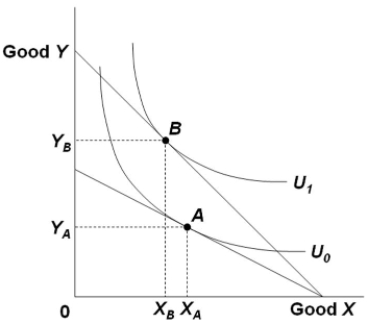
(Multiple Choice)
4.9/5 (78)
(78) "Essential" water is cheaper than "nonessential" diamonds because
(Multiple Choice)
4.9/5 (89)
(89) Suppose a consumer has an income of $16, the price of A is $2, and the price of B is $1. Which of the following combinations is on the consumer's budget line?
(Multiple Choice)
4.8/5 (77)
(77) If you receive a gift whose market price is $20, but you consider it to be worth only $10, then
(Multiple Choice)
4.7/5 (91)
(91) Refer to the diagram. If the budget line shifts from ab to ac, the 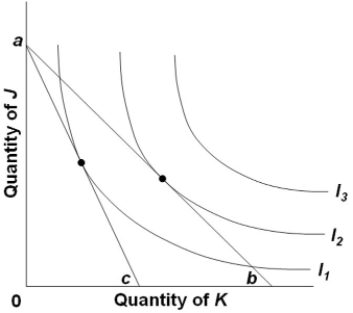
(Multiple Choice)
4.9/5 (76)
(76) Answer the question based on the table below showing the marginal utility schedules for product X and product Y for a hypothetical consumer. The price of product X is $4, and the price of product Y is $2. The income of the consumer is $20.
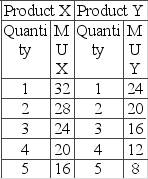 If the consumer buys both product X and product Y, how much will the consumer buy of each in order to maximize utility?
 (Multiple Choice)
4.7/5 (81)
(81) A rational consumer will try to achieve the highest indifference curve that his or her income will allow.
(True/False)
4.8/5 (91)
(91) 
Filters
- Essay(0)
- Multiple Choice(0)
- Short Answer(0)
- True False(0)
- Matching(0)