



 Chat with AI
Exam 7: Utility Maximization

Exam 1: Limits, Alternatives, and Choices398 Questions
Exam 2: The Market System and the Circular Flow252 Questions
Exam 3: Demand, Supply, and Market Equilibrium339 Questions
Exam 4: Market Failures: Public Goods and Externalities235 Questions
Exam 5: Governments Role and Government Failure275 Questions
Exam 6: Elasticity255 Questions
Exam 7: Utility Maximization256 Questions
Exam 8: Behavioral Economics274 Questions
Exam 9: Businesses and the Costs of Production307 Questions
Exam 10: Pure Competition in the Short Run167 Questions
Exam 11: Pure Competition in the Long Run182 Questions
Exam 12: Pure Monopoly224 Questions
Exam 13: Monopolistic Competition194 Questions
Exam 14: Oligopoly and Strategic Behavior265 Questions
Exam 15: Technology, Rd, and Efficiency231 Questions
Exam 16: The Demand for Resources244 Questions
Exam 17: Wage Determination308 Questions
Exam 18: Rent, Interest, and Profit210 Questions
Exam 19: Natural Resource and Energy Economics290 Questions
Exam 20: Public Finance: Expenditures and Taxes232 Questions
Exam 21: Antitrust Policy and Regulation237 Questions
Exam 22: Agriculture: Economics and Policy217 Questions
Exam 23: Income Inequality, Poverty, and Discrimination272 Questions
Exam 24: Health Care240 Questions
Exam 25: Immigration197 Questions
Exam 26: International Trade241 Questions
Exam 27: The Balance of Payments, Exchange Rates, and Trade Deficits252 Questions
Exam 28: The Economics of Developing Countries249 Questions
Select questions type


Answer the question based on the table below showing the marginal utility schedules for product X and product Y for a hypothetical consumer. The price of product X is $4, and the price of product Y is $2. The income of the consumer is $20.
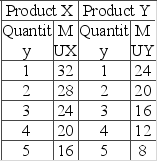 If the consumer buys product X or product Y one unit at a time, which of the following will the consumer's first two purchases be?
 (Multiple Choice)
4.9/5  (81)
(81) The table shows a consumer's utility schedule. 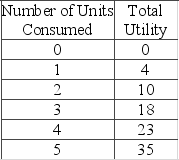 Based on the data, you can conclude that the consumer
 (Multiple Choice)
4.8/5 (78)
(78) Answer the question on the basis of the following two schedules, which show the amounts of additional satisfaction (marginal utility) that a consumer would get from successive quantities of products J and K.  If the consumer's money income were cut from $52 to $28, and the prices of J and K remain at $8 and $4, respectively, she would maximize her satisfaction by purchasing
 (Multiple Choice)
4.9/5 (81)
(81) A consumer is in equilibrium and is spending income in such a way that the marginal utility of product X is 40 units and that of Y is 16 units. If the unit price of X is $5, then the price of Y must be
(Multiple Choice)
4.9/5 (79)
(79) If the price of product X rises, then the resulting decline in the amount purchased will
(Multiple Choice)
4.8/5 (76)
(76) Edith is buying products X and Y with her money income. Suppose her budget line shifts rightward (outward). This might be the result of
(Multiple Choice)
4.8/5 (78)
(78) Answer the question on the basis of the following total utility data for products L and M. Assume that the prices of L and M are $3 and $4, respectively, and that the consumer's income is $18  How many units of the two products will the rational consumer purchase?
 (Multiple Choice)
5.0/5 (85)
(85) In a topographic map, each line represents a particular elevation above sea level, and in an indifference map, each line represents a particular level of
(Multiple Choice)
4.8/5 (75)
(75) The substitution effect of a price decrease for a good causes an increase in the consumption of the good, regardless of whether the good is normal or inferior.
(True/False)
4.9/5 (65)
(65) When total utility reaches a maximum, then marginal utility is
(Multiple Choice)
5.0/5 (84)
(84) The fact that most medical care purchases are financed through insurance
(Multiple Choice)
5.0/5 (73)
(73) Assume that Tonya consumes only two products, pizza and potato chips, out of a given budget. Both are normal goods for Tonya. If the price of pizza decreases, then Tonya's consumption of pizza will
(Multiple Choice)
4.7/5 (73)
(73) A consumer maximizes total utility when she or he purchases the combination of the two products at which her or his budget line is tangent to an indifference curve.
(True/False)
4.9/5 (72)
(72) Refer to the diagram. If the budget line shifts from ab to ac, the 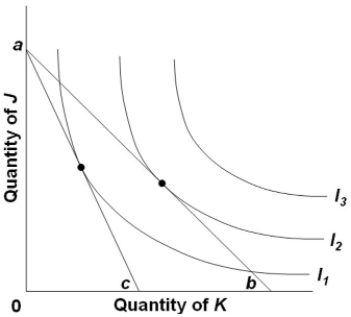
(Multiple Choice)
4.8/5 (83)
(83) In deciding what to buy, the consumer will choose the good with the
(Multiple Choice)
4.9/5 (78)
(78) What do the income effect, the substitution effect, and diminishing marginal utility have in common?
(Multiple Choice)
4.9/5 (88)
(88) 
Filters
- Essay(0)
- Multiple Choice(0)
- Short Answer(0)
- True False(0)
- Matching(0)