



 Chat with AI
Exam 12: Evolution of Low-Mass Stars

Exam 1: Our Place in the Universe71 Questions
Exam 2: Patterns in the Skymotions of Earth92 Questions
Exam 3: Laws of Motion70 Questions
Exam 4: Light and Telescopes71 Questions
Exam 5: The Formation of Stars and Planets79 Questions
Exam 6: Terrestrial Worlds in the Inner Solar System91 Questions
Exam 7: Atmospheres of Venus, Earth, and Mars69 Questions
Exam 8: The Giant Planets79 Questions
Exam 9: Small Bodies of the Solar System75 Questions
Exam 10: Measuring the Stars75 Questions
Exam 11: Our Star: The Sun71 Questions
Exam 12: Evolution of Low-Mass Stars73 Questions
Exam 13: Evolution of High-Mass Stars71 Questions
Exam 14: The Expansion of Space71 Questions
Exam 15: The Realm of the Galaxies71 Questions
Exam 16: Our Galaxy: The Milky Way80 Questions
Exam 17: Modern Cosmology and the Origin of Structure100 Questions
Exam 18: Life in the Universe41 Questions
Select questions type


When a star burns hydrogen in a shell,it will never produce as much energy (per unit time)as when it burns hydrogen in the core because the core has a higher temperature.
(True/False)
4.7/5  (78)
(78) What types of chemical elements can low-mass stars contribute to the enrichment of the interstellar medium and how are they produced?
(Essay)
4.8/5 (68)
(68) When a low-mass star becomes an AGB star and has a temperature of 3300 K,in which wavelength range will it shine the brightest?
(Multiple Choice)
4.8/5 (75)
(75) What would you need to measure about a planetary nebula (see the image below)to determine how long ago its parent star died? 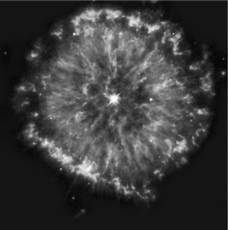
(Multiple Choice)
4.9/5 (69)
(69) What is the shortest phase of evolution for a one solar mass star that we can visibly see?
(Essay)
4.9/5 (78)
(78) Which star spends the longest time as a main-sequence star?
(Multiple Choice)
4.8/5 (90)
(90) Using the figure below,describe how the composition of the Sun varies by radius over time?
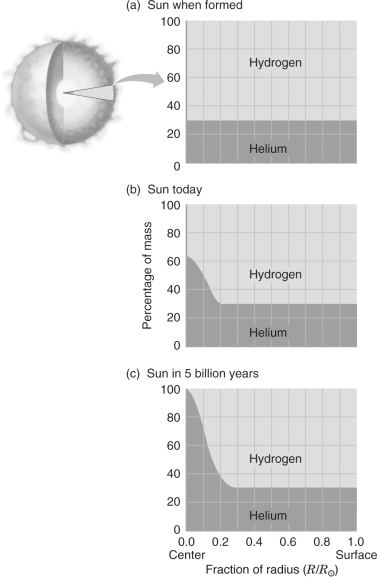
(Essay)
4.8/5 (92)
(92) 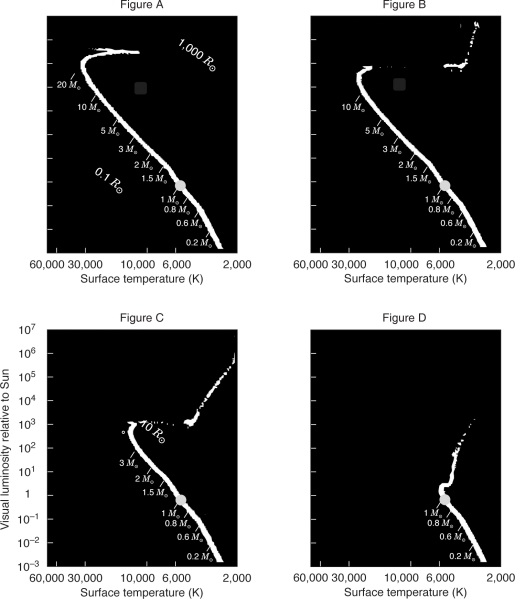
The evolutionary cutoff between low- and high-mass stars occurs at approximately:
(Multiple Choice)
4.7/5 (83)
(83) 
Filters
- Essay(0)
- Multiple Choice(0)
- Short Answer(0)
- True False(0)
- Matching(0)