



 Chat with AI
Exam 12: Evolution of Low-Mass Stars

Exam 1: Our Place in the Universe71 Questions
Exam 2: Patterns in the Skymotions of Earth92 Questions
Exam 3: Laws of Motion70 Questions
Exam 4: Light and Telescopes71 Questions
Exam 5: The Formation of Stars and Planets79 Questions
Exam 6: Terrestrial Worlds in the Inner Solar System91 Questions
Exam 7: Atmospheres of Venus, Earth, and Mars69 Questions
Exam 8: The Giant Planets79 Questions
Exam 9: Small Bodies of the Solar System75 Questions
Exam 10: Measuring the Stars75 Questions
Exam 11: Our Star: The Sun71 Questions
Exam 12: Evolution of Low-Mass Stars73 Questions
Exam 13: Evolution of High-Mass Stars71 Questions
Exam 14: The Expansion of Space71 Questions
Exam 15: The Realm of the Galaxies71 Questions
Exam 16: Our Galaxy: The Milky Way80 Questions
Exam 17: Modern Cosmology and the Origin of Structure100 Questions
Exam 18: Life in the Universe41 Questions
Select questions type


Which point on the figure below represents the location on the H-R diagram where the star is expelling mass creating a planetary nebula? 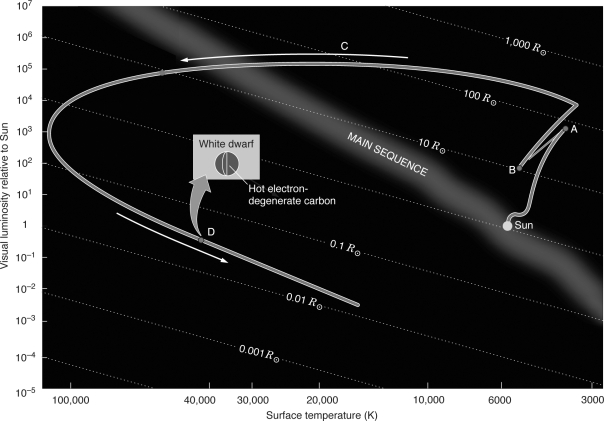
(Multiple Choice)
4.9/5  (77)
(77) Explain the two different forms of pressure that support the core of a low-mass main-sequence star and the core of a low-mass red giant star?
(Essay)
4.8/5 (87)
(87) If a main-sequence star's core temperature increased,fusion reaction rates would decrease because the protons would be moving faster.
(True/False)
4.7/5 (85)
(85) As a red giant star evolves,hydrogen shell burning proceeds increasingly faster due to:
(Multiple Choice)
4.8/5 (85)
(85) The percent of hydrogen in the Sun's core today is roughly half of what it had originally.
(True/False)
4.7/5 (75)
(75) 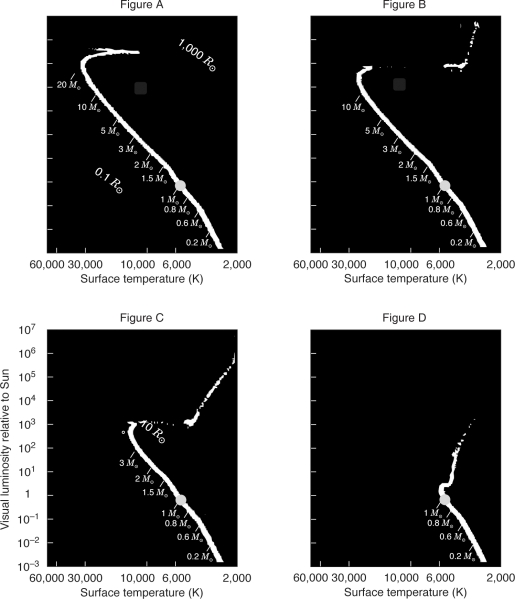
Why does the core of a main-sequence star have to be hotter to burn helium into carbon than hydrogen into helium?
(Essay)
4.7/5 (67)
(67) How many times longer does a 1.0 M main-sequence star live compared to a 2.1 M main-sequence star?
(Essay)
4.9/5 (89)
(89) What factor is most important in determining a star's position on the main sequence and subsequent evolution?
(Multiple Choice)
4.9/5 (86)
(86) Calculate the main-sequence lifetimes of the following stars of different spectral types: B0 (18 M ),B5 (6 M ),A5 (2 M ),F5 (1.3 M ),and M0 (0.5 M ).What trend do you notice in your results?
(Essay)
4.9/5 (88)
(88) When helium fusion begins in the core of a red giant star,the situation quickly gets out of control because electron-degeneracy pressure does not respond to changes in:
(Multiple Choice)
4.9/5 (63)
(63) Which point on the figure below represents the location on the H-R diagram where the star is on the horizontal branch? 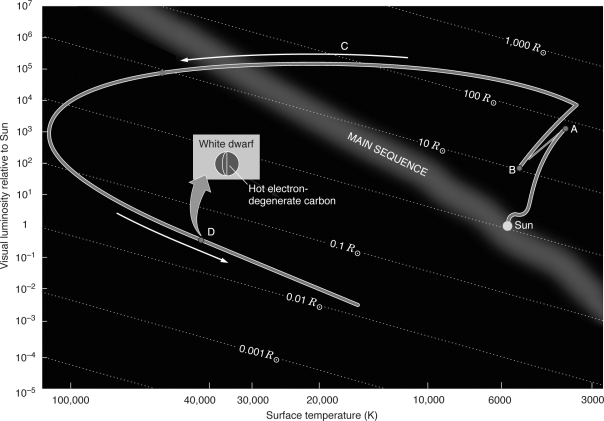
(Multiple Choice)
4.9/5 (81)
(81) How can the core of a star be degenerate with respect to the electrons but nondegenerate with respect to the nuclei?
(Essay)
4.8/5 (88)
(88) The more massive a star,the more hydrogen it has to burn,and the longer its main-sequence lifetime will be.
(True/False)
4.8/5 (81)
(81) 
Filters
- Essay(0)
- Multiple Choice(0)
- Short Answer(0)
- True False(0)
- Matching(0)