



 Chat with AI
Exam 8: The Giant Planets

Exam 1: Our Place in the Universe71 Questions
Exam 2: Patterns in the Skymotions of Earth92 Questions
Exam 3: Laws of Motion70 Questions
Exam 4: Light and Telescopes71 Questions
Exam 5: The Formation of Stars and Planets79 Questions
Exam 6: Terrestrial Worlds in the Inner Solar System91 Questions
Exam 7: Atmospheres of Venus, Earth, and Mars69 Questions
Exam 8: The Giant Planets79 Questions
Exam 9: Small Bodies of the Solar System75 Questions
Exam 10: Measuring the Stars75 Questions
Exam 11: Our Star: The Sun71 Questions
Exam 12: Evolution of Low-Mass Stars73 Questions
Exam 13: Evolution of High-Mass Stars71 Questions
Exam 14: The Expansion of Space71 Questions
Exam 15: The Realm of the Galaxies71 Questions
Exam 16: Our Galaxy: The Milky Way80 Questions
Exam 17: Modern Cosmology and the Origin of Structure100 Questions
Exam 18: Life in the Universe41 Questions
Select questions type


Band systems on Saturn,Uranus,and Neptune are most prominent when viewed in which wavelength regime?

Free
(Multiple Choice)
4.8/5  (83)
(83) Correct Answer: Verified
B
Of the giant planets,only Saturn and Jupiter have ring systems.
Free
(True/False)
4.8/5 (80)
(80) Correct Answer:Verified
VerifiedFalse
Which of the giant planets was predicted to exist mathematically before it was ever seen through a telescope?
Free
(Multiple Choice)
4.8/5 (82)
(82) Correct Answer:Verified
VerifiedD
Two years after first being observed,astronomers reported that Saturn's rings vanished.What happened to them? 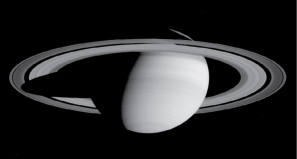
(Multiple Choice)
5.0/5 (76)
(76) Why do astronomers believe that Saturn has such prominent rings,and does the observed total mass in the ring system support this theory?
(Essay)
4.7/5 (84)
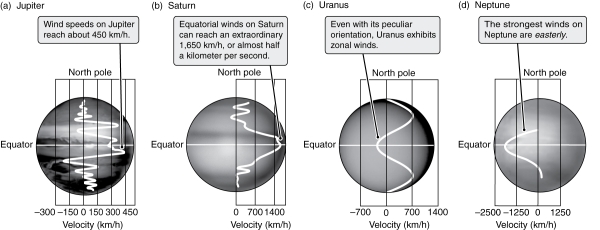
(84) Examine the figure below.Why are winds on the giant planets far faster than those on Earth?
(Essay)
4.8/5 (79)
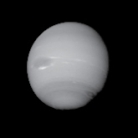
(79) Suppose Neptune moves with an average orbital speed of 3.5 km/s.If it takes Neptune 4 hours to pass directly in front of a star,what is Neptune's diameter? Give Neptune's radius in units of Earth diameters,where the diameter of Earth is 12,800 km.
(Essay)
4.7/5 (77)
(77) If you could find a large enough ocean,which one of these planets would float in it?
(Multiple Choice)
4.7/5 (73)
(73) You could fit roughly __________ Jupiters across the diameter of the Sun and roughly __________ Earths across Jupiter's diameter.
(Multiple Choice)
4.8/5 (65)
(65) The strong magnetic fields of Uranus and Neptune arise from magnetic dynamos in their liquid rocky cores.
(True/False)
4.9/5 (77)
(77) What gives rise to the large magnetic fields of Uranus and Neptune? How does this source help explain why the axes of their magnetic fields are misaligned and significantly offset from their rotational axes?
(Essay)
4.8/5 (70)
(70) As a group,the giant planets all rotate __________ terrestrial planets.
(Multiple Choice)
4.9/5 (75)
(75) On which of the giant planets do we think we can find deep oceans of water? Why do we think this?
(Essay)
4.8/5 (91)
(91) As seen from the outer giant planets,the Sun would appear as simply a very bright star in a sea of fainter stars.
(True/False)
4.7/5 (78)
(78) 
Filters
- Essay(0)
- Multiple Choice(0)
- Short Answer(0)
- True False(0)
- Matching(0)