



 Chat with AI
Exam 8: The Giant Planets

Exam 1: Our Place in the Universe71 Questions
Exam 2: Patterns in the Skymotions of Earth92 Questions
Exam 3: Laws of Motion70 Questions
Exam 4: Light and Telescopes71 Questions
Exam 5: The Formation of Stars and Planets79 Questions
Exam 6: Terrestrial Worlds in the Inner Solar System91 Questions
Exam 7: Atmospheres of Venus, Earth, and Mars69 Questions
Exam 8: The Giant Planets79 Questions
Exam 9: Small Bodies of the Solar System75 Questions
Exam 10: Measuring the Stars75 Questions
Exam 11: Our Star: The Sun71 Questions
Exam 12: Evolution of Low-Mass Stars73 Questions
Exam 13: Evolution of High-Mass Stars71 Questions
Exam 14: The Expansion of Space71 Questions
Exam 15: The Realm of the Galaxies71 Questions
Exam 16: Our Galaxy: The Milky Way80 Questions
Exam 17: Modern Cosmology and the Origin of Structure100 Questions
Exam 18: Life in the Universe41 Questions
Select questions type


Of the giant planets,only Jupiter and Saturn have thick inner layers of:
(Multiple Choice)
4.9/5  (87)
(87) What clues do the differences in the masses of the giant planets give about conditions in the early Solar System?
(Essay)
4.8/5 (87)
(87) Uranus and Neptune are called ice giants because they have deep salty oceans that give rise to their strong magnetic fields.
(True/False)
4.9/5 (89)
(89) The colors of the cloud bands on Jupiter and Saturn are due primarily to differences in their:
(Multiple Choice)
4.8/5 (85)
(85) The different cloud layers seen in Jupiter's bands represent clouds at different altitudes in Jupiter's atmosphere.
(True/False)
4.8/5 (75)
(75) On the giant planets,the atmospheric vortices that occur almost always lie between oppositely directed zonal winds.
(True/False)
4.8/5 (74)
(74) All the giant planets,not just Jupiter,have atmospheric bands and storms.
(True/False)
4.9/5 (97)
(97) When charged particles oscillate around magnetic field lines of a planet they emit radiation in the microwave region of the spectrum.
(True/False)
4.8/5 (73)
(73) Uranus and Neptune do not have bands as distinct as those on Jupiter and Saturn,because Uranus and Neptune:
(Multiple Choice)
4.8/5 (78)
(78) Explain why it was difficult for the Voyager space probe to detect Jupiter's ring system as it was approaching the planet,but easy to detect the rings once it passed behind Jupiter.
(Essay)
4.8/5 (85)
(85) Particles that make up the rings of Uranus and Neptune are composed of:
(Multiple Choice)
4.9/5 (80)
(80) The presence of shepherd moons keeps the giant planets' ring systems completely stable and the rings will last forever.
(True/False)
4.7/5 (96)
(96) Why do we find methane clouds above water clouds in the atmosphere of Saturn?
(Multiple Choice)
4.7/5 (77)
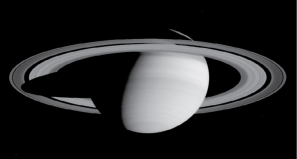
(77) If Saturn's rotational period is 11 hours and its radius is 6 × 10⁷ m,what is the average speed of a cloud in its atmosphere that is rotating with Saturn? (Neglect differential speeds due to winds.)
(Essay)
4.9/5 (66)
(66) If you monitor Saturn's atmosphere and you see a storm at a longitude of 0° west on one day and at a longitude of 90° west 3 days later,what is the average wind speed on Saturn at this storm's latitude? Note that these positions are measured on a coordinate system that rotates with the planet's interior.(The radius of Saturn is 6 × 10⁷ m.) 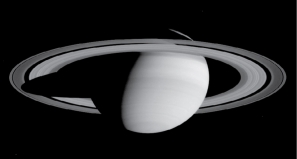
(Multiple Choice)
4.8/5 (74)
(74) You observe Neptune as it occults a background star when the relative velocity between Neptune and the Earth is 30 km/s,and the star crosses through the middle of the planet and disappears for 27.6 minutes.What is Neptune's diameter?
(Multiple Choice)
4.9/5 (77)
(77) The fact that Jupiter's radius is contracting at a rate of 1 mm/year results in:
(Multiple Choice)
4.9/5 (75)
(75) Neptune and Uranus probably took longer to form than Jupiter and Saturn,because the solar nebula was __________ at the radius of Neptune and Uranus.
(Multiple Choice)
4.8/5 (83)
(83) 
Filters
- Essay(0)
- Multiple Choice(0)
- Short Answer(0)
- True False(0)
- Matching(0)