



 Chat with AI
Exam 8: The Giant Planets

Exam 1: Our Place in the Universe71 Questions
Exam 2: Patterns in the Skymotions of Earth92 Questions
Exam 3: Laws of Motion70 Questions
Exam 4: Light and Telescopes71 Questions
Exam 5: The Formation of Stars and Planets79 Questions
Exam 6: Terrestrial Worlds in the Inner Solar System91 Questions
Exam 7: Atmospheres of Venus, Earth, and Mars69 Questions
Exam 8: The Giant Planets79 Questions
Exam 9: Small Bodies of the Solar System75 Questions
Exam 10: Measuring the Stars75 Questions
Exam 11: Our Star: The Sun71 Questions
Exam 12: Evolution of Low-Mass Stars73 Questions
Exam 13: Evolution of High-Mass Stars71 Questions
Exam 14: The Expansion of Space71 Questions
Exam 15: The Realm of the Galaxies71 Questions
Exam 16: Our Galaxy: The Milky Way80 Questions
Exam 17: Modern Cosmology and the Origin of Structure100 Questions
Exam 18: Life in the Universe41 Questions
Select questions type


How do Uranus's rings differ from the ring systems of the other giant planets? 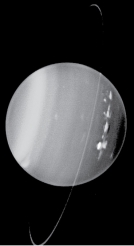
(Multiple Choice)
4.9/5  (78)
(78) If you wanted to search for faint rings around a giant planet by sending a spacecraft on a flyby,it would be best to do so:
(Multiple Choice)
4.8/5 (72)
(72) How does the thickness of Saturn's bright ring system compare to its diameter? 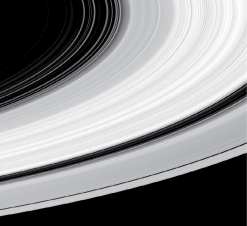
(Multiple Choice)
4.8/5 (77)
(77) All the giant planets radiate more energy into space than they receive from the Sun EXCEPT:
(Multiple Choice)
4.9/5 (80)
(80) Jupiter and Saturn contain solid rocky cores that are approximately 5 to 10 times the mass of the Earth.
(True/False)
4.8/5 (84)
(84) What is the ratio of Jupiter's volume to that of Earth's if both planets can be modeled as spheres and Jupiter's radius is 11 times that of Earth's?
(Essay)
4.7/5 (76)
(76) The composition of the giant planets is consistent with solar abundance,but not with the composition of the universe as a whole.
(True/False)
4.8/5 (83)
(83) How does the discovery of Neptune relate to the discovery of extrasolar planets?
(Essay)
4.9/5 (64)
(64) The Great Red Spot,Jupiter's most prominent storm system,has a diameter that is __________ times the Earth's diameter. 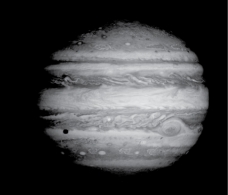
(Multiple Choice)
4.8/5 (77)
(77) The giant planets are made primarily of carbon dioxide and methane.
(True/False)
4.7/5 (76)
(76) If you monitor Jupiter's atmosphere and you see a storm move from a longitude of 60° west to a longitude of 80° west over 6 days,what is the wind speed at this storm's latitude on Jupiter? Note that these positions are measured on a coordinate system that rotates with the planet's interior.(The radius of Jupiter is 7.2 × 10⁴ km.) 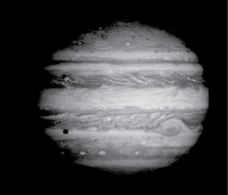
(Multiple Choice)
4.8/5 (77)
(77) Where do Uranus's and Neptune's high magnetic fields originate?
(Multiple Choice)
4.8/5 (94)
(94) If the flux of sunlight on a planet suggested its temperature should be 200 K,but its actual temperature was 220 K,then how much more energy does this planet emit relative to the energy it receives from its parent star?
(Multiple Choice)
4.8/5 (78)
(78) The inner core of each of the giant planets is made up of rocky material that is __________ times the mass of the Earth.
(Multiple Choice)
5.0/5 (83)
(83) The compositions of Uranus and Neptune differ primarily from that of Jupiter and Saturn in that the outer two planets contain more:
(Multiple Choice)
4.8/5 (87)
(87) Jupiter radiates 70 percent more energy than it receives from the Sun,mostly because it is still contracting under its own gravity.
(True/False)
4.9/5 (81)
(81) All the giant planets except __________ experience seasons.
(Multiple Choice)
5.0/5 (75)
(75) Uranus and Neptune are bluish green because they contain large amounts of:
(Multiple Choice)
4.8/5 (82)
(82) 
Filters
- Essay(0)
- Multiple Choice(0)
- Short Answer(0)
- True False(0)
- Matching(0)