



 Chat with AI
Exam 16: Our Galaxy: The Milky Way

Exam 1: Our Place in the Universe71 Questions
Exam 2: Patterns in the Skymotions of Earth92 Questions
Exam 3: Laws of Motion70 Questions
Exam 4: Light and Telescopes71 Questions
Exam 5: The Formation of Stars and Planets79 Questions
Exam 6: Terrestrial Worlds in the Inner Solar System91 Questions
Exam 7: Atmospheres of Venus, Earth, and Mars69 Questions
Exam 8: The Giant Planets79 Questions
Exam 9: Small Bodies of the Solar System75 Questions
Exam 10: Measuring the Stars75 Questions
Exam 11: Our Star: The Sun71 Questions
Exam 12: Evolution of Low-Mass Stars73 Questions
Exam 13: Evolution of High-Mass Stars71 Questions
Exam 14: The Expansion of Space71 Questions
Exam 15: The Realm of the Galaxies71 Questions
Exam 16: Our Galaxy: The Milky Way80 Questions
Exam 17: Modern Cosmology and the Origin of Structure100 Questions
Exam 18: Life in the Universe41 Questions
Select questions type


If you wanted to study the properties of nearby stars that were some of the first stars to form in the Milky Way,but were NOT members of a globular cluster,how could you go about finding them?

Free
(Essay)
4.7/5  (83)
(83) Correct Answer: Verified
You would look for stars that were members of the Milky Way halo.The stars would have highly elliptical orbits,not rotating like other disk stars,and you could identify them by the very high velocities they have as they pass through the solar neighborhood.Also,you could identify halo stars by their low chemical abundance,and main-sequence halo stars by their relatively bluer colors than disk stars.
Cosmic rays come mostly from extragalactic sources and contribute little to the overall energy balance in the Milky Way disk.
Free
(True/False)
4.8/5 (78)
(78) Correct Answer:Verified
VerifiedFalse
The AVERAGE density of the interstellar medium is:
Free
(Multiple Choice)
4.9/5 (85)
(85) Correct Answer:Verified
VerifiedA
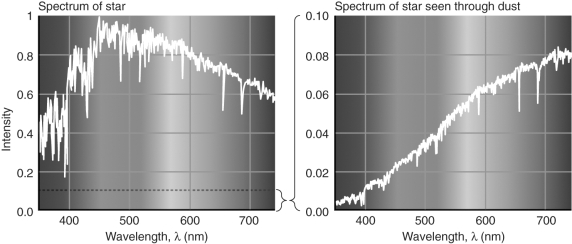
In the figure below,the spectrum of a star is given without being obscured by dust and also being obscured by dust.Explain how the dust affects the light arriving from the star.
(Essay)
4.9/5 (89)
(89) If you wanted to study regions where star formation is currently happening you could use:
(Multiple Choice)
4.9/5 (74)
(74) In a star that has a chemical abundance similar to the Sun,what percentage of its mass is made of heavy elements?
(Multiple Choice)
4.8/5 (72)
(72) Halo stars formed before gas in the Milky Way collapsed to form the disk.
(True/False)
4.9/5 (93)
(93) Stars forming in molecular clouds tend to form first in the low-density periphery.
(True/False)
4.9/5 (74)
(74) At what wavelength are H II regions most clearly visible,and why do H II regions mark the regions where new stars are currently being formed?
(Essay)
4.9/5 (69)
(69) When radiation from an object passes through the interstellar medium:
(Multiple Choice)
4.9/5 (80)
(80) Sagittarius A*,the radio source located at the center of our galaxy,is believed to be:
(Multiple Choice)
4.8/5 (71)
(71) Explain how a standard candle allows you to determine the distance to an object.What is it that you have to measure or know about the standard candle to derive its distance?
(Essay)
4.8/5 (87)
(87) Where are the most metal-rich stars found in the Milky Way?
(Multiple Choice)
4.9/5 (78)
(78) The lowest-density gas in the interstellar medium is also the coldest.
(True/False)
4.7/5 (70)
(70) Our galaxy is classified as an Sd galaxy in the Hubble sequence.
(True/False)
4.8/5 (71)
(71) Why is the supermassive black hole in the center of our galaxy not an AGN right now? Could it be active in the future? Why or why not?
(Essay)
4.9/5 (80)
(80) Molecular clouds are best observed at __________ wavelengths.
(Multiple Choice)
4.9/5 (83)
(83) Describe the differences between the ages and chemical abundances of globular and open star clusters.
(Essay)
4.8/5 (87)
(87) 
Filters
- Essay(0)
- Multiple Choice(0)
- Short Answer(0)
- True False(0)
- Matching(0)