



 Chat with AI
Exam 16: Our Galaxy: The Milky Way

Exam 1: Our Place in the Universe71 Questions
Exam 2: Patterns in the Skymotions of Earth92 Questions
Exam 3: Laws of Motion70 Questions
Exam 4: Light and Telescopes71 Questions
Exam 5: The Formation of Stars and Planets79 Questions
Exam 6: Terrestrial Worlds in the Inner Solar System91 Questions
Exam 7: Atmospheres of Venus, Earth, and Mars69 Questions
Exam 8: The Giant Planets79 Questions
Exam 9: Small Bodies of the Solar System75 Questions
Exam 10: Measuring the Stars75 Questions
Exam 11: Our Star: The Sun71 Questions
Exam 12: Evolution of Low-Mass Stars73 Questions
Exam 13: Evolution of High-Mass Stars71 Questions
Exam 14: The Expansion of Space71 Questions
Exam 15: The Realm of the Galaxies71 Questions
Exam 16: Our Galaxy: The Milky Way80 Questions
Exam 17: Modern Cosmology and the Origin of Structure100 Questions
Exam 18: Life in the Universe41 Questions
Select questions type


What observed property of the Milky Way suggests that it contains a large amount of matter not in the form of stars?
(Multiple Choice)
5.0/5  (79)
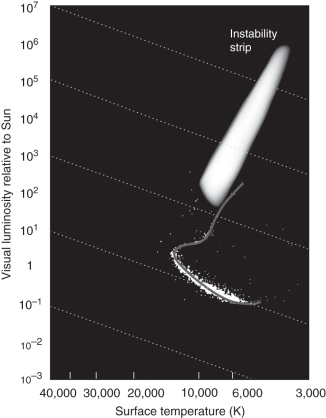
(79) Examine the figure below.How does the H-R diagram of the globular star cluster M92 show that its age is very old?
(Essay)
4.8/5 (87)
(87) The Milky Way has two major spiral arms that emanate from the ends of its bar.
(True/False)
4.8/5 (66)
(66) The dust in the interstellar medium comes primarily from stellar winds of main-sequence stars.
(True/False)
4.8/5 (74)
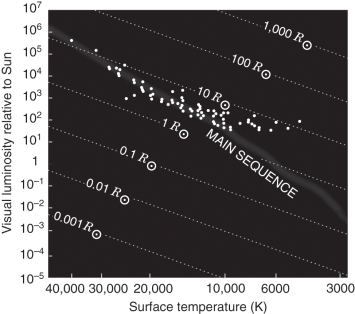
(74) Examine the figure below.How does the H-R diagram of open star cluster NGC 6530 show that its age is very young?
(Essay)
4.8/5 (68)
(68) Globular clusters have much higher stellar densities than the local solar neighborhood.
(True/False)
4.9/5 (84)
(84) Where would we find the stars with the richest abundance of massive elements? Where would we find those with the smallest amounts of massive elements? Why?
(Essay)
4.9/5 (82)
(82) 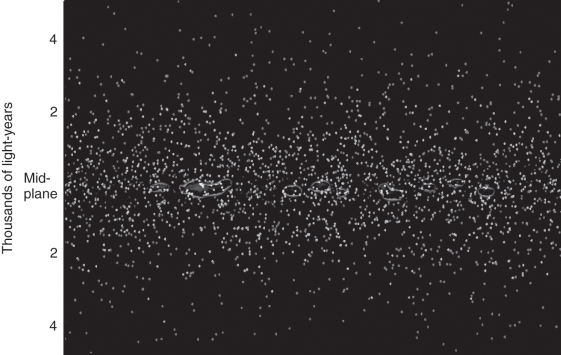
Sitting in a 100°F hot tub feels much hotter than standing outside on a 100°F day.This analogy illustrates why:
(Multiple Choice)
4.9/5 (76)
(76) Studying standard candles in globular clusters offered the first conclusive proof that our galaxy was much __________ than originally believed.
(Multiple Choice)
5.0/5 (84)
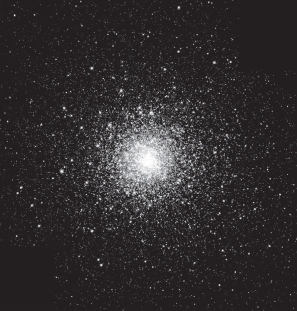
(84) A typical globular cluster (image below)is composed of 500,000 stars in a sphere whose radius is approximately 15 light-years.The distance between stars in a globular cluster is given approximately by d r/N1/3,where r is the radius and N is the number of stars in the cluster.Calculate this distance,and determine how many times smaller it is than the typical distance between stars in the solar neighborhood,which is 3 light-years.
(Essay)
4.8/5 (70)
(70) Why can the observed chemical abundance of a star tell you something about its age?
(Essay)
4.9/5 (91)
(91) Why do we know that at least one generation of stars formed and died before the Milky Way's globular clusters formed?
(Multiple Choice)
4.9/5 (88)
(88) We detect neutral gas in the interstellar medium by looking for radiation at 21 cm that arises when:
(Multiple Choice)
4.8/5 (83)
(83) 
Filters
- Essay(0)
- Multiple Choice(0)
- Short Answer(0)
- True False(0)
- Matching(0)