



 Chat with AI
Exam 11: Our Star: The Sun

Exam 1: Our Place in the Universe71 Questions
Exam 2: Patterns in the Skymotions of Earth92 Questions
Exam 3: Laws of Motion70 Questions
Exam 4: Light and Telescopes71 Questions
Exam 5: The Formation of Stars and Planets79 Questions
Exam 6: Terrestrial Worlds in the Inner Solar System91 Questions
Exam 7: Atmospheres of Venus, Earth, and Mars69 Questions
Exam 8: The Giant Planets79 Questions
Exam 9: Small Bodies of the Solar System75 Questions
Exam 10: Measuring the Stars75 Questions
Exam 11: Our Star: The Sun71 Questions
Exam 12: Evolution of Low-Mass Stars73 Questions
Exam 13: Evolution of High-Mass Stars71 Questions
Exam 14: The Expansion of Space71 Questions
Exam 15: The Realm of the Galaxies71 Questions
Exam 16: Our Galaxy: The Milky Way80 Questions
Exam 17: Modern Cosmology and the Origin of Structure100 Questions
Exam 18: Life in the Universe41 Questions
Select questions type


When solar activity is very high,the Earth's atmosphere will:

Free
(Multiple Choice)
4.7/5  (81)
(81) Correct Answer: Verified
A
The best wavelength to use to observe a solar prominence or flare is:
Free
(Multiple Choice)
4.9/5 (79)
(79) Correct Answer:Verified
VerifiedB
Through hydrogen fusion,the Sun loses approximately 4 million tons of mass each second.If it burns hydrogen at this rate for 10 billion years,what percentage of its original mass will it lose in all? (Note: The mass of the Sun is 1.99 × 1030 kg and 1 ton = 1,000 kg.)
Free
(Essay)
4.9/5 (67)
(67) Correct Answer:Verified
VerifiedThe total amount of mass lost is: 4,000 × 106 kg/s × (60 s/min)× (60 min/hr)× (24 hr/day)× (365 days/yr)× (10 × 109 years)= 1.26 × 1027 kg total mass lost,or 1.26 × 1027 kg/1.99 × 1030 kg = 6.34 × 10-4 = 0.063 percent of its mass.
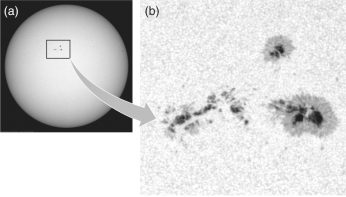
Examine the figure below.In a sunspot,the umbra is cooler than the penumbra.
(True/False)
5.0/5 (79)
(79) What are the three ways in which energy could be transported within a star (or to your fingers)? Explain your answer.
(Essay)
4.9/5 (86)
(86) Explain why magnetic fields trap coronal gas over much of the solar surface but allow it to escape in coronal holes.
(Essay)
4.8/5 (91)
(91) Examine the figure below.The interior zones of the Sun are distinguished by: 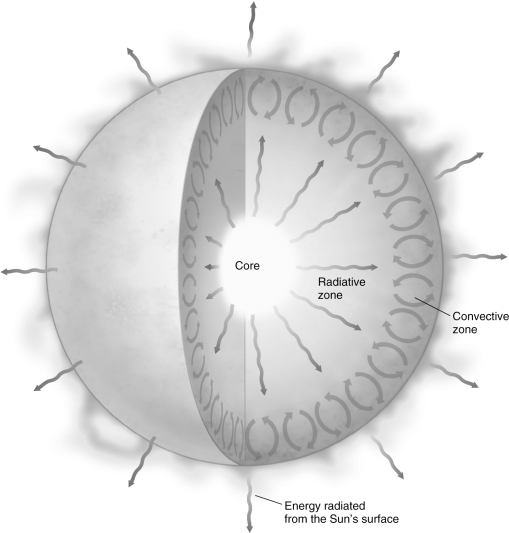
(Multiple Choice)
4.8/5 (78)
(78) If the Sun converts 5 × 10¹¹ kg of H to He per second and 10 percent of the Sun's total mass is available for nuclear burning,how long might we expect the Sun to live?
(Multiple Choice)
4.9/5 (83)
(83) We can determine how the density changes with radius in the Sun using:
(Multiple Choice)
4.7/5 (66)
(66) Magnetic field is continuously produced and deformed in the Sun by:
(Multiple Choice)
4.9/5 (83)
(83) The temperature of the corona is much hotter than any other layer in the solar atmosphere.
(True/False)
4.8/5 (76)
(76) Our Sun is unique compared to the other stars in our galaxy because of its:
(Multiple Choice)
4.9/5 (84)
(84) Approximately how long does it take the photons released in nuclear reactions in the core of the Sun to exit the photosphere?
(Multiple Choice)
4.8/5 (88)
(88) Explain why the solution to the solar neutrino problem is an excellent example of how observations drive the evolution of science.
(Essay)
4.7/5 (85)
(85) Which of the following methods is not used to transport energy from the core to the surface of the Sun?
(Multiple Choice)
4.8/5 (69)
(69) Examine the figure below.The corona of the Sun has a temperature of approximately 1 million degrees.At what wavelength and in what part of the electromagnetic spectrum does its radiation peak? 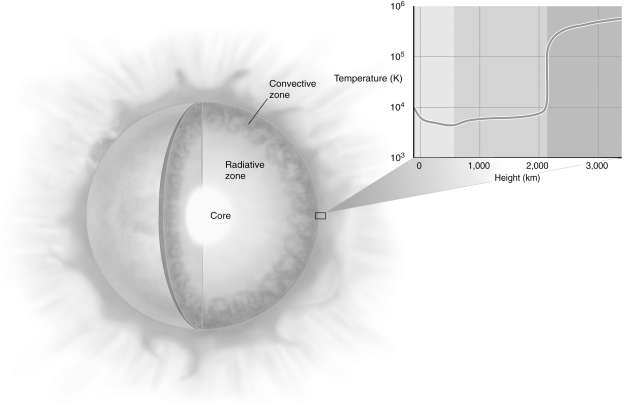
(Multiple Choice)
5.0/5 (85)
(85) 
Filters
- Essay(0)
- Multiple Choice(0)
- Short Answer(0)
- True False(0)
- Matching(0)