



 Chat with AI
Exam 11: Our Star: The Sun

Exam 1: Our Place in the Universe71 Questions
Exam 2: Patterns in the Skymotions of Earth92 Questions
Exam 3: Laws of Motion70 Questions
Exam 4: Light and Telescopes71 Questions
Exam 5: The Formation of Stars and Planets79 Questions
Exam 6: Terrestrial Worlds in the Inner Solar System91 Questions
Exam 7: Atmospheres of Venus, Earth, and Mars69 Questions
Exam 8: The Giant Planets79 Questions
Exam 9: Small Bodies of the Solar System75 Questions
Exam 10: Measuring the Stars75 Questions
Exam 11: Our Star: The Sun71 Questions
Exam 12: Evolution of Low-Mass Stars73 Questions
Exam 13: Evolution of High-Mass Stars71 Questions
Exam 14: The Expansion of Space71 Questions
Exam 15: The Realm of the Galaxies71 Questions
Exam 16: Our Galaxy: The Milky Way80 Questions
Exam 17: Modern Cosmology and the Origin of Structure100 Questions
Exam 18: Life in the Universe41 Questions
Select questions type


Opacity in the interior of the Sun allows efficient release of energy to surrounding layers.
(True/False)
4.8/5  (87)
(87) Neutrinos are particles with small masses that interact easily with normal matter.
(True/False)
4.9/5 (82)
(82) Explain why hydrostatic equilibrium results in the center of the Sun having the highest pressure and temperature.
(Essay)
4.8/5 (77)
(77) Examine the figure below.By studying how the surface of the Sun vibrates like a struck bell we can determine its: 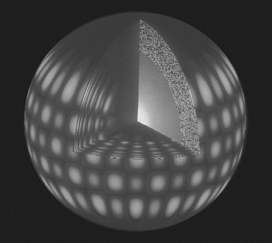
(Multiple Choice)
4.9/5 (88)
(88) If a sunspot is half as bright as the surrounding photosphere of the Sun,what is the approximate temperature of the gas in the sunspot if the photosphere's average temperature is 5800 K?
(Essay)
4.8/5 (69)
(69) In addition to the laws of physics and chemistry,what information do we need to know about our Sun to calculate its structure?
(Essay)
4.9/5 (86)
(86) In the radiative zone inside the Sun,photons are transported from the core to the convective zone in a matter of seconds.
(True/False)
4.8/5 (74)
(74) 
Filters
- Essay(0)
- Multiple Choice(0)
- Short Answer(0)
- True False(0)
- Matching(0)