



 Chat with AI
Exam 7: Atmospheres of Venus, Earth, and Mars

Exam 1: Our Place in the Universe71 Questions
Exam 2: Patterns in the Skymotions of Earth92 Questions
Exam 3: Laws of Motion70 Questions
Exam 4: Light and Telescopes71 Questions
Exam 5: The Formation of Stars and Planets79 Questions
Exam 6: Terrestrial Worlds in the Inner Solar System91 Questions
Exam 7: Atmospheres of Venus, Earth, and Mars69 Questions
Exam 8: The Giant Planets79 Questions
Exam 9: Small Bodies of the Solar System75 Questions
Exam 10: Measuring the Stars75 Questions
Exam 11: Our Star: The Sun71 Questions
Exam 12: Evolution of Low-Mass Stars73 Questions
Exam 13: Evolution of High-Mass Stars71 Questions
Exam 14: The Expansion of Space71 Questions
Exam 15: The Realm of the Galaxies71 Questions
Exam 16: Our Galaxy: The Milky Way80 Questions
Exam 17: Modern Cosmology and the Origin of Structure100 Questions
Exam 18: Life in the Universe41 Questions
Select questions type


Given the thickness and composition of Venus's atmosphere,by how much would you expect its average surface temperature to change between day and night?

Free
(Multiple Choice)
4.7/5  (82)
(82) Correct Answer: Verified
A
What would you expect the temperature of a comet to be if its distance was 100 AU from the Sun? Assume that it is very icy and reflective so that its albedo is equal to 0.6.Does it matter what the radius of the comet is?
Free
(Essay)
4.9/5 (88)
(88) Correct Answer:Verified
VerifiedNo,it does not matter what the size of the comet is.As derived in Working It Out 7.1,the temperature of any object in the Solar System will be equal to T = 279 K × sqrt([sqrt(1 - a)]/dAU)where a is the albedo and dAU is the distance from the Sun measured in units of AU.Thus,the comet's temperature is T = 279 K × sqrt([sqrt(1 - 0.6)]/100)= 279 K × 0.080 = 22 K.
The fraction of oxygen in the Earth's atmosphere has always remained about the same as it is today.
Free
(True/False)
4.9/5 (82)
(82) Correct Answer:Verified
VerifiedFalse
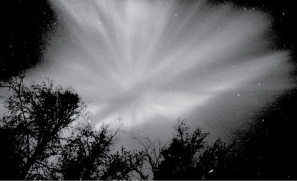 Auroras are:
Venus's atmospheric clouds are so thick that the surface of the planet is rarely seen when observing it in visible light.
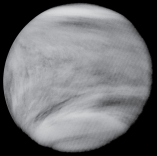
(True/False)
4.7/5 (77)
(77) In the figure below,why is it so difficult to see the surface of Mars in September as compared to June?
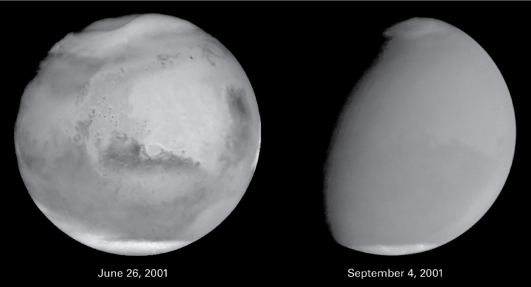
(Essay)
4.9/5 (75)
(75) The greenhouse effect raises Earth's surface temperature by roughly:
(Multiple Choice)
4.7/5 (69)
(69) __________ in our atmosphere is a direct consequence of the emergence of life.
(Multiple Choice)
4.8/5 (77)
(77) All the terrestrial planets have atmospheres as dense as or denser than Earth's.
(True/False)
4.9/5 (79)
(79) Charged particles can easily move across magnetic field lines,but not along them.
(True/False)
4.9/5 (90)
(90) Heating from __________ causes the top of the Earth's stratosphere to be warmer than the bottom.
(Multiple Choice)
4.9/5 (80)
(80) Which of the following is the hottest part of the atmosphere?
(Multiple Choice)
4.8/5 (80)
(80) The Earth releases the energy it receives from the Sun by emitting __________ radiation.
(Multiple Choice)
4.8/5 (87)
(87) Which molecule moves with the fastest average speed in the Earth's atmosphere in thermal equilibrium?
(Multiple Choice)
4.8/5 (80)
(80) Which of the following has an atmosphere of primarily carbon dioxide?
(Multiple Choice)
4.8/5 (75)
(75) Examine the figure below.Over the past 50 years,the average temperature of the Earth has risen by approximately 1°C.
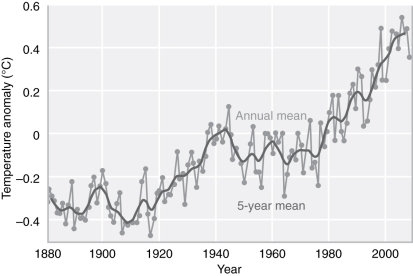
(True/False)
4.9/5 (67)
(67) Molecules in the atmosphere moving faster than the escape speed of the planet are lost to space.
(True/False)
4.9/5 (89)
(89) 
Filters
- Essay(0)
- Multiple Choice(0)
- Short Answer(0)
- True False(0)
- Matching(0)