



 Chat with AI
Exam 7: Atmospheres of Venus, Earth, and Mars

Exam 1: Our Place in the Universe71 Questions
Exam 2: Patterns in the Skymotions of Earth92 Questions
Exam 3: Laws of Motion70 Questions
Exam 4: Light and Telescopes71 Questions
Exam 5: The Formation of Stars and Planets79 Questions
Exam 6: Terrestrial Worlds in the Inner Solar System91 Questions
Exam 7: Atmospheres of Venus, Earth, and Mars69 Questions
Exam 8: The Giant Planets79 Questions
Exam 9: Small Bodies of the Solar System75 Questions
Exam 10: Measuring the Stars75 Questions
Exam 11: Our Star: The Sun71 Questions
Exam 12: Evolution of Low-Mass Stars73 Questions
Exam 13: Evolution of High-Mass Stars71 Questions
Exam 14: The Expansion of Space71 Questions
Exam 15: The Realm of the Galaxies71 Questions
Exam 16: Our Galaxy: The Milky Way80 Questions
Exam 17: Modern Cosmology and the Origin of Structure100 Questions
Exam 18: Life in the Universe41 Questions
Select questions type


The main greenhouse gases in the atmosphere of the terrestrial planets are:
(Multiple Choice)
4.9/5  (85)
(85) Which of the following contributes most to the large difference in the average daytime and nighttime temperatures on the Moon?
(Multiple Choice)
4.9/5 (80)
(80) 
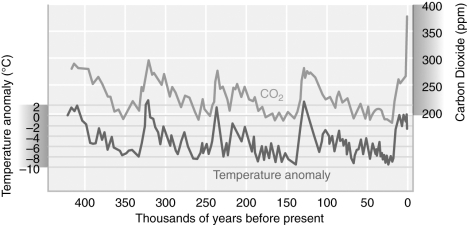
Examine the figure below.Carbon dioxide levels in Earth's atmosphere have been rising by about 4 percent per decade due to the use of fossil fuels.If this trend continues,what could happen to Earth?
(Essay)
4.8/5 (78)
(78) The major component of the air we breathe today was deposited on Earth via cometary impacts.
(True/False)
4.9/5 (78)
(78) The two layers of Earth's atmosphere that have temperature gradients that allow convection to occur are:
(Multiple Choice)
4.8/5 (73)
(73) The reason that Earth is hotter than Jupiter is because the Earth is smaller than Jupiter.
(True/False)
4.8/5 (78)
(78) If the carbon dioxide in Earth rocks were suddenly released into its atmosphere,Earth could quite possibly undergo a runaway greenhouse effect.
(True/False)
4.8/5 (95)
(95) In our solar system,a planet's temperature depends primarily on its albedo and distance from the Sun.
(True/False)
4.8/5 (80)
(80) Which of the following processes did NOT contribute to Earth's secondary atmosphere?
(Multiple Choice)
4.8/5 (84)
(84) On Mars,water would exist in what forms (solid,liquid,or gas)? How does this vary with the seasons on Mars? Why are the seasonal variations on Mars different between the northern and southern hemispheres?
(Essay)
4.9/5 (85)
(85) Examine the figure below.In the Southern Hemisphere,hurricanes __________ compared to hurricanes in the Northern Hemisphere due to the Coriolis effect. 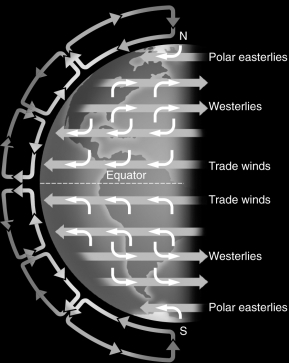
(Multiple Choice)
4.8/5 (74)
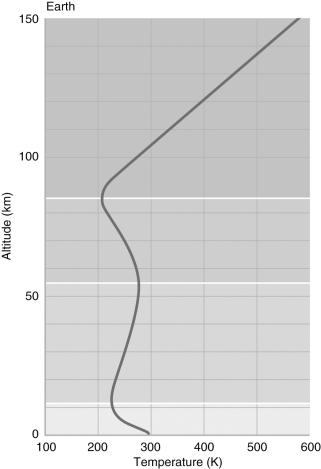
(74) In the stratosphere of the Earth's atmosphere,how does the temperature vary with altitude and what causes this variation?
(Essay)
4.9/5 (91)
(91) Humans cannot survive on the surface of Mars for long periods of time because:
(Multiple Choice)
4.9/5 (91)
(91) Earth has roughly __________ times more atmospheric pressure than Mars and __________ times less than Venus.
(Multiple Choice)
4.9/5 (70)
(70) If water vapor was released from Venus's surface due to tectonic activity into its upper atmosphere,what would most likely happen to it?
(Multiple Choice)
4.9/5 (87)
(87) If Saturn has a semimajor axis of 10 AU and an albedo of 0.7,what is its expected temperature?
(Multiple Choice)
4.9/5 (89)
(89) Venus rotates so rapidly that the dominant form of convection is powered by hurricanes moving east to west in its atmosphere.
(True/False)
4.9/5 (73)
(73) 
Filters
- Essay(0)
- Multiple Choice(0)
- Short Answer(0)
- True False(0)
- Matching(0)