



 Chat with AI
Exam 6: Terrestrial Worlds in the Inner Solar System

Exam 1: Our Place in the Universe71 Questions
Exam 2: Patterns in the Skymotions of Earth92 Questions
Exam 3: Laws of Motion70 Questions
Exam 4: Light and Telescopes71 Questions
Exam 5: The Formation of Stars and Planets79 Questions
Exam 6: Terrestrial Worlds in the Inner Solar System91 Questions
Exam 7: Atmospheres of Venus, Earth, and Mars69 Questions
Exam 8: The Giant Planets79 Questions
Exam 9: Small Bodies of the Solar System75 Questions
Exam 10: Measuring the Stars75 Questions
Exam 11: Our Star: The Sun71 Questions
Exam 12: Evolution of Low-Mass Stars73 Questions
Exam 13: Evolution of High-Mass Stars71 Questions
Exam 14: The Expansion of Space71 Questions
Exam 15: The Realm of the Galaxies71 Questions
Exam 16: Our Galaxy: The Milky Way80 Questions
Exam 17: Modern Cosmology and the Origin of Structure100 Questions
Exam 18: Life in the Universe41 Questions
Select questions type


Describe two reasons why Earth's magnetic field cannot be a result of permanent magnetism.

Free
(Essay)
4.9/5  (81)
(81) Correct Answer: Verified
First,the interior temperature is too high (iron loses its magnetism at high temperatures).Second,Earth's field has been shown to change with time (the positions of the magnetic poles change along with entire field reversals).
The American and African/European continents are now separated by the Atlantic Ocean,which is approximately 4,000 km wide.Assuming a continental drift rate of 2 cm/year,how long has it been since they were one landmass?
Free
(Essay)
4.8/5 (87)
(87) Correct Answer:Verified
VerifiedIf we assume a constant drift rate of 2 cm/year,we can set up the relationship 2 cm/year = 4,000 km/X years,where X is the amount of time since the two landmasses were one.Rearranging,X = 4,000 km/(2 cm/year)= 4 × 108 cm/(2cm/year)= 200 million years ago.
In the past,the Moon was closer to the Earth and the difference in the heights of the ocean at high and low tides were:
Free
(Multiple Choice)
4.7/5 (72)
(72) Correct Answer:Verified
VerifiedB
Which of the following is NOT a factor that helps explain Earth's lack of craters compared to the Moon?
(Multiple Choice)
4.8/5 (87)
(87) There are two main forces that shape a planet's surface: impacts and plate tectonics.
(True/False)
4.7/5 (75)
(75) Which of the following is a remnant from space that has hit the surface of the Earth?
(Multiple Choice)
4.9/5 (81)
(81) What is the best explanation for the heating of Earth's interior today?
(Multiple Choice)
4.7/5 (85)
(85) Name the terrestrial planets in order of increasing distance from the Sun.What are the terrestrial planets in order of increasing geologic age of their surface?
(Essay)
4.8/5 (83)
(83) Based on the assumption that a liquid,conducting core and rapid rotation are both required for a magnetic field to operate,which terrestrial planets would you expect to have magnetic fields?
(Multiple Choice)
4.8/5 (66)
(66) Tides are strongest when the Moon is at first quarter phase or third quarter phase.
(True/False)
4.7/5 (87)
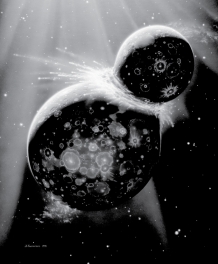
(87) Examine the figure below.Explain the theory as to how the Moon was formed and why it is currently accepted.
(Essay)
4.9/5 (91)
(91) If a radioactive element has a half-life of 10,000 years,what fraction of it is left in a rock after 40,000 years?
(Multiple Choice)
4.9/5 (83)
(83) The maria on the Moon's surface are approximately 1 billion years younger than the rest of its surface.
(True/False)
4.8/5 (84)
(84) We suspect that Mars once had liquid water on its surface because:
(Multiple Choice)
4.9/5 (85)
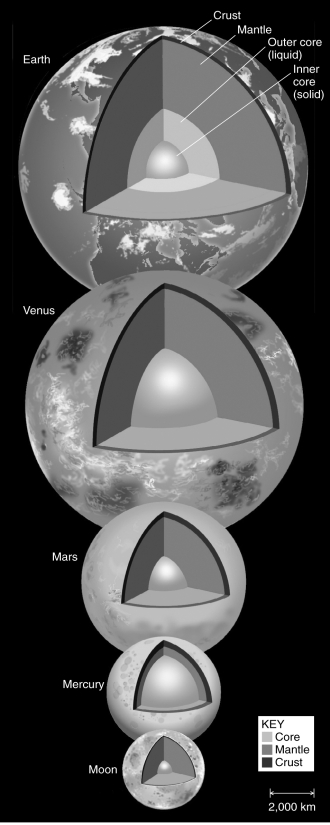
(85) Mercury has the largest core compared to the size of the planet.
(True/False)
4.9/5 (84)
(84) Compared to the dark-colored regions on the surface of the Moon,the light-colored regions are approximately:
(Multiple Choice)
4.9/5 (83)
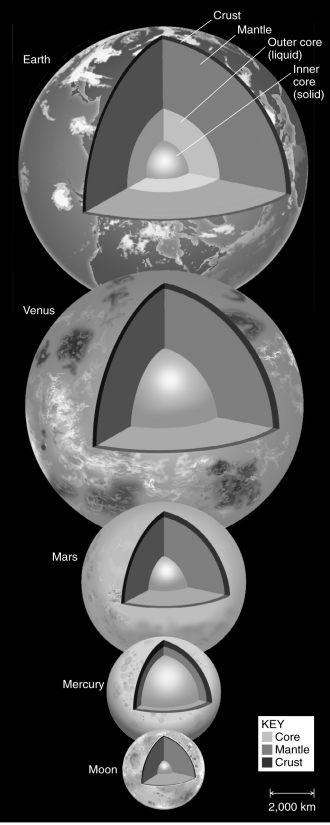
(83) 
Describe the difference between seismic primary and secondary waves and why this difference makes them useful in probing the structure of the Earth's interior.
(Essay)
4.9/5 (77)
(77) 
Filters
- Essay(0)
- Multiple Choice(0)
- Short Answer(0)
- True False(0)
- Matching(0)